November 27, 2026
Is AI Replacing Telecallers or Just Making Them Faster? A 2027 Reality Check
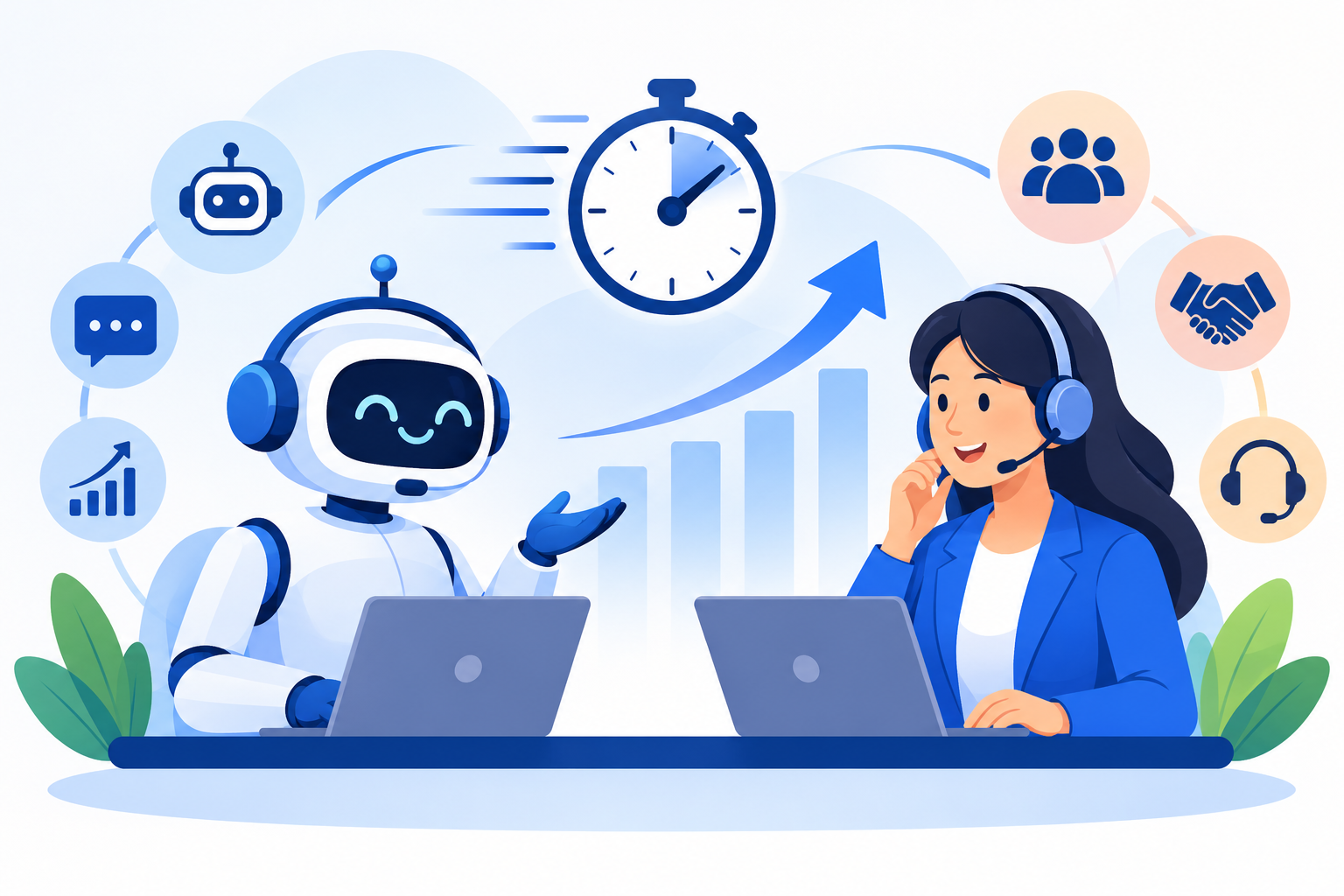
According to a Gartner survey published in May 2026, AI tools now save the average seller 4.8 hours a week. That's more than half a working day.
You'd expect calling teams to be shrinking fast, then. They aren't. Gartner also expects that by 2027, 50% of the companies that planned to cut service staff because of AI will drop those plans.
Most sales managers we speak with sit somewhere in the middle. They've seen the voice bot demos. They've also seen a bot struggle with a customer who wants answers to complex queries.
A lot has been written about AI replacing telecallers by 2027. Some say telecallers will soon lose their jobs. Others say nothing will change. Neither view helps a team lead decide how many people to hire next quarter.
We've already looked at will AI replace telecallers as a career question. This piece looks at the operating side: what the data shows, which calls are moving to software, and what TRAI's new rules mean for AI calling in India.
AI Replacing Telecallers: What the Data Actually Shows
When generative AI took off, plenty of companies treated it as a headcount plan. Two years later, most have changed their minds.
In a March 2025 Gartner poll of 163 customer service leaders, 95% said they plan to keep human agents.
The prime example of such companies which took a different route in 2023 was Klarna.
This firm announced halting all new recruitment at its helpdesk in late 2023 and focused entirely on implementing AI in its processes.
In February 2024, it declared that its AI-based chatbot was doing the tasks of 700 people and processing 75% of all customer queries, some 2.3 million in its first month of operations.
By 2025, its CEO acknowledged that the AI-based chatbot push had been too cost-driven, quality had slipped, and Klarna was hiring people again.
Even AI calling vendors in India now build humans into their pitch. Several position their bots for 70 to 85% of routine contacts, with a handover to a person for everything else.
So AI in telecalling, as it's used today, is mostly a first filter and a back-office assistant. The selling still happens on a human call.
Which Telecalling Tasks Are Moving to AI?
Your risk depends on what kind of calls fill your day. Here's roughly how the work is splitting on Indian calling floors:
1) Call type
- Appointment booking, EMI and COD reminders
Who handles it - Mostly AI
Reason - Fixed script, high volume
2) Call type - Order status and basic FAQs
Who handles it - Mostly AI
Reason - Answers come from existing data
3) Call type - First-level lead qualification
Who handles it - AI, with human handover
Reason - Simple, rule-based questions
4) Call type - Follow-up and objection calls
Who handles it - Human
Reason - Outcome depends on judgement
5) Call type - High-ticket sales (property, insurance, loans)
Who handles it - Human
Reason - Trust decides the outcome
6) Call type - Complaints and escalations
Who handles it - Human
Reason - Needs empathy and authority
If a call can be written out word for word in advance, a bot can probably make it. If the outcome depends on tone, hesitation or trust, it stays with a person.
That's the part a lot of writing on AI replacing telecallers skips.
Telecallers whose entire shift goes into COD confirmations or reminder calls should start building new skills now. For those who handle follow-ups and objections, the role will change rather than disappear: less manual data entry, and more use of call data to plan each conversation.
How Is AI Making Telecallers Faster?
Ask a team lead where the hours go, and "on calls" is rarely the answer. Much of a telecaller's day goes into updating sheets, looking up lead details and planning callbacks. As Gartner's Dan Gottlieb put it, "AI is not the hero of this story; AI is the accelerant."
Here is how AI sales calling tools save time for telecallers:
- logging call notes and outcomes automatically, so nobody spends the last hour of a shift updating a sheet
- sorting the lead list so interested prospects get called first
- showing when people actually pick up (across 5 crore telecalling records analysed by Callyzer, 53% of first attempts went unanswered, and connect rates peaked at 61.79% at 5 PM)
- Flagging the calls a manager should listen to
There is one catch. Saved time only helps if it goes back into selling. Decide early where those extra hours will go, such as faster follow-ups or more time with interested leads. Otherwise, they slowly get lost in small tasks.
All of this depends on accurate call data, and manual logs are rarely accurate. A call management system that captures calls straight from the device solves that. When call records come straight from the phone, reports show what actually happened on each call rather than what someone remembered to write down.
Where Do Human Telecallers Still Outperform AI?
Take a property lead in Pune who filled in a form late at night. The next morning, the lead wants to know about parking, the builder's delivery record and whether there's room on price, all before her husband sees the brochure.
A good telecaller handles that in a few minutes. A bot usually loops back to its script.
Indian sales calls are full of moments like this. Customers switch between Hindi, English and their own language mid-sentence, and big purchases are almost always a family decision.
People still do better on:
- high-ticket sales like property, insurance, loans and B2B software
- soft objections such as "I'll discuss it at home," which need a follow-up question
- upset customers who need to feel heard first
- long-running accounts where the client expects the same voice
How Do TRAI's 2027 Rules Affect AI Calling in India?
In September 2026, TRAI notified the Third Amendment to its commercial communication rules, and it applies directly to AI calling.
Automated, pre-recorded, and artificial-voice calls now count as Application-to-Person (A2P) calls. Businesses must declare them to their telecom provider, or they're treated as spam. These calls can carry a termination charge of up to ₹0.05 per minute, and a number can face action after three complaints in ten days if the operator's AI system has flagged it too.
AI calling is still allowed. A careless bot campaign, though, now gets caught much faster, which is one more reason to keep sensitive and high-value calls with your team.
How Should Sales Leaders Prepare?
Begin by selecting one week of call data. Divide this into scripted calls and actual conversations, and the automation choice is clear. Then:
- Move reminder and confirmation calls to AI first. If something goes wrong here, the damage is small.
- Make sure every call gets recorded before you add AI. If your call records are incomplete, the AI's advice will be wrong too.
- Schedule what you will do with the saved time, for instance making faster callbacks and reaching out to more interested prospects.
- Train the telecallers to deal with objections and to know their call metrics, for instance, how many calls are connected by each of them.
The Bottom Line
So, is AI replacing telecallers in 2027? Partly. Reminder calls, data entry, and list sorting are moving to software for good. What AI can't do yet is earn a customer's trust over several calls, in their own language, on a purchase that matters to them.
The teams that do well this year will let software handle the volume and give their best telecallers better data and more time to sell.