August 20, 2026
Autonomous Lending Platform: How AI-Driven Automation Is Reshaping the Future of Credit in India
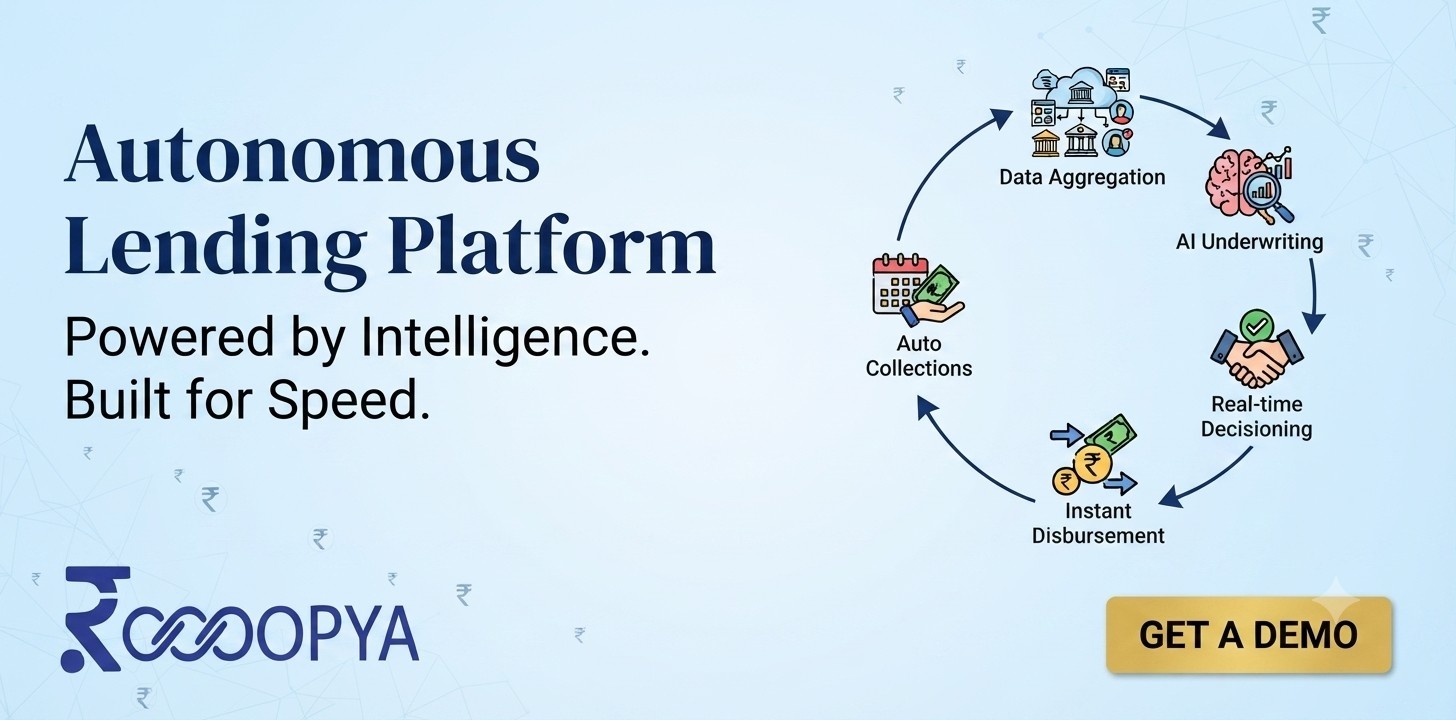
Lending used to be slow by design. Weeks of paperwork, queues at the branch, opaque decisions, and anxious wait periods were simply accepted as the cost of accessing credit. Not any more.
Across India, a new breed of technology is rewriting these rules. Autonomous lending platforms — systems that can receive a loan application, verify identity, pull credit data, assess risk, make a decision, generate an offer, and trigger disbursement, all without a single human touch — are transforming the economics and the experience of lending from the ground up.
This is not incremental digitisation. It is a structural shift. And whether you are an NBFC scaling to new geographies, a microfinance institution trying to serve underbanked populations, or a bank modernising its retail lending stack, understanding autonomous lending — and choosing the right platform — is now a strategic imperative.
This guide explains what an autonomous lending platform is, why it matters, what features define best-in-class systems, and how Roopya is leading this transformation for Indian lenders.
1. What Is an Autonomous Lending Platform?
An autonomous lending platform is an end-to-end digital system that automates the complete loan lifecycle — origination, underwriting, decisioning, documentation, and disbursement — with minimal or zero manual intervention. It combines artificial intelligence, machine learning, rules-based logic, and deep third-party integrations to replicate, and in most areas surpass, the judgment of a traditional human-led credit process.
The word autonomous is deliberate and meaningful. Unlike basic digital lending tools that merely digitise paper forms, an autonomous lending platform actively orchestrates complex workflows in real time. It decides. It acts. It learns. It adapts. The human team's role shifts from processing applications to designing credit policy, analysing portfolio data, and making strategic decisions — while the platform handles the operational execution at scale.
Think of it as the difference between a car with power steering and a self-driving vehicle. Both move you forward. Only one allows you to focus on the destination rather than the mechanics of driving.
In the Indian context, autonomous lending platforms are particularly transformative. The country has over 500 NBFCs, thousands of MFIs, and a massive unmet credit demand — especially in Tier 2 and 3 cities, among thin-file borrowers, and within the MSME ecosystem. Manual processes simply cannot scale to meet this demand efficiently or profitably. Autonomous platforms can.
2. Why Autonomous Lending Is the Future, Not a Trend
The business case for autonomous lending is not built on futurism. It is built on hard numbers and market realities that are already reshaping the competitive landscape.
2.1 The Scale Imperative
India's formal credit gap is estimated at over Rs 25 lakh crore. The borrowers who need credit most — small business owners, rural households, first-time credit seekers — are exactly the ones that manual, branch-led processes serve worst. Autonomous lending platforms allow lenders to extend credit to these segments at scale without proportionally increasing headcount or operational cost.
2.2 The Speed Expectation
The modern borrower — shaped by the UPI experience, by e-commerce instant gratification, and by fintech neobanks — expects financial services to move at app speed. Research consistently shows that loan conversion rates drop sharply when decisions are delayed beyond 24 hours. An autonomous lending platform can make a credit decision in seconds. That speed is not just a feature; it is a conversion and retention engine.
2.3 The Consistency Demand
Human underwriting is inherently variable. Two loan officers reviewing identical applications can reach different decisions based on fatigue, mood, personal bias, or differing interpretations of policy. An autonomous lending platform applies your exact credit policy, uniformly, to every application, every time — eliminating inconsistency and the regulatory and ethical risks that come with it.
2.4 The Regulatory Pressure
RBI guidelines around digital lending — the Digital Lending Guidelines 2022, fair practice codes, data localisation, consent management, and audit trail requirements — are complex and evolving. Manual systems struggle to keep pace. Autonomous lending platforms are architected for compliance from the ground up, with built-in consent frameworks, immutable audit logs, and continuous regulatory updates.
2.5 The Economics of Automation
Cost per loan application in manual processes typically runs from Rs 500 to Rs 2,000 depending on product complexity. Autonomous platforms can reduce this to under Rs 100 per application at scale. For a lender processing 10,000 loans a month, this represents a cost saving of Rs 4 crore or more annually — savings that can be reinvested in lower interest rates, better borrower experience, or accelerated growth.
3. Core Components of a World-Class Autonomous Lending Platform
Not all lending automation is equal. A true autonomous lending platform is defined by the depth and sophistication of its component capabilities. Here is what best-in-class looks like.
3.1 Intelligent Application Intake
The autonomous journey begins the moment a borrower initiates an application. A modern platform offers configurable, mobile-first digital application forms with real-time smart validation — checking PAN structure, Aadhaar format, IFSC codes, and geographic eligibility as the borrower types. Incomplete or invalid data is caught before submission, reducing processing failures downstream.
Roopya provides 20+ pre-configured loan product journeys — personal loans, MSME credit, gold loans, microfinance products, and more — that lenders can activate without building from scratch. A new product can be live within hours of configuration.
3.2 Automated Identity Verification and KYC
Identity verification is the first gatekeeping function of any lending process. In an autonomous platform, this happens without any manual review. Aadhaar eKYC, PAN verification via NSDL, Digilocker integration, facial liveness detection, and video KYC are all orchestrated automatically based on product rules and regulatory requirements.
Roopya's platform comes pre-integrated with every major KYC provider in India. A borrower can complete full, RBI-compliant KYC from their smartphone in under two minutes — with results fed directly into the downstream decisioning workflow.
3.3 Real-Time Bureau and Alternate Data Pulls
A complete credit picture requires data from multiple sources. An autonomous lending platform automatically triggers pulls from all relevant bureaus — CIBIL, Experian, CRIF, and Equifax — on the basis of borrower consent, the moment an application is received. Bureau reports are parsed, scored, and synthesised automatically.
Beyond traditional bureaus, leading platforms like Roopya integrate alternate data sources — GST filing history, bank statement analytics via Account Aggregator, telecom data, and e-commerce transaction history — to build richer credit profiles for thin-file and new-to-credit borrowers who would otherwise be invisible to conventional underwriting.
3.4 AI-Powered Document Processing
Bank statements, salary slips, ITR documents, GST returns, property papers — the document-heavy nature of lending has traditionally been one of its biggest bottlenecks. An autonomous lending platform applies AI-driven Optical Character Recognition and Natural Language Processing to extract structured data from unstructured documents in seconds.
Roopya's document intelligence engine goes beyond extraction. It cross-validates extracted data against application-declared information, flags discrepancies and potential fraud signals, and calculates derived metrics like average monthly income, EMI obligations, and debt-to-income ratios — automatically, without human review.
The system achieves over 99% extraction accuracy and typically processes a full document set in under 30 seconds — compared to the 30 to 60 minutes a trained human analyst would require.
3.5 No-Code Business Rule Engine (BRE)
The Business Rule Engine is the intellectual core of an autonomous lending platform. It is where your credit policy lives — encoded into automated logic that evaluates every application against your exact lending criteria. A powerful BRE allows credit teams to define complex, multi-variable eligibility rules: minimum CIBIL score by product, income thresholds by employment category, geographic restrictions, age limits, and maximum EMI-to-income ratios.
Critically, the best platforms give business users — not developers — direct control over these rules through a visual, no-code interface. When your credit policy changes, your risk team updates the BRE directly, without raising a development ticket and waiting weeks for implementation.
Roopya's no-code BRE is one of the most sophisticated in the Indian market. It supports conditional logic trees, multi-tier scoring, policy exceptions, and ML-assisted rule optimisation — suggesting improvements based on observed portfolio outcomes.
3.6 Machine Learning Credit Scoring
Traditional scorecards use a fixed set of variables with manually assigned weights. ML-based credit scoring models learn continuously from new application and performance data, automatically identifying the variables with the highest predictive power and adjusting their weights over time.
An autonomous lending platform with embedded ML scoring produces more accurate risk assessments, especially for underserved segments where traditional variables have limited predictive value. Roopya's scoring models can incorporate 200+ variables from multiple data sources, including behavioural signals and alternate data, producing nuanced risk segmentation that improves both approval rates and portfolio quality.
3.7 Automated Credit Decisioning and Offer Generation
Once all data is collected and scored, the autonomous platform synthesises everything through the BRE and credit models to produce an instant decision. For approved applicants, a personalised loan offer is generated automatically — with the sanctioned amount, tenure, interest rate, processing fee, and EMI schedule all computed according to product pricing logic.
The offer is delivered immediately to the borrower through their preferred channel — in-app, WhatsApp, SMS, or email — while the decision rationale is logged in the audit trail for compliance and quality review purposes.
3.8 Digital Documentation and eSign
An autonomous lending platform eliminates physical documentation entirely. Loan agreements, sanction letters, and schedule of charges are generated automatically from approved templates and populated with application-specific data. Borrowers execute these documents digitally using Aadhaar OTP-based eSign or Digilocker eSign — both legally valid under the Information Technology Act and RBI guidelines.
The entire documentation and execution process can be completed by the borrower in under five minutes, from any device, anywhere in India — without a branch visit, a physical signature, or a courier.
3.9 Automated Disbursement Triggering
Once documentation is complete, the autonomous platform triggers disbursement workflows automatically. Bank account verification via penny drop or Account Aggregator, NACH mandate registration, and funds transfer to the borrower's verified account are all orchestrated without manual intervention. For clean applications, the end-to-end journey — from application submission to funds in account — can be completed in under 15 minutes.
3.10 Embedded Compliance and Regulatory Reporting
Compliance is not an afterthought in a well-designed autonomous lending platform — it is embedded throughout every stage. Consent is captured and stored at each data-pull event. Every action is timestamped and logged. Credit bureau reporting, CERSAI registration, and regulatory return data are generated automatically. RBI inspection-ready audit trails are available on demand.
Roopya's compliance framework is maintained by a dedicated regulatory team that monitors RBI guidelines continuously, ensuring the platform always reflects the latest requirements without lenders needing to manage this internally.
4. The Role of AI and Machine Learning in Autonomous Lending
Artificial intelligence is not a single feature of an autonomous lending platform — it is the connective tissue that makes the entire system work. Here is where AI operates across the lending lifecycle:
- Document Intelligence: OCR and NLP extract and validate data from PDFs, images, and scanned documents with human-level accuracy and machine-level speed.
- Fraud Detection: ML models identify patterns associated with fraudulent applications — identity mismatches, synthetic identity signals, application clustering, document tampering — in real time, before disbursement.
- Credit Scoring: Ensemble ML models score credit risk using hundreds of variables, including alternate data signals, outperforming traditional scorecards especially for thin-file segments.
- Behavioural Analytics: AI analyses borrower behaviour through the application journey — device signals, session patterns, data entry behaviour — as additional fraud and intent signals.
- Portfolio Intelligence: Post-disbursement, ML models monitor portfolio performance, flag early warning signals of stress, and feed insights back into the BRE for continuous policy improvement.
- Conversational AI: NLP-driven chatbots guide borrowers through the application process, answer queries, and follow up on incomplete applications — in multiple Indian languages.
Roopya's AI layer is deeply integrated across all of these functions. It is not a bolt-on module — it is woven into the platform's architecture, enabling it to become smarter with every application processed.
5. Autonomous vs. Traditional Lending Software: A Clear Comparison
- Speed: Traditional software — days to weeks for a decision. Autonomous platform — seconds to minutes.
- Scalability: Traditional — headcount-constrained. Autonomous — cloud-native, scales infinitely with demand.
- Consistency: Traditional — subject to human variability. Autonomous — policy applied uniformly to every application.
- Data Sources: Traditional — bureau-only underwriting. Autonomous — bureaus plus alternate data, document analysis, and behavioural signals.
- Implementation: Traditional — 6 to 12 months. Autonomous platform like Roopya — 1-day go-live.
- Compliance: Traditional — manual monitoring. Autonomous — embedded, continuously updated.
- Cost per Loan: Traditional — Rs 500 to Rs 2,000+. Autonomous — under Rs 100 at scale.
- Learning: Traditional — static rules. Autonomous — continuously improving ML models.
The comparison is not close. For any lender with ambitions to compete in the digital lending era, the question is not whether to move to an autonomous platform — it is which platform to choose and how fast to make the transition.
6. Who Benefits from an Autonomous Lending Platform?
NBFCs
NBFCs are the natural home of autonomous lending. Operating with leaner balance sheets and more agile regulatory environments than banks, NBFCs need technology that delivers enterprise-grade capability without enterprise-scale IT budgets. Roopya's pay-as-you-use model and 1-day go-live are designed precisely for this segment.
Microfinance Institutions (MFIs)
MFIs face a unique challenge: serving rural, low-literacy, thin-file borrowers at massive scale and very low ticket sizes. Autonomous lending platforms with vernacular language support, offline-capable mobile applications, and alternate data underwriting can extend credit profitably to segments that traditional credit infrastructure cannot reach.
Banks and Housing Finance Companies
Larger institutions use autonomous lending platforms to modernise specific product lines — personal loans, credit cards, MSME loans — while maintaining existing core banking systems. API-first platforms like Roopya can integrate into existing banking stacks without requiring a full system overhaul.
Fintech Lenders and Embedded Finance Players
For fintech companies that originate loans through partner platforms, apps, or marketplaces, an autonomous lending platform with strong API capabilities is the foundational infrastructure. Roopya's embedded finance APIs allow any digital platform to offer credit products to their users without building lending infrastructure from scratch.
7. Benefits of Roopya's Autonomous Lending Platform
1-Day Go-Live
Implementation of traditional lending software takes 6 to 12 months. Roopya's pre-built product journeys, 300+ pre-integrated APIs, and no-code configuration environment allow lenders to process their first live application within 24 hours of onboarding. Time to market is a competitive advantage — and Roopya maximises it.
300+ Pre-Integrated APIs
Every integration a lender needs is already built: all four credit bureaus, all major KYC providers, leading eSign platforms, banking APIs for account verification and NACH, GST data, accounting software, and more. No custom development. No integration delays. No ongoing maintenance burden.
Truly No-Code Configuration
Roopya's no-code BRE, product configuration engine, and workflow builder give business users — credit managers, risk officers, operations heads — direct control over the platform. Policy changes that used to take weeks of development time are implemented in minutes.
Pay-As-You-Use Pricing
Zero upfront licence fees. Zero capital expenditure. Lenders pay only for what they process, making Roopya's autonomous lending platform accessible from day one of operations — whether you are processing 100 applications a month or 100,000.
Superior AI and Data Intelligence
Roopya's ML scoring, document intelligence, and fraud detection capabilities are production-tested across millions of applications. The models are continuously retrained on new data, ensuring performance improves over time rather than degrading.
Complete Regulatory Compliance
Roopya's regulatory team monitors RBI guidelines and updates the platform continuously. Lenders operate with confidence that their technology stack is always compliant — without dedicating internal resources to regulatory monitoring.
8. Autonomous Lending and the Account Aggregator Revolution
One of the most significant tailwinds for autonomous lending in India is the Account Aggregator framework — an RBI-regulated system that allows borrowers to share their financial data across institutions with explicit, granular consent.
For autonomous lending platforms, Account Aggregator is transformational. Instead of asking borrowers to upload six months of bank statements, a lender can access verified, structured financial data in seconds through the AA network. Income verification, cash flow analysis, and repayment capacity assessment become near-instantaneous.
For underserved borrowers — the self-employed, the informally employed, small business owners — AA data provides a rich financial picture that makes underwriting viable where bureau data alone would not support a credit decision. This is perhaps the most important development in expanding formal credit access in India since Jan Dhan Yojana.
Roopya is a fully AA-integrated autonomous lending platform. Lenders on Roopya can offer AA-based loan journeys with a few configuration changes — no new development required.
9. Building a People-First Autonomous Lending Experience
Autonomous does not mean impersonal. The best autonomous lending platforms are designed to serve borrowers better — not just faster. Here is what a people-first autonomous lending experience looks like in practice:
- Transparency: Borrowers receive clear explanations of what data is being accessed, why it is needed, and what it will be used for — with explicit digital consent at every step.
- Accessibility: Multi-language support, screen-reader compatibility, and low-bandwidth optimisation ensure the platform is accessible to the broadest possible borrower population.
- Respect for Dignity: Automated rejection communications are thoughtful and constructive — explaining the decision clearly and, where policy permits, suggesting next steps or alternative products.
- Data Privacy: Borrower data is handled in full compliance with RBI data localisation requirements, and is never used for purposes beyond those explicitly consented to.
- Human Escalation: For complex cases or borrower distress, the platform intelligently routes to human support — ensuring automation never becomes a barrier to accessing help.
Roopya is built with these principles at its core. The platform is designed not just to process applications efficiently, but to create lending experiences that borrowers trust and return to.
10. Why Roopya Is India's Leading Autonomous Lending Platform
Roopya was conceived and built for one purpose: to give every Indian lender — regardless of size, geography, or product focus — access to the same autonomous lending capabilities that the most sophisticated global institutions enjoy.
- Built for India: Regulatory alignment with RBI guidelines, integration with India's digital public infrastructure (Aadhaar, DigiLocker, UPI, Account Aggregator), and deep understanding of Indian lending dynamics.
- Full-Stack Autonomy: End-to-end automation from application intake to disbursement — not just one or two stages.
- Proven at Scale: Roopya's platform processes millions of loan applications, with a track record of 99.9% uptime and sub-second API response times.
- Continuous Innovation: A dedicated product and AI team constantly extends Roopya's capabilities — conversational AI journeys, advanced fraud detection, AA-native underwriting, and predictive portfolio analytics.
- Trusted by Leaders: IndiaKaLoan, QuickFinShop, Recapita, Findoc, EazyCredit and others have built their lending operations on Roopya's autonomous platform.
- Partnership Mindset: Roopya works as a strategic partner, not just a software vendor — with dedicated onboarding support, ongoing training, and a customer success team embedded in your growth journey.
If you are ready to build a lending operation that runs at scale, serves borrowers with speed and dignity, and learns from every application it processes — Roopya's autonomous lending platform is where that journey begins.
Book a free demo today. Go live in 24 hours. Lend without limits.