August 13, 2026
Benefits of Autonomous Lending Systems: The Complete Guide for Modern Lenders
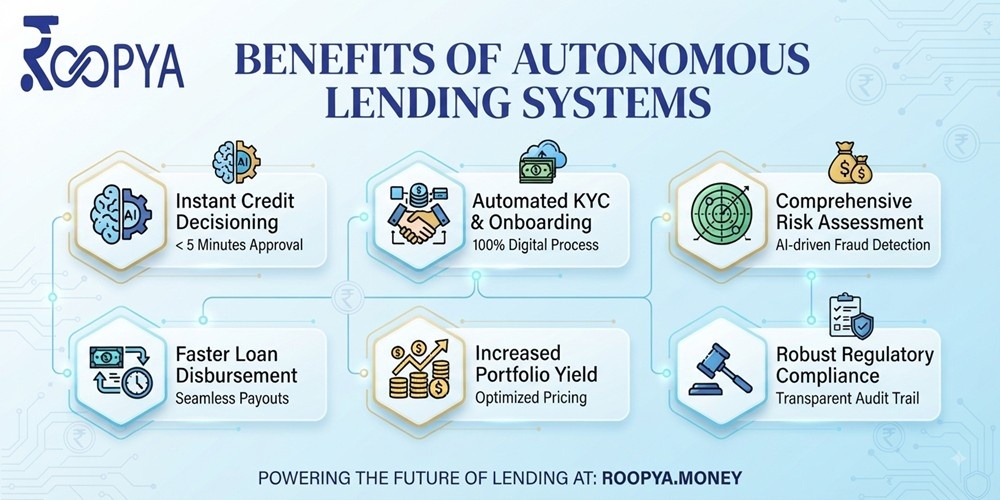
The Indian lending ecosystem is at an inflection point. For decades, loan origination, underwriting, and servicing were heavily manual processes — bottlenecked by human bandwidth, prone to error, and slow to adapt to changing market conditions. Today, a new generation of technology is rewriting these rules entirely. Autonomous lending systems are transforming how NBFCs, banks, microfinance institutions, and fintech lenders operate — automating decisions, learning from data, and processing thousands of applications without human intervention.
But what exactly is an autonomous lending system, and why are India's most progressive lenders racing to adopt one? This comprehensive guide explores the full spectrum of benefits that autonomous lending systems deliver — from speed and cost efficiency to risk management, regulatory compliance, and customer experience. We also examine how Roopya's autonomous lending infrastructure is helping modern Indian lenders go from concept to live operations in a single day.
1. What Is an Autonomous Lending System?
An autonomous lending system is an end-to-end digital lending platform that can initiate, evaluate, decide on, and manage loan applications with minimal to zero human intervention. It combines several advanced technology layers — artificial intelligence, machine learning, robotic process automation, no-code workflow engines, and pre-integrated data APIs — into a unified infrastructure that replicates and often surpasses the judgment of experienced credit professionals.
Unlike traditional loan management software, which automates individual tasks, an autonomous lending system automates the entire decision chain. From the moment a borrower submits an application to the point of disbursement and beyond into collections and early warning management, every step is orchestrated by intelligent, self-improving algorithms that learn from every transaction they process.
Roopya's platform is built around this philosophy. Described on their website as 'Autonomous Lending Systems for Modern Lenders,' Roopya delivers a unified, no-code lending infrastructure that covers the complete lending lifecycle — origination, underwriting, disbursement, servicing, collections, and risk analytics — all within a single, interconnected system.
2. The Core Benefits of Autonomous Lending Systems
2.1 Dramatically Faster Loan Processing and Decision Speed
Speed is perhaps the most immediately visible benefit of an autonomous lending system. In a manual lending environment, a personal loan application might take anywhere from two to seven days to process — with bottlenecks at every stage from document verification to credit analysis to approval committee review. An autonomous lending system compresses this timeline to minutes, or in many cases, seconds.
Roopya's platform demonstrates this vividly: AI-powered document processing verifies identity and income documents in under 30 seconds. Automated credit bureau pulls deliver bureau scores in real time. The no-code Business Rule Engine (BRE) evaluates the application against the lender's full credit policy instantaneously and returns an approve, reject, or refer-for-review decision without any human input. For clean profiles, the entire journey from application submission to loan offer can be completed in under 15 minutes.
This speed is not merely a convenience — it is a commercial advantage. In a market where a borrower may apply to multiple lenders simultaneously, the institution that responds first with a clear, personalised offer wins the relationship. Autonomous lending systems make that first-mover advantage structurally reliable, not dependent on individual staff performance.
2.2 Significant Reduction in Operational Costs
Every stage of a manually operated lending process carries cost: loan officers to collect and verify information, analysts to assess bureau reports, underwriters to evaluate creditworthiness, operations staff to prepare and dispatch documentation, and relationship managers to follow up with borrowers. These costs are not fixed — they scale directly with application volume.
An autonomous lending system fundamentally changes this equation. By automating document analysis, credit decisioning, KYC verification, and loan offer generation, lenders dramatically reduce the headcount required to process a given volume of applications. Lenders operating on Roopya's platform report a 40–60% reduction in cost per loan processed compared to their pre-automation baselines. As volume scales, these savings compound — each additional application costs a fraction of what it would in a manual environment.
Beyond direct processing costs, autonomous systems reduce error-correction costs — the expense of reversing bad decisions, managing disputes, and handling compliance failures caused by human mistakes. When rules are encoded into a system and applied consistently, these downstream costs are dramatically reduced.
2.3 Consistent, Bias-Free Credit Decisioning
One of the least-discussed but most consequential benefits of autonomous lending systems is the elimination of human bias from credit decisions. In a manually operated lending environment, the same application reviewed by two different underwriters on two different days may receive two different outcomes. Fatigue, confirmation bias, personal risk appetite, and even the time of day can influence human credit decisions.
An autonomous lending system applies the same rules to every single application, every time, without exception. The lender's credit policy — encoded in the Business Rule Engine — becomes the universal standard. Whether an application is received at 9am on a Monday or 11pm on a Sunday, it is evaluated identically against the same criteria.
This consistency has both commercial and ethical implications. Commercially, it protects the lender's portfolio from idiosyncratic underwriting errors. Ethically, it ensures that creditworthy borrowers from any background, geography, or employment type receive decisions based purely on their financial profile — not on who happens to review their file.
2.4 Superior Risk Management Through AI and Machine Learning
Traditional lending risk management relies on a relatively small number of variables — primarily credit bureau scores, income, and debt-to-income ratios. This approach works reasonably well for prime borrowers with extensive credit histories, but it systematically underserves new-to-credit borrowers while simultaneously missing complex risk signals in the profiles of seemingly creditworthy applicants.
Autonomous lending systems powered by machine learning can analyse thousands of data points simultaneously — bureau scores, bank statement patterns, GST return trajectories, employment stability, digital footprint signals, and behavioural data. Roopya's intelligent credit decisioning engine evaluates alternative data and real-time financial indicators to produce risk assessments that are demonstrably more accurate than traditional methods. The platform claims 40% better accuracy in credit scoring compared to conventional approaches.
Critically, autonomous systems learn continuously. Every loan that is approved, every EMI that is paid or missed, every default that occurs feeds back into the model and refines its predictive accuracy. Roopya's platform runs continuous learning cycles — 24 hours a day, 7 days a week — meaning the risk models become more sophisticated with every transaction processed.
Fraud detection is another dimension of risk management where autonomous systems dramatically outperform manual processes. Roopya's built-in AI fraud modules cross-reference document metadata, application patterns, device signals, and bureau data to detect fraudulent applications that would be nearly impossible for a human reviewer to catch. The platform reports an 80% reduction in fraud rates for lenders using its autonomous fraud detection capabilities.
2.5 Seamless Scalability Without Proportional Cost Growth
Lending businesses that grow rapidly face a fundamental tension in manually operated environments: increasing application volume requires increasing headcount, which increases cost, which compresses margins, which limits the capital available for portfolio growth. This creates a growth ceiling that is fundamentally structural rather than market-driven.
Autonomous lending systems eliminate this tension. Because the core processing infrastructure is software-based and cloud-hosted, it scales elastically with demand. Whether a lender processes 500 applications in a month or 500,000, the same system handles the volume without proportional cost increases. Roopya's cloud infrastructure scales automatically — there are no manual provisioning steps, no capacity planning headaches, and no staffing spikes required to handle volume peaks.
This scalability benefit is particularly powerful for lenders entering new geographies or launching new product lines. An NBFC that has been originating personal loans in one state and decides to expand to five new states can do so without building five new regional underwriting teams. The autonomous system extends seamlessly into every new market from day one.
2.6 Enhanced Regulatory Compliance and Audit Readiness
Regulatory compliance is one of the most demanding aspects of operating a lending business in India. RBI guidelines on KYC, credit bureau reporting, data localisation, fair practice codes, and digital lending regulations are detailed, frequently updated, and carry significant penalties for non-compliance. Manual compliance processes — maintaining paper audit trails, manually generating regulatory reports, managing consent documentation — are expensive, error-prone, and difficult to scale.
Autonomous lending systems address this challenge by making compliance structural rather than operational. Every action taken within the system is automatically logged with a timestamp, user ID, and data source reference. Digital consent is captured at every required touchpoint. KYC verification is executed through regulated, API-connected providers and documented automatically. Credit bureau reports are pulled, stored, and linked to credit decisions without manual intervention.
Roopya's platform is continuously updated to reflect the latest RBI requirements, meaning lenders do not need to track regulatory changes themselves — the platform does it for them. Regulatory reports required by RBI, bureau reporting requirements under credit information company regulations, and CERSAI filings can all be generated directly from the platform with a few clicks. Audit readiness is built in, not bolted on.
2.7 Superior Borrower Experience and Higher Conversion Rates
The borrower's experience of applying for a loan through an autonomous system is categorically different from the traditional branch-based or even basic digital-form experience. Rather than filling out lengthy forms, waiting days for a decision, and repeatedly following up with a relationship manager, borrowers using an autonomous lending system receive instant feedback, real-time guidance, and personalised offers within a single continuous session.
Roopya's platform demonstrates the commercial impact of this experience quality: faster decisions and personalised offers translate into higher application-to-approval conversion rates and higher approval-to-disbursement conversion rates. Borrowers who receive an instant decision are far less likely to shop around or abandon the application process than those left waiting. Roopya's conversational AI module achieves a 95% borrower satisfaction rate in contextual AI interactions, underscoring the business value of an exceptional borrower experience.
The multi-channel nature of autonomous lending systems further enhances the borrower experience. Whether a customer applies through a lender's website, mobile app, DSA agent interface, or an embedded finance integration in a partner platform, the autonomous system delivers a consistent, high-quality experience across every touchpoint.
2.8 Faster Time-to-Market for New Products and Policies
In a traditional lending environment, launching a new loan product — or even adjusting credit policy for an existing product — can take weeks or months. Credit policy committees must approve changes, technology teams must implement them in legacy systems, testing and QA must validate the changes, and operations staff must be retrained. This cycle makes lenders slow to respond to market opportunities and regulatory changes.
Autonomous lending systems built on no-code infrastructure eliminate this bottleneck entirely. Roopya's no-code Business Rule Engine allows credit and risk teams to reconfigure eligibility criteria, adjust bureau score thresholds, change income computation rules, or launch entirely new product types through an intuitive visual interface — without writing a single line of code. Changes take effect immediately, allowing lenders to respond to market conditions in hours rather than months.
Roopya's claim of 1-day go-live is the most extreme expression of this benefit: a brand-new lending institution can go from zero to processing live loan applications within 24 hours of onboarding, using pre-configured product journeys and pre-built integrations that eliminate the traditional implementation timeline entirely.
2.9 Richer Data Insights and Portfolio Intelligence
Manual lending operations generate data, but extracting actionable intelligence from that data requires significant analytical effort. Autonomous lending systems, by contrast, are built around data — every interaction, every decision, every payment, and every default is captured, stored, and made available for analysis in real time.
Roopya's lending analytics module includes portfolio analytics, performance metrics, risk assessment dashboards, and trend analysis tools that give lenders a real-time view of their entire lending operation. AI-driven analytics and NLP-powered reporting allow users to query the platform in plain English and receive detailed analytical outputs instantly — without needing a data science team to run reports. The platform automatically generates executive summaries, identifies trends, and predicts portfolio performance, transforming raw transaction data into strategic intelligence.
This data advantage compounds over time. The longer an autonomous lending system operates, the richer its historical dataset becomes, and the more powerful its predictive capabilities grow. Lenders who invest in autonomous systems early build a data moat that competitors operating manual systems simply cannot replicate.
2.10 Early Warning and Proactive Collections
The benefits of autonomous lending systems extend well beyond the loan origination stage into portfolio management and collections. Roopya's Early Warning System uses predictive analytics and behavioural modelling to identify accounts at elevated risk of default before a payment is missed. Lenders receive automated alerts about at-risk accounts with suggested intervention strategies, allowing relationship managers to engage proactively rather than reactively.
The collections module takes a similarly intelligent approach — using borrower behavioural data to determine the optimal timing, channel, and tone for collection outreach, and automatically escalating accounts through collections workflows based on response patterns. Roopya's AI-driven collection engine claims a 60% improvement in collection effectiveness for platform users, a figure that directly impacts the lender's net interest margin and portfolio health.
3. The Roopya Advantage: Autonomous Lending Built for India
Roopya was built from the ground up as an autonomous lending infrastructure for the Indian market. Unlike global platforms adapted for Indian conditions, or legacy Indian systems that have added digital features incrementally, Roopya's architecture was designed from the start to support the full spectrum of autonomous lending — across all product types, all borrower segments, and all regulatory requirements specific to India.
The platform's 300+ pre-integrated APIs cover every data source an autonomous lending system requires: all four major credit bureaus (CIBIL, Experian, Equifax, CRIF), Aadhaar eKYC, PAN verification, Digilocker, VKYC providers, eSign platforms, banking APIs for bank statement analysis, GST data providers, payment gateways, and accounting software integrations. Every API is pre-connected and production-ready — no custom development required.
The no-code architecture means that business users — not developers — control the lending operation. Credit policy changes, new product launches, workflow modifications, and reporting configurations are all managed through intuitive visual interfaces. This no-code philosophy is what makes the 1-day go-live promise credible: when there is no code to write, there is no development timeline to manage.
Roopya is already trusted by IndiaKaLoan, QuickFinShop, Recapita, Findoc, EazyCredit, and other modern Indian lenders who have chosen autonomous lending infrastructure as the foundation of their growth strategy. For any NBFC, bank, MFI, or fintech lender looking to compete in the next decade of Indian lending, autonomous systems are not a nice-to-have — they are the only viable path to sustainable, scalable, profitable growth.
4. Summary: Why Autonomous Lending Systems Are the Future of Indian Lending
The benefits of autonomous lending systems are not incremental — they are transformational. Speed, cost efficiency, consistency, risk intelligence, scalability, compliance, customer experience, and data advantage: each of these benefits alone would justify the investment in autonomous infrastructure. Together, they represent a fundamental competitive repositioning that separates the lenders who will lead the next decade from those who will struggle to keep pace.
India's credit market is growing faster than any manual lending operation can sustainably serve. The winners will be institutions that have automated the routine, freed their people for the exceptional, and built data-driven systems that improve with every loan they process. Autonomous lending systems — delivered through platforms like Roopya — make that future accessible today, for lenders of every size and at every stage of growth.