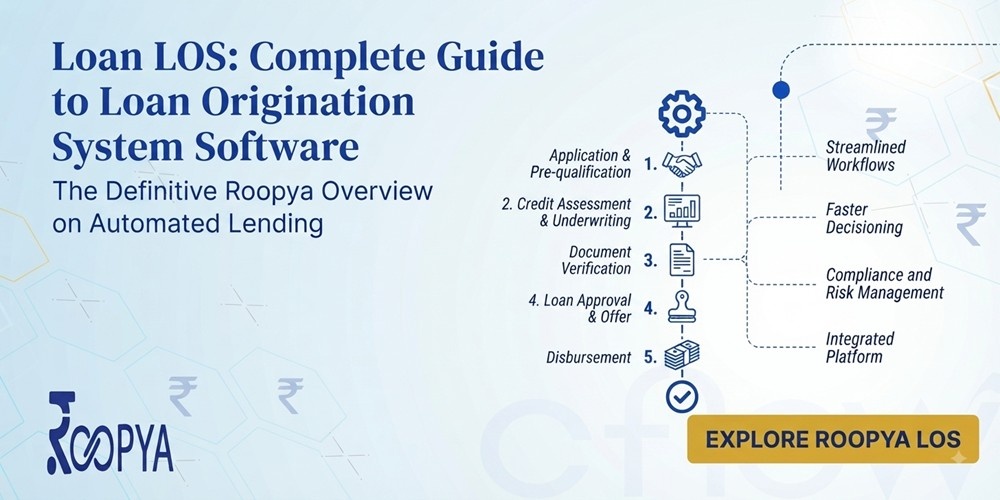
A Loan LOS (Loan Origination System) is a software platform that helps lenders manage and automate the journey from loan application to credit assessment, underwriting, approval and disbursement.
For banks, NBFCs, MFIs, fintech companies and other lending institutions, an LOS can bring multiple stages of the lending process into one structured workflow. Instead of depending on disconnected spreadsheets, emails, manual document checks and repetitive data entry, lenders can use technology to standardize processes and give teams better visibility into every application.
A modern Loan LOS can support digital application forms, customer onboarding, KYC, document verification, credit bureau integrations, credit assessment, business rules, scorecards, underwriting workflows, approval processes and disbursal-stage activities.
Roopya provides a cloud-based lending platform designed to help lenders originate and underwrite loans through configurable workflows, integrations and automated decisioning capabilities. Its platform includes features such as multi-bureau connectivity, scorecards, business rule engines and KYC workflows.
What Is a Loan LOS?
A Loan LOS, or Loan Origination System, is technology used to manage the loan origination process.
The origination journey generally begins when a customer or business submits a loan application. The lender then collects and verifies information, performs credit and risk checks, evaluates eligibility, completes underwriting and makes a lending decision.
A Loan LOS helps connect these activities into a defined digital workflow.
In simple terms:
Loan Application → Customer Onboarding → KYC & Verification → Credit Assessment → Underwriting → Decision → Documentation → Disbursement
The exact workflow varies according to the lender, loan product, risk policy and regulatory requirements.
A well-designed LOS does not simply digitize paperwork. It can help lenders create consistent processes, reduce repetitive manual work, improve application visibility and make decisions using predefined lending policies.
Why Do Lenders Need a Loan LOS?
Traditional loan processing can involve multiple teams, systems and manual handoffs.
An application may move between sales, operations, credit, verification, underwriting and disbursement teams. When information is exchanged manually, lenders may face delays, duplicate data entry, missing documents and limited visibility into application status.
A Loan LOS can centralize these activities.
1. Faster Loan Processing
Automated workflows can route applications to the appropriate team or decision stage without requiring every step to be handled manually.
2. Better Application Visibility
Lenders can track applications and identify where an application is currently positioned in the origination journey.
3. Standardized Credit Processes
Business rules, eligibility criteria and underwriting workflows can help lenders apply policies consistently.
4. Centralized Customer Information
Applicant information, documents, verification results and credit information can be managed within connected workflows.
5. Improved Operational Efficiency
Automating repetitive activities can allow lending teams to spend more time on exceptions, customer service and higher-value decisions.
6. Better Integration
Modern LOS platforms can connect with external services and existing enterprise systems through APIs and integrations.
How Does a Loan Origination System Work?
Although workflows differ between lenders, a typical Loan LOS process includes several stages.
Step 1: Customer Application
The borrower submits information through a digital application form or another supported channel.
The application may capture details such as:
- Personal information
- Contact details
- Employment or business information
- Income
- Loan requirement
- Existing liabilities
- Banking information
- Supporting documents
Step 2: Customer Onboarding
The system creates the customer profile and captures the information required for the relevant lending process.
For lenders working through multiple channels or partners, the onboarding workflow can also include LSP or partner onboarding.
Step 3: KYC and Verification
The lender verifies the information and documentation required for the application.
Depending on the lender's workflow, this may involve identity verification, document checks and other verification services.
Step 4: Credit Bureau Checks
A Loan LOS can connect with supported credit bureaus to retrieve relevant credit information.
The resulting information can become an input into the lender's credit assessment and decisioning process.
Step 5: Credit Assessment
The lender evaluates the applicant using its credit policy.
Factors can include credit history, income, repayment capacity, existing obligations and other relevant information.
Step 6: Business Rules and Scorecards
A business rule engine can apply predefined eligibility and credit policies.
Scorecards can also be used to support standardized risk assessment.
Roopya's platform includes scorecard and business-rule capabilities as part of its loan origination infrastructure.
Step 7: Underwriting
Applications that require additional assessment can move through underwriting workflows.
Depending on the product, underwriting may include document review, financial assessment, exception handling and approval authority.
Step 8: Loan Decision
The application can be approved, rejected or routed for additional review based on the lender's configured policies.
Automated decisioning should operate within the lender's approved credit policies and appropriate human oversight.
Step 9: Documentation and Disbursement
After approval, the application moves toward documentation, fulfilment and disbursement according to the lender's process.
This creates a connected origination journey rather than a collection of disconnected activities.
Key Features of Loan LOS Software
When evaluating a Loan LOS, lenders should look beyond basic application management.
Digital Loan Application
A digital application workflow can make it easier to capture borrower information and reduce manual data entry.
Customer Onboarding
The system should provide structured onboarding workflows for customers and, where applicable, lending partners or LSPs.
KYC and Verification
Verification capabilities help lenders collect and validate information required during the origination process.
Credit Bureau Integration
Connectivity with supported credit bureaus can help lenders access credit information during underwriting and decisioning.
Business Rule Engine
A configurable Business Rule Engine, or BRE, allows lending teams to define eligibility criteria, policies, thresholds and routing rules.
Credit Scorecards
Scorecards can help lenders standardize credit assessment based on defined variables and policies.
Automated Decisioning
Decisioning workflows can help route applications according to configured rules and credit policies.
Document Management
Centralized document handling can make it easier for teams to collect, verify and manage application documentation.
Workflow Management
Workflow automation helps route applications between different stages and teams.
API Integrations
A modern LOS should be able to connect with relevant external services and existing technology infrastructure.
Roopya states that its broader lending platform provides 300+ pre-integrated APIs and an open API architecture for integrations.
Reporting and Analytics
Reporting capabilities help lending teams understand application volumes, approval rates, turnaround times and other operational metrics.
Benefits of Using Loan LOS Software
A Loan Origination System can provide benefits across operations, credit, technology and customer experience.
Reduced Manual Work
Automating repetitive activities can reduce the amount of operational effort required for each application.
Consistent Processes
Configurable workflows and rules can help standardize the way applications move through the organization.
Faster Turnaround
Automated data flows and workflow routing can reduce avoidable delays between origination stages.
Better Risk Management
Credit rules, scorecards and verification workflows can support more structured lending decisions.
Improved Customer Experience
Digital workflows can make the application process more transparent and convenient for borrowers.
Better Data Visibility
A centralized system gives teams greater visibility into applications and their status.
Easier Scalability
Technology-enabled workflows can help lenders handle increasing application volumes without increasing manual processes at the same rate.
Loan LOS for NBFCs
NBFCs often manage multiple loan products, customer segments, channels and credit policies.
A Loan LOS can help NBFCs create product-specific origination workflows while maintaining centralized visibility.
Common use cases include:
- Personal loans
- Consumer loans
- MSME loans
- Business loans
- Small-ticket loans
- Vehicle finance
- Secured lending
- Unsecured lending
The right configuration depends on the NBFC's products, policies, risk framework and operating model.
Loan LOS for Banks
Banks can use LOS technology to organize loan applications across different lending products and channels.
A bank may need integration with existing core banking, CRM, document management, credit, compliance and payment systems.
Therefore, integration architecture and configurability are important when evaluating an LOS.
Loan LOS for Fintech Companies
Fintech lenders typically prioritize digital customer journeys, API connectivity, automation and rapid product iteration.
A cloud-based LOS can provide the infrastructure needed to connect application journeys with verification, credit assessment, decisioning and disbursement workflows.
For fintech companies, the ability to configure workflows without extensive development can also be valuable when launching or modifying lending products.
Loan LOS for MFIs and Small-Ticket Lending
Microfinance and small-ticket lenders may process high volumes of applications with standardized eligibility and underwriting requirements.
An LOS can help manage application intake, verification, credit policies, approval workflows and disbursement-stage processes in a structured manner.
AI in Modern Loan LOS
Artificial intelligence is increasingly being incorporated into lending technology.
Potential applications include:
- Document analysis
- Data extraction
- Fraud detection
- Risk analytics
- Credit decision support
- Behavioral analysis
- Portfolio insights
- Automated reporting
Roopya describes AI capabilities including document analysis, AI-enhanced business rules, intelligent credit decisioning and AI-driven analytics.
However, AI should complement rather than blindly replace responsible lending controls. Lenders should maintain appropriate validation, governance, monitoring and human oversight for credit decisions.
How to Choose the Right Loan LOS
Selecting an LOS is a technology and business decision.
Before choosing a platform, lenders should evaluate:
1. Product Flexibility
Can the platform support your current and future loan products?
2. Workflow Configuration
Can business users configure workflows without depending on developers for every change?
3. Credit Decisioning
Does the system support your credit rules, scorecards and underwriting requirements?
4. Integrations
Can it integrate with the systems and external services your lending operation requires?
5. Scalability
Can it handle your expected application volumes and future growth?
6. Security
Evaluate authentication, access controls, encryption, monitoring, backup and other relevant security controls.
7. Compliance Support
The technology should support the lender's regulatory and internal compliance processes. It should not be assumed that software alone makes a lending operation compliant.
8. Reporting
Check whether the platform provides the operational, management and regulatory reporting capabilities your organization needs.
9. Implementation
Understand implementation timelines, configuration requirements, migration needs and support.
10. Total Cost of Ownership
Consider setup, integration, implementation, support, usage and future customization costs.
Loan LOS vs Loan Management System
A Loan Origination System primarily focuses on the front-end and decisioning stages of lending.
A Loan Management System, or LMS, focuses more heavily on servicing and managing loans after origination.
A simplified distinction is:
Loan LOS Loan Management System Application intake Loan servicing Customer onboarding Account management KYC and verification Repayment tracking Credit assessment Payment processing Underwriting Amortization Decisioning Portfolio management Approval Customer servicing Pre-disbursement workflow Post-disbursement operationsModern lending platforms can combine LOS and LMS capabilities to create a connected lending lifecycle.
Roopya's platform covers both Loan Origination and Loan Management capabilities as part of its broader lending infrastructure.
Loan LOS and the Future of Digital Lending
The lending industry is moving toward more connected, configurable and data-driven processes.
Future-ready LOS platforms are likely to focus on:
- Configurable no-code workflows
- Real-time decisioning
- API-first architecture
- AI-assisted document processing
- Advanced fraud detection
- Predictive analytics
- Automated compliance workflows
- Better customer self-service
- Integrated origination and servicing
- Continuous risk monitoring
The goal should not simply be to automate every activity.
The goal is to build a lending process that is faster, consistent, transparent, scalable and appropriately controlled.
Why Consider Roopya for Loan Origination?
Roopya provides a cloud-based Loan Origination Platform designed for lenders and supports customer onboarding, LSP onboarding, disbursal-stage management, multi-bureau connections, scorecards, business rules and KYC workflows.
Its broader lending infrastructure also includes Loan Management, Collections, Lending Analytics, Early Warning and Advanced Reporting capabilities.
For organizations evaluating a Loan LOS, Roopya can be considered when the requirement is for a configurable lending infrastructure that connects origination with other parts of the lending lifecycle.
Frequently Asked Questions About Loan LOS
What is a Loan LOS?
A Loan LOS, or Loan Origination System, is software that helps lenders manage the loan journey from application and onboarding through credit assessment, underwriting, approval and disbursement.
What does LOS stand for in lending?
LOS stands for Loan Origination System. It is used to manage and automate processes involved in originating new loans.
What is the difference between LOS and LMS?
LOS primarily manages loan origination, including application, verification, underwriting and approval. LMS generally manages post-origination activities such as servicing, repayments, amortization and portfolio management.
Who uses Loan LOS software?
Banks, NBFCs, MFIs, fintech companies, consumer lenders and other lending organizations can use LOS software to manage loan origination workflows.
Can a Loan LOS automate underwriting?
Yes. Modern LOS platforms can automate parts of underwriting through configurable workflows, business rules, scorecards, data integrations and decisioning. The exact level of automation depends on the lender's policies and platform configuration.
Can Loan LOS integrate with credit bureaus?
Yes. LOS platforms can integrate with supported credit bureaus and other verification or data providers through APIs or pre-built integrations.
Is Loan LOS useful for NBFCs?
Yes. An LOS can help NBFCs digitize applications, manage KYC, automate workflows, apply credit policies, coordinate underwriting and improve visibility across loan origination.
Does Loan LOS support AI?
Some modern LOS platforms incorporate AI for activities such as document processing, fraud detection, analytics and decision support. Roopya offers AI-related capabilities within its lending infrastructure.
How do I choose the best Loan LOS?
Compare platforms based on workflow flexibility, integrations, credit decisioning, security, scalability, reporting, implementation, support and total cost of ownership. Request a product demonstration and evaluate the platform against your actual lending workflows.
Is Roopya a Loan Origination System?
Yes. Roopya provides a cloud-based Loan Origination Platform designed to help lenders originate and underwrite loans through configurable lending workflows and integrations.
Can Loan LOS improve loan processing efficiency?
A well-configured LOS can reduce repetitive manual work, standardize workflows, improve data visibility and automate selected verification and decisioning activities. Actual efficiency improvements depend on implementation and the lender's processes.
A Loan LOS is more than an online loan application form. It can become the operational foundation for a lender's origination process by connecting customer onboarding, verification, credit assessment, underwriting, decisioning and disbursement workflows.
For banks, NBFCs, MFIs and fintech companies, the right platform should combine automation with flexibility, integrations, security, reporting and responsible lending controls.
Roopya's cloud-based lending infrastructure brings Loan Origination together with broader capabilities for loan management, collections and analytics, making it an option for lenders looking to modernize their lending technology stack.
Ready to evaluate your lending workflow? Request a Roopya demo to see how its Loan Origination Platform can fit your lending operation.