August 18, 2026
Loan Management System: The Definitive Guide for Modern Lenders in India
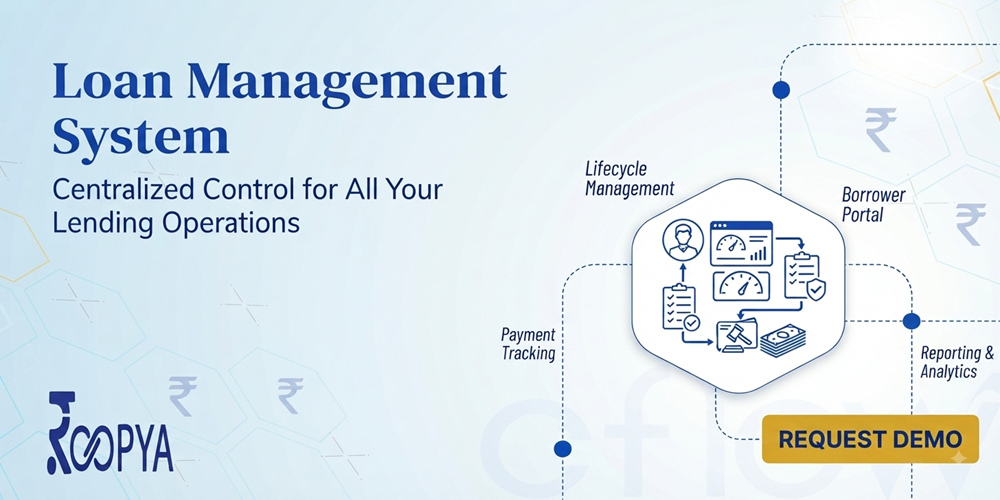
Every rupee you lend is a promise — a promise that the borrower will repay on time, that your collections team will follow up precisely, that your compliance officer will never lose sleep over a missed regulatory filing, and that your finance team will always know, to the paisa, how your portfolio is performing. Delivering on all four of those promises simultaneously, at scale, is impossible with spreadsheets and manual processes. It requires a Loan Management System.
A Loan Management System (LMS) is the operational spine of any lending business. It is the platform that takes over the moment a loan is disbursed and manages everything that follows — EMI scheduling, payment collection, interest accrual, prepayment and foreclosure handling, delinquency tracking, regulatory reporting, and customer communication — until the very last rupee is recovered and the account is closed.
In India's rapidly evolving lending landscape — where NBFCs, banks, MFIs, and fintech lenders are scaling fast, regulatory expectations from the RBI are tightening, and borrowers demand seamless digital experiences — the quality of your Loan Management System is increasingly the difference between a profitable, scalable lending business and one that is perpetually firefighting.
This guide explores everything you need to know about Loan Management Systems: what they do, why they matter, what to look for, and how Roopya's purpose-built LMS is helping Indian lenders manage portfolios worth crores with the confidence and precision that modern lending demands.
1. What Is a Loan Management System?
A Loan Management System is a specialised software platform that automates and manages the complete post-disbursement lifecycle of a loan. Where a Loan Origination System (LOS) handles the front-end — the application, underwriting, and sanctioning of a loan — the LMS takes responsibility for everything that follows after the money reaches the borrower's account.
Think of the LOS as the intake process and the LMS as the ongoing relationship management engine. The LMS records the loan account, generates the repayment schedule, tracks every payment and missed payment, applies interest and penalties, manages restructuring or moratorium requests, generates statements on demand, feeds data to regulatory systems, and ultimately closes the account when all dues are settled.
In a modern, integrated lending platform like Roopya, the LOS and LMS are unified — meaning there is no data handoff between systems, no reconciliation errors, and no delay between disbursement and the loan appearing in the management system. The entire lifecycle — from application to final closure — runs on a single platform.
2. Why a Loan Management System Is Non-Negotiable for Indian Lenders
The scale and complexity of managing a loan portfolio manually is grossly underestimated until it becomes a crisis. Consider a mid-sized NBFC with 5,000 active loan accounts. Each account has its own disbursement date, tenure, EMI amount, interest rate, and repayment history. Each month, the NBFC must:
- Generate and send 5,000 EMI reminders across SMS, WhatsApp, and email
- Reconcile 5,000 expected payments against actual receipts from payment gateways, NACH mandates, and branch collections
- Identify and escalate every missed or partial payment within 24 hours
- Calculate interest accruals, penal charges, and GST on all relevant transactions
- Generate account statements for borrowers who request them
- Prepare NPA provisioning data as per RBI IRACP norms
- File CERSAI satisfaction entries for loans that have been repaid
Attempting this with spreadsheets and manual processes leads to errors, delays, compliance lapses, and — ultimately — portfolio deterioration. An LMS automates every one of these tasks, reducing operational cost, eliminating errors, and ensuring your portfolio is managed with the precision that regulators, investors, and borrowers expect.
Beyond operational efficiency, there are three structural reasons why a purpose-built LMS has become essential in the current environment:
- RBI's tightening compliance framework: The revised IRACP (Income Recognition and Asset Classification) norms, the Fair Practice Code requirements, and the KFS (Key Fact Statement) mandates all require data that only a properly configured LMS can produce reliably.
- The NPA imperative: Non-performing assets are the existential threat of any lending business. An LMS with automated early-warning triggers, intelligent collections workflows, and bureau-linked monitoring dramatically reduces the risk of loans slipping into delinquency undetected.
- Investor and auditor expectations: Any NBFC looking to raise debt or equity capital must demonstrate clean, auditable portfolio data. An LMS is the source of truth that satisfies due diligence requirements from banks, NBFCs, and institutional investors.
3. Core Features of a World-Class Loan Management System
3.1 Automated Loan Scheduling and Amortisation
The moment a loan is disbursed, the LMS generates a complete amortisation schedule — breaking down every EMI into principal and interest components across the full tenure. This schedule must handle multiple interest rate types: flat rate, reducing balance (monthly and daily), and step-up/step-down structures. It must also accommodate irregular disbursements, moratoriums, and mid-tenure interest rate changes without requiring manual recalculation. Roopya's LMS handles all standard and non-standard loan structures with automatic schedule regeneration when any parameter changes.
3.2 Multi-Channel Payment Collection
Modern borrowers repay through multiple channels — NACH auto-debit, UPI, NEFT, RTGS, payment gateway links, branch cash collection, and business correspondent (BC) networks. A robust LMS must support all of these channels simultaneously, automatically reconciling payments against open demands in real time. Roopya's LMS integrates with all major payment rails and NACH sponsors, providing a single reconciliation view regardless of how the borrower chose to pay.
3.3 Real-Time Reconciliation and GL Integration
Every payment received must be reconciled against the correct loan account, applied to the correct demand (principal, interest, fees, penal charges — in the correct regulatory order), and reflected in the general ledger instantly. Manual reconciliation is the single biggest operational risk in lending. Roopya's LMS performs real-time reconciliation with rule-based payment waterfall logic that is fully configurable without code, and pushes entries to connected accounting systems automatically.
3.4 Delinquency Management and Collections Automation
The first 48 hours after a missed payment are the most critical window for collections. A good LMS identifies missed payments the moment the collection window closes, triggers automated multi-channel reminders, and escalates to the collections team with a complete borrower profile, contact history, and payment history. Roopya's LMS supports configurable delinquency buckets (1-30 DPD, 31-60 DPD, 61-90 DPD, 90+ DPD), automated collections workflows with SLA tracking, and field collections app integration for feet-on-street teams.
3.5 NPA Classification and Provisioning
RBI's IRACP norms require precise, timely NPA classification based on days-past-due data. The LMS must automatically flag accounts that cross NPA thresholds (90 DPD for most asset classes), compute provisioning requirements as per the applicable RBI circular, and generate the provisioning data that feeds into your balance sheet. Roopya's LMS maintains a continuous, real-time DPD ledger and generates NPA and provisioning reports that are audit-ready.
3.6 Prepayment, Foreclosure, and Restructuring
Borrowers frequently request to prepay partially or foreclose their loans ahead of schedule. Each such event requires precise recalculation of outstanding principal, interest accrued to the foreclosure date, applicable prepayment charges (including GST), and a final settlement amount. Restructuring — where a loan's tenure, rate, or EMI is modified — requires complete schedule regeneration and a revised loan agreement. Roopya's LMS handles all these events automatically, generating accurate calculations and triggering the necessary document workflows in seconds.
3.7 Automated Borrower Communication
Borrower communication throughout the loan tenure — EMI reminders, payment receipts, missed payment alerts, NOC issuance after closure, annual account statements — is a compliance requirement and a customer experience imperative. Roopya's LMS automates all standard borrower communications across SMS, WhatsApp, email, and in-app push notifications, with configurable templates, timing rules, and language preferences. Every communication is logged with a timestamp for audit purposes.
3.8 Regulatory Reporting and Compliance
A compliant NBFC or bank must file regular reports — to the RBI, to credit bureaus, to CERSAI, and internally for board-level reporting. The LMS is the primary data source for all of these. Roopya's LMS generates RBI supervisory returns, credit bureau (CIBIL, Experian, Equifax, CRIF) data tapes on schedule, CERSAI satisfaction filings, and customisable management information system (MIS) reports — automatically and on time.
3.9 Portfolio Analytics and Risk Monitoring
A great LMS does not just manage loans — it gives leadership a real-time view of portfolio health. Vintage analysis, bucket-wise DPD trends, product-wise yield curves, collection efficiency ratios, and geographic concentration reports all emerge from the LMS data layer. Roopya provides an integrated analytics dashboard that translates loan-level data into portfolio-level intelligence, enabling proactive risk management rather than reactive firefighting.
3.10 Audit Trail and Document Management
Every action taken on a loan account — every payment applied, every call made to a borrower, every restructuring approved, every status change — must be logged with user identity, timestamp, and before/after values. This audit trail is essential for regulatory inspections, internal audits, and dispute resolution. Roopya's LMS maintains an immutable, comprehensive audit log and a linked document management system that stores all loan-related documents — sanction letters, agreements, receipts, NOCs — in a searchable, access-controlled repository.
4. Types of Loan Products an LMS Must Handle
A versatile LMS must manage the full spectrum of loan products without requiring product-specific custom builds. Roopya's LMS is pre-configured for:
- Personal Loans: Fixed-tenure, reducing-balance, salaried and self-employed — with standard EMI structures and bureau-linked monitoring.
- Business and SME Loans: Bullet repayment, flexible tenure, and overdraft structures — with GST-linked monitoring and business health indicators.
- Microfinance Loans (JLG/SHG): Weekly and fortnightly collection cycles, group-level tracking, BC-led field collection workflows, and centre meeting management.
- Gold Loans: Short-tenure, bullet repayment, interest-only EMI, and LTV monitoring with automated auction triggers on breach.
- Home Loans and LAP: Long-tenure loans with floating rate adjustments, CERSAI integration, disbursement tranche management, and anniversary resets.
- Two-Wheeler and Auto Loans: RC hypothecation tracking, insurance monitoring, and dealer-level portfolio reporting.
- Education Loans: Moratorium during study period, step-up repayment, and guarantor management.
- Payday and Salary Advance: Ultra-short tenure, salary-linked NACH, and employer-level portfolio management.
5. LMS vs. LOS: Understanding the Distinction
The terms Loan Management System and Loan Origination System are frequently confused, and using them interchangeably leads to poor technology decisions. Here is the clearest way to understand the distinction:
- Loan Origination System (LOS): Manages the pre-disbursement lifecycle — application intake, KYC, credit bureau checks, underwriting, credit decisioning, loan offer, agreement execution, and disbursement trigger. The LOS is the sales and underwriting engine.
- Loan Management System (LMS): Manages the post-disbursement lifecycle — repayment scheduling, EMI collection, delinquency management, NPA classification, restructuring, regulatory reporting, and account closure. The LMS is the servicing and collections engine.
Both are essential. Many lenders make the mistake of investing heavily in origination technology but under-investing in management systems — only to discover that their collections efficiency, regulatory compliance, and portfolio visibility suffer as a result. Roopya provides both LOS and LMS as a single, integrated platform, eliminating the data silos and integration costs that come with using separate systems from different vendors.
6. How Roopya's Loan Management System Works
Roopya is designed around the principle that lending technology should be powerful enough to satisfy a large NBFC's compliance requirements and simple enough for a newly licensed lender to configure and go live in a single day. Here is the Roopya LMS in practice:
- Instant Loan Boarding: The moment a loan is disbursed via the Roopya LOS, the account is automatically created in the LMS — with disbursement date, sanction amount, tenure, rate, and schedule pre-populated. There is zero manual data entry.
- Automated Schedule Generation: The system generates the full amortisation schedule immediately, breaking every EMI into principal and interest components across the complete tenure.
- NACH and Payment Gateway Integration: NACH mandates are registered automatically at disbursement. Payment gateway links, UPI collect requests, and branch receipts are all captured and auto-reconciled.
- Daily DPD Engine: Every night, the system runs a DPD (Days Past Due) calculation across every active account, updating the delinquency bucket and triggering the appropriate collections workflow for any account that has crossed a threshold.
- Automated Communications: Reminders, receipts, alerts, and statements go out automatically — no manual intervention. Every communication is logged.
- Regulatory Data Outputs: Credit bureau data tapes, RBI returns, and CERSAI filings are generated on schedule without requiring a compliance officer to extract and format data manually.
- Portfolio Dashboard: Leadership has a real-time view of disbursements, collections, DPD buckets, NPA ratios, and yield metrics — from a single dashboard accessible on any device.
7. The Business Impact of the Right Loan Management System
Improved Collection Efficiency
Lenders who move from manual collections to an automated LMS with intelligent workflows consistently report collection efficiency improvements of 15–25 percentage points. Automated reminders reduce unintentional defaults. Early-warning triggers catch genuine delinquencies before they become NPAs. And field collections teams equipped with a mobile LMS interface are significantly more productive than those working from printed lists.
Dramatically Reduced Operational Cost
The cost of manually managing a loan account — across the teams responsible for reconciliation, collections, compliance, and customer service — is typically ₹200–₹500 per account per month in a mid-sized NBFC. A well-implemented LMS reduces this to ₹50–₹100 per account per month, with further reductions as volume scales. For a portfolio of 10,000 active accounts, this translates to ₹1.5–₹4.5 crore in annual cost savings.
Regulatory Confidence and Audit Readiness
An LMS that automatically generates RBI returns, credit bureau data tapes, and NPA provisioning data transforms compliance from a monthly crisis into a routine output. Audit-ready data, immutable audit trails, and a complete document repository mean that regulatory inspections and investor due diligence can be handled with confidence rather than anxiety.
Better Borrower Experience
Borrowers who receive timely reminders, instant receipts, on-demand account statements, and prompt NOCs after closure are significantly more likely to return for subsequent loans and to refer new borrowers. The LMS is the primary driver of post-disbursement borrower experience — an area that most lenders underinvest in, and a significant competitive differentiator for those who get it right.
Investor-Grade Portfolio Reporting
NBFCs seeking to raise Non-Convertible Debentures (NCDs), bank credit lines, or equity capital must present clean, consistent portfolio data — vintage analysis, collection ratios, NPA trends, and product-level performance. An LMS that generates this data automatically, in standard formats, dramatically accelerates fundraising processes and improves lender-investor relationships.
8. Choosing a Loan Management System: What to Evaluate
- Does it handle your specific loan product types? Ensure the system supports all your current products — and the products you plan to launch in the next 12 months.
- Is it truly no-code for business users? Credit policy changes, interest rate adjustments, collection workflow modifications, and report customisation should not require a developer ticket.
- How does it handle payment reconciliation? Automated, real-time reconciliation across all payment channels is non-negotiable at any meaningful scale.
- What is the NPA and provisioning logic? The system must be aligned with current RBI IRACP norms and must be updateable when norms change.
- What regulatory reports are pre-built? RBI supervisory returns, credit bureau data tapes, and CERSAI filings should be system outputs, not manual exports.
- Is it integrated with a LOS? A unified LOS-LMS platform eliminates data silos, reconciliation errors, and integration costs.
- What is the implementation timeline? Any system that takes more than a month to implement is a risk for a growing lender. Roopya goes live in a day.
- How does it scale? The system must handle 10x your current volume without performance degradation or infrastructure changes on your part.
- What does support look like? Dedicated onboarding, ongoing training, and responsive technical support are as important as the software features.
9. Roopya LMS: Built for India, Built for Scale
Roopya is not a global lending platform adapted for India. It is an Indian platform built specifically for the regulatory environment, borrower demographics, payment infrastructure, and operational realities of Indian lending — from the Reserve Bank of India's compliance requirements to the specifics of NACH, UPI, and the Account Aggregator ecosystem.
Here is what sets Roopya's LMS apart:
- No-Code Configuration: Interest rate changes, collection workflows, communication templates, report formats, and product parameters are all configurable by business users — no developer required, ever.
- 1-Day Go-Live: Pre-built integrations, pre-configured product templates, and a guided setup process mean most lenders are processing live loan accounts within 24 hours of signing up.
- 300+ Pre-Integrated APIs: NACH sponsors, payment gateways, credit bureaus, accounting software, and SMS/WhatsApp providers are all pre-integrated — no custom development needed.
- Unified LOS + LMS: A single platform manages the complete loan lifecycle — origination, underwriting, disbursement, and servicing — with no data handoffs, no reconciliation gaps, and no integration risk.
- RBI-Compliant by Design: IRACP-aligned NPA logic, automated credit bureau reporting, CERSAI integration, and audit-ready data are built in and continuously updated as regulations evolve.
- AI-Powered Collections: Machine learning-driven collections prioritisation identifies which accounts need immediate attention, which need automated nudges, and which are likely to self-cure — dramatically improving collection efficiency.
- Pay-As-You-Use Pricing: Zero upfront cost, no large licence fees. You pay based on actual portfolio size — making Roopya equally accessible to early-stage NBFCs and established financial institutions.
- Trusted by Modern Lenders: IndiaKaLoan, QuickFinShop, Recapita, Findoc, EazyCredit, and others use Roopya to manage their portfolios with confidence.
If you are building a lending business that needs to scale, stay compliant, and deliver a great borrower experience — Roopya's Loan Management System is the foundation you need. Book a free demo today and see your loan portfolio managed the way it deserves to be.