August 14, 2026
Loan Origination System Explained: Features, Benefits & Process
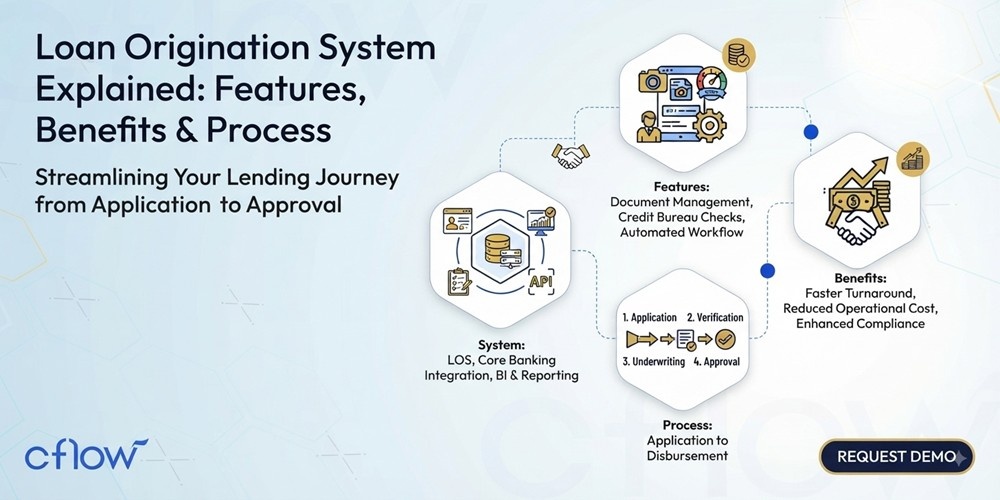
The lending industry has changed significantly with the growth of digital finance. Borrowers today expect faster approvals, paperless documentation, convenient applications, and real-time updates. At the same time, banks, NBFCs, fintech companies, MFIs, and other lenders need to process applications efficiently while maintaining strong credit controls, risk management, and regulatory compliance.
A Loan Origination System (LOS) helps lenders achieve these objectives by digitizing and automating the loan application and approval journey.
Instead of managing applications through spreadsheets, emails, physical documents, and disconnected systems, a modern LOS brings the major stages of loan origination into a centralized digital workflow. This can include lead capture, application processing, KYC and document verification, credit bureau checks, underwriting, rule-based decisioning, approval, documentation, and disbursement.
Roopya provides a digital Loan Origination System designed to help modern lenders streamline customer onboarding, credit assessment, document management, decisioning, and loan processing through configurable workflows and integrations. Its platform also forms part of a broader lending infrastructure covering origination, loan management, collections, analytics, and related lending functions.
What Is a Loan Origination System?
A Loan Origination System (LOS) is software that manages and automates the process of creating and processing a loan application, from the initial application through credit assessment, approval, documentation, and disbursement.
The exact workflow varies depending on the lender, loan product, risk policy, and regulatory requirements. However, a typical LOS can help manage:
- Customer and lead onboarding
- Digital loan applications
- KYC and identity verification
- Document collection
- Document extraction and verification
- Credit bureau checks
- Income and financial data analysis
- Credit scoring
- Business rules and eligibility checks
- Underwriting workflows
- Approval hierarchies
- Loan offer and sanction processing
- E-signature and documentation
- Disbursement initiation
- Application tracking and reporting
The primary objective is to create a controlled, efficient, and auditable lending workflow while reducing unnecessary manual intervention.
Why Do Lenders Need a Loan Origination System?
Traditional loan processing can involve multiple teams, systems, documents, and approval stages. When these processes are heavily manual, lenders may face operational bottlenecks, inconsistent decisions, data-entry errors, limited visibility, and longer turnaround times.
A digital LOS addresses these challenges by creating a structured workflow.
For example, once an applicant submits information, the system can automatically trigger applicable verification and credit checks. Based on predefined policies, the application can then be routed to the appropriate decision or underwriting workflow.
Modern LOS platforms can therefore help lenders create more consistent processes without removing the need for appropriate human oversight.
Roopya describes its LOS as supporting digital application forms, automated credit scoring, document verification, and real-time decisioning.
How Does a Loan Origination System Work?
The loan origination process generally moves through several stages. A modern LOS connects these stages into a single workflow.
1. Lead Generation and Application Capture
The process begins when a prospective borrower expresses interest in a loan.
Leads may come from:
- Lender websites
- Mobile applications
- Loan Service Providers (LSPs)
- Digital marketing campaigns
- Branches
- Partner channels
- Direct sales teams
- Embedded finance platforms
A Loan Origination System can capture these leads and convert eligible prospects into loan applications.
Roopya's platform supports centralized lead generation and multiple pipelines based on product type and lending rules.
2. Digital Customer Onboarding
Once the applicant begins the loan application, the LOS collects relevant customer information.
Depending on the loan product, this may include:
- Personal details
- Contact information
- Employment information
- Income details
- Business information
- Banking information
- Loan requirements
- Identity information
Digital forms can make the application process easier for borrowers while helping lenders standardize the information they receive.
3. KYC and Identity Verification
Customer verification is a critical part of lending.
An LOS can connect with appropriate verification services to validate information and support the lender's KYC process.
Instead of manually reviewing every piece of information, integrated workflows can automatically trigger the required verification checks and record the results against the application.
This creates a more structured process and reduces repetitive operational work.
4. Document Collection and Verification
Loan applications often require supporting documents.
Depending on the loan product, these could include identity documents, income documents, bank statements, business documents, or other financial records.
A digital LOS can provide a centralized location for collecting and managing these documents.
Modern platforms can also use OCR and AI-assisted document processing to extract relevant information and identify potential inconsistencies. Roopya highlights AI-powered document analysis for extracting, verifying, and analyzing lending documents.
5. Credit Bureau and Financial Data Checks
Credit assessment is another important stage of loan origination.
The LOS can integrate with relevant credit bureaus and other data providers to obtain information required by the lender's credit policy.
Depending on the product and applicable requirements, lenders may evaluate:
- Credit history
- Existing obligations
- Repayment behavior
- Income
- Banking information
- Business performance
- Other permitted financial or alternative data
Roopya's LOS supports integrations with credit-risk vendors and automated credit assessment workflows.
6. Eligibility and Business Rule Evaluation
Every lender has its own credit policies.
For example, a lender may define rules around:
- Minimum income
- Applicant age
- Loan amount
- Employment type
- Credit profile
- Existing exposure
- Geographic eligibility
- Product-specific criteria
A Business Rule Engine (BRE) can automate these policy checks.
Instead of requiring developers to manually implement every policy change, a configurable rule engine allows authorized business or credit teams to manage defined lending rules.
Roopya offers a no-code Business Rule Engine for configuring lending rules, credit policies, and approval workflows.
7. Credit Scoring and Underwriting
After collecting the necessary data, the application moves into credit assessment and underwriting.
The lender can use scorecards, rules, bureau data, financial information, and other approved inputs to evaluate the application's risk.
Depending on the lending model, applications may be:
- Approved automatically
- Rejected according to predefined criteria
- Sent for manual review
- Escalated to a credit manager
- Routed through a multi-level approval process
This creates a consistent decisioning framework while allowing human intervention where required.
8. Approval and Sanction
If the application meets the applicable criteria, it can move through the lender's approval workflow.
An LOS can support:
- Multi-level approvals
- Credit committee workflows
- Approval limits
- Exception handling
- Application status tracking
- Automated notifications
Once approved, the system can generate or initiate the next documentation and sanction steps.
9. Documentation and E-Sign
After approval, borrowers may need to accept loan terms and execute relevant documentation.
Digital lending workflows can integrate document generation and electronic signing to reduce dependence on physical paperwork.
This can help lenders create a smoother customer experience and maintain a centralized digital record.
10. Loan Disbursement
The final stage of origination is disbursement.
Once the necessary conditions are satisfied, the loan can move to the disbursement process.
An integrated lending platform can connect the origination workflow with payment or disbursement systems, reducing manual handoffs.
After disbursement, the account generally moves into the servicing or Loan Management System (LMS) for repayment, interest, schedules, collections, and other post-disbursement activities.
Roopya combines LOS capabilities with broader loan management and collections infrastructure.
Key Features of a Modern Loan Origination System
A modern LOS should do more than simply collect loan applications. It should provide lenders with an integrated framework for managing the complete origination journey.
1. Digital Loan Application Forms
Mobile-friendly digital forms allow borrowers to submit applications online and provide structured information to the lender.
2. Customer Onboarding
A centralized onboarding workflow can help collect borrower information and initiate required verification processes.
3. KYC and Verification Integrations
Integration with verification providers allows lenders to automate appropriate identity and compliance checks.
4. Document Management
A digital repository helps organize application documents and maintain a centralized record.
5. OCR and Intelligent Document Processing
OCR and AI-assisted processing can extract information from documents and support faster verification. Roopya highlights AI-powered document analysis as part of its lending infrastructure.
6. Credit Bureau Integration
Integration with credit bureaus enables lenders to incorporate credit information into their assessment workflows.
7. Business Rule Engine
A configurable BRE allows lenders to implement eligibility criteria, credit policies, routing logic, and approval conditions.
8. Automated Credit Scoring
Credit scoring capabilities can help lenders evaluate applications using defined models and scoring criteria.
9. Automated Underwriting
Underwriting workflows can combine customer information, verification results, credit data, rules, and scorecards to support lending decisions.
10. Workflow Automation
Automated workflows can route applications between teams and stages according to predefined conditions.
11. Real-Time Decisioning
Where the lender's policy and integrations support it, automated decisioning can significantly reduce the time required to evaluate eligible applications.
12. Multi-Level Approval
Lenders can configure approval hierarchies according to loan amount, product, risk, geography, or other internal policies.
13. Fraud Detection
Modern lending platforms can incorporate fraud detection capabilities to identify suspicious applications and unusual patterns. Roopya includes AI-powered fraud detection capabilities in its lending infrastructure.
14. API-Based Integrations
APIs allow the LOS to connect with external services such as verification providers, credit bureaus, payment systems, CRMs, ERPs, and other lending infrastructure.
Roopya states that its platform provides an open API architecture and 300+ pre-integrated APIs.
15. Reporting and Dashboards
Operational dashboards can provide visibility into application volumes, approval rates, turnaround times, pending applications, and other relevant lending metrics.
Benefits of a Loan Origination System
Faster Loan Processing
Automation reduces repetitive manual activities and can help lenders process applications faster.
Reduced Operational Work
Automated verification, workflows, document processing, and decisioning can reduce the amount of repetitive work performed by operations teams.
Better Customer Experience
Borrowers increasingly expect digital applications, minimal paperwork, faster decisions, and transparent application tracking.
A well-designed LOS can help lenders deliver a smoother borrowing journey.
Consistent Credit Processes
A rules-based approach helps lenders apply defined credit policies consistently across applications.
Improved Risk Management
An LOS can centralize information from multiple sources and apply predefined risk rules, scorecards, and underwriting workflows.
Better Application Visibility
A centralized dashboard allows teams to track applications and identify bottlenecks.
Easier Product Launches
Configurable workflows and business rules can make it easier for lenders to introduce or modify loan products.
Roopya positions its platform as a no-code lending infrastructure where business users can configure lending operations without traditional coding requirements.
Scalability
As application volumes grow, manual processes can become increasingly difficult to manage. A digital LOS provides a technology foundation that can support higher application volumes and more standardized workflows.
Loan Origination System vs. Loan Management System
A Loan Origination System (LOS) and Loan Management System (LMS) serve different stages of the lending lifecycle.
Loan Origination System Loan Management System Manages loan creation Manages loans after origination Captures applications Manages active loan accounts Handles KYC and verification Manages repayments Performs credit assessment Maintains repayment schedules Supports underwriting Handles servicing activities Manages approval workflows Supports collections Facilitates documentation Manages portfolio information Supports disbursement Tracks account performanceIn simple terms:
LOS = Application to Disbursement
LMS = Disbursement to Closure
A unified platform can connect these stages and reduce data silos between origination and servicing. Roopya offers both Loan Origination and Loan Management capabilities as part of its broader lending infrastructure.
Who Can Use Loan Origination Software?
A Loan Origination System can be useful for many types of lenders, including:
Banks
Banks can use LOS technology to digitize lending workflows across retail, business, SME, and other credit products.
NBFCs
NBFCs can automate onboarding, underwriting, credit decisioning, approval, and disbursement workflows.
Fintech Companies
Fintech lenders can use API-driven LOS infrastructure to build digital-first lending experiences.
Microfinance Institutions
MFIs can use digital origination workflows to improve application processing and borrower onboarding.
Digital Lending Companies
Digital lenders can integrate multiple verification, credit, payment, and data services into a centralized origination process.
SME and Business Lenders
Business lenders can use LOS workflows to collect financial information, analyze borrower profiles, and manage credit assessments.
How to Choose the Right Loan Origination System
Choosing an LOS should be based on the lender's business model, loan products, technology environment, risk requirements, and expected application volume.
Consider these factors:
1. Configurability
Can your credit and operations teams configure products and rules without depending heavily on developers?
2. Integration Capabilities
Does the platform integrate with the credit bureaus, KYC providers, payment systems, document services, and other tools your lending operation requires?
3. Business Rule Engine
Can you easily configure eligibility criteria and credit policies?
4. Automation
Which parts of the loan journey can be automated?
5. Security and Compliance
Does the platform support your security, privacy, audit, and regulatory requirements?
6. Scalability
Can the platform support your expected growth in applications, products, users, and integrations?
7. Analytics and Reporting
Does the system provide the visibility your credit, operations, risk, and management teams need?
8. Customer Experience
Is the borrower journey mobile-friendly, simple, transparent, and easy to complete?
9. Implementation Time
Evaluate how quickly the platform can be configured and deployed for your lending operation.
Why Roopya for Loan Origination?
Roopya provides a no-code lending infrastructure designed for modern lenders. Its Loan Origination System supports digital application forms, automated credit scoring, document verification, real-time decisioning, configurable business rules, and integrations.
The platform is positioned as more than an isolated LOS. Roopya combines origination with loan management, collections, early-warning capabilities, lending analytics, and reporting within its broader lending infrastructure.
Key capabilities include:
- Digital application forms
- Automated credit scoring
- Document verification
- Real-time decisioning
- No-code Business Rule Engine
- AI-powered document analysis
- Fraud detection
- API-based integrations
- Lending analytics
- Custom dashboards
- Loan management
- Collections workflows
- Early-warning capabilities
Roopya also states that its platform includes 300+ pre-integrated APIs, 20+ pre-configured loan products, and a no-code configuration environment.
The Future of Loan Origination
The future of lending is moving toward increasingly automated, data-driven, and configurable processes.
AI, machine learning, API-based integrations, intelligent document processing, automated decisioning, and real-time analytics are changing how lenders evaluate applications and manage risk.
However, automation should not simply mean removing humans from the lending process. The most effective lending infrastructure combines automation with appropriate human oversight, clear credit policies, explainable decision processes, strong controls, and regulatory compliance.
A modern LOS therefore becomes more than a processing tool. It becomes a core component of a lender's technology infrastructure.
Final Thoughts
A Loan Origination System helps lenders digitize and streamline the journey from loan application to approval and disbursement. By connecting customer onboarding, verification, document management, credit assessment, underwriting, business rules, approvals, documentation, and disbursement into a structured workflow, an LOS can help improve operational efficiency and borrower experience.
For banks, NBFCs, fintech companies, MFIs, and other lenders looking to modernize their lending operations, investing in a configurable and integrated Loan Origination System can provide a strong foundation for digital lending.
Roopya's LOS combines origination workflows with business-rule automation, credit decisioning, document verification, integrations, and broader lending infrastructure, giving modern lenders a centralized technology platform for managing the lending lifecycl