September 16, 2026
AI Lending Agents: The Next Generation of Digital Lending Automation
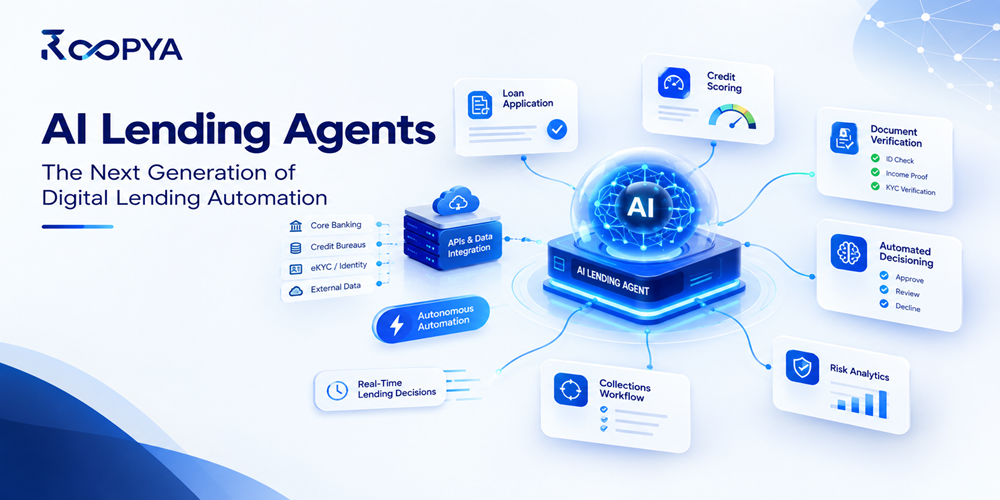
Lending has moved from paper files to online forms to rule-based automation — and now to something fundamentally different: AI agents that can reason, decide, and act across the entire loan lifecycle. Here's what that shift really means for banks and NBFCs, and how to prepare for it.
For the better part of two decades, "digital lending" mostly meant taking a paper process and putting it online. Applications moved from forms to web pages. Credit bureau pulls moved from phone calls to APIs. Approval letters moved from courier to email. It was digitization — faster, cheaper, and more convenient than the branch-led process it replaced, but still fundamentally the same workflow, just automated step by step.
AI lending agents represent a different kind of change. Instead of automating a single step in the loan journey, an AI lending agent can understand a borrower's documents, assess risk, apply policy, converse with the applicant, flag fraud, and even decide the next best action — often without a human touching every file. This is not a chatbot bolted onto an existing loan origination system. It is a new operating layer for lending itself, and it is arriving at exactly the moment banks and NBFCs are under pressure to lend faster, cheaper, and more safely than ever before.
This guide breaks down what AI lending agents actually are, how they differ from the automation lenders already use, where they fit across origination, underwriting, servicing, and collections, and what a lender should weigh before adopting them.
From RPA to Reasoning: The Evolution of Lending Automation
To understand why AI lending agents matter, it helps to see where lending automation has already been.
Generation 1: Rule-Based Automation
The first wave of lending technology digitized paperwork and applied hard-coded rules: if credit score is above X, if income is above Y, approve; otherwise, reject or refer. Business rule engines (BREs) made these rules configurable without a developer, which was a genuine leap forward — lenders could tune policy without waiting on engineering sprints. But the system still only did exactly what it was told, one rule at a time, and every new product or edge case meant writing more rules.
Generation 2: Machine Learning Scorecards
The second wave layered statistical and machine learning models on top of rules — credit scorecards that weighed dozens or hundreds of variables to predict default probability more accurately than a handful of cut-offs ever could. This improved risk pricing and approval rates, but the models were still narrow: a scorecard could score an application, but it couldn't read a bank statement, chase a missing document, or explain a decision to a confused applicant in plain language.
Generation 3: Point AI Features
More recently, lenders began bolting on individual AI capabilities — OCR to read PAN cards, NLP to parse bank statements, a chatbot for FAQs, a fraud model for identity checks. Each feature was useful in isolation, but they lived in silos, often from different vendors, stitched together with manual handoffs between systems and teams.
Generation 4: Agentic AI
AI lending agents are the natural next step: instead of a collection of disconnected AI features, an agent is a system that can perceive (read documents, data, and conversation), reason (apply policy and risk logic), decide (approve, refer, request more information, flag for review), and act (trigger the next workflow step) — largely on its own, within guardrails a lender defines. The difference is not just more automation; it's automation that can handle ambiguity, incomplete information, and multi-step tasks the way a trained credit officer would, at a speed and scale no human team could match.
What Exactly Is an AI Lending Agent?
An AI lending agent is a software system, usually built on large language models combined with specialized credit, fraud, and document-processing models, that is given a goal ("process this loan application end to end within policy") rather than a fixed script. It plans the steps needed to reach that goal, uses tools — APIs to credit bureaus, KYC databases, bank statement analyzers, the loan management system itself — to gather what it needs, and takes action within limits set by the lender.
A useful way to separate an AI lending agent from ordinary automation is intent versus instruction. Traditional automation is instructed: "if field A equals X, do Y." An agent is given intent: "verify this applicant's identity and income, and recommend a decision consistent with our credit policy." It then works out how to do that using the tools and data available to it, adapting when a document is missing, a name doesn't match exactly, or an applicant asks an unexpected question.
This does not mean AI lending agents operate without oversight. In a regulated lending environment, the responsible design is "human-on-the-loop": the agent handles the repetitive, data-heavy work and proposes a decision or next step, while a credit officer retains the authority to override, and every action the agent takes is logged and explainable.
Core Capabilities of AI Lending Agents
Most AI lending agent platforms are built around a common set of capabilities that can be combined or used independently depending on where a lender wants to start.
Intelligent Document Processing
Loan files are still document-heavy: identity proofs, income documents, bank statements, GST returns, property papers, and more. AI lending agents use OCR combined with natural language understanding to extract structured data from unstructured documents, cross-check details against application data, detect tampering or inconsistencies, and flag documents that need a human look. What used to take a back-office team hours per file can be reduced to seconds, with far fewer manual data-entry errors.
Conversational Borrower Engagement
Rather than a static web form, an AI lending agent can converse with an applicant in natural language — in multiple languages and dialects — to collect information, explain why a document was rejected, nudge them to complete a stalled application, or answer questions about EMI schedules and eligibility. Because the agent is connected to the underlying loan system rather than working from a fixed script, it can give accurate, applicant-specific answers instead of generic FAQ responses.
Credit Risk Decisioning
At the center of most agent platforms sits a decisioning engine that goes beyond a traditional scorecard. It can pull in alternative data — bank transaction patterns, utility payments, GST filings, even device and behavioral signals — alongside bureau data, apply the lender's policy and scorecards, and generate a recommendation along with the reasoning behind it. Because the agent can also gather missing information itself before deciding, referral rates for "incomplete file" cases drop sharply.
Fraud and Anomaly Detection
AI agents are particularly well suited to fraud detection because they can correlate signals across a file — a document that looks edited, an address that doesn't match a geolocation ping, an income figure inconsistent with the bank statement — that a rules engine checking one field at a time would miss. This pattern-level view is one of the biggest reasons AI-powered lending platforms report significant reductions in fraud losses compared to manual or purely rules-based review.
Collections and Early-Warning Intelligence
On the servicing side, agents can monitor repayment behavior, predict which borrowers are likely to miss a payment before they do, and personalize the collections approach — a gentle reminder for a usually reliable borrower, an earlier and firmer outreach for one showing signs of stress. This shifts collections from a reactive, one-size-fits-all process to a proactive, borrower-specific one.
AI Lending Agents Across the Loan Lifecycle
The real value of an AI lending agent shows up when it is applied consistently across the loan lifecycle rather than as a single point solution.
Origination
At origination, an agent can guide an applicant through the form, extract and validate documents in real time, run KYC and bureau checks, and pre-qualify the applicant before a credit officer ever opens the file. For simple, policy-clear cases, the agent can carry the file all the way to an in-principle approval; for complex cases, it hands off to a human with a complete, pre-analyzed file rather than a raw application.
Underwriting
During underwriting, the agent applies the lender's credit policy and scorecards, incorporates alternative data where permitted, and produces a recommendation with a clear rationale — which data points drove the decision, and which policy rules were triggered. This transparency matters both for internal audit and for explaining decisions to regulators and applicants.
Loan Servicing
Once a loan is disbursed, an agent can manage routine servicing — answering balance and EMI queries, processing prepayment or foreclosure requests, updating KYC, and generating statements — freeing the servicing team to focus on exceptions and relationship-sensitive cases.
Collections and Recovery
As repayments come due, the agent tracks payment behavior, triggers reminders through the borrower's preferred channel, negotiates simple restructuring or payment-plan requests within pre-approved limits, and escalates to a human collections agent only when a case needs judgment or empathy a script cannot provide.
Portfolio Monitoring and Early Warning
Across the whole portfolio, agents continuously watch for early signs of stress — a sudden change in transaction patterns, a missed utility payment, a shift in bureau data — and surface an early-warning signal well before a loan is officially delinquent, giving risk teams time to intervene.
Business Benefits for Banks and NBFCs
The appeal of AI lending agents for lenders comes down to a few measurable outcomes:
- Faster turnaround times — document verification and initial underwriting that used to take hours can happen in seconds, shrinking time-to-disbursal from days to minutes for straightforward loans.
- Lower cost per loan — automating document review, data entry, and first-level underwriting reduces the operational headcount needed to process the same loan volume, which matters most for small-ticket, high-volume lending where manual processing costs can exceed the interest earned.
- Better risk accuracy — combining alternative data with pattern-level fraud detection typically improves both approval accuracy and fraud detection compared to manual or purely rules-based review.
- Consistency and auditability — an agent applies the same policy the same way to every file and logs its reasoning, which reduces the inconsistency that comes from different underwriters interpreting policy slightly differently.
- Scalability without linear headcount growth — a lender can absorb a spike in application volume, or launch a new loan product, without a proportional increase in operations staff.
- Better borrower experience — faster decisions, clearer communication, and self-service for routine questions all improve completion rates and borrower satisfaction, particularly for younger, mobile-first applicants.
Inside the Architecture: How AI Lending Agents Are Built
A production-grade AI lending agent is not a single model; it is a stack of coordinated components.
- Perception layer: OCR, document classifiers, and NLP models that turn scanned documents, uploaded PDFs, and free-text messages into structured, usable data.
- Reasoning layer: typically a large language model orchestrating the agent's plan, deciding which tool or data source to call next, and interpreting the results.
- Tool and integration layer: APIs into credit bureaus, KYC and AML databases, bank statement analyzers, payment gateways, and — critically — the lender's own loan origination and loan management systems, since the agent's decisions have to actually flow into the system of record.
- Policy and guardrail layer: the business rule engine and credit policy that constrain what the agent is allowed to decide on its own versus what it must refer to a human.
- Audit and explainability layer: logging of every decision, the data used, and the reasoning behind it, both for regulatory compliance and for internal model governance.
This is also why AI lending agents work best when they sit on top of a unified lending infrastructure rather than being stitched across disconnected point tools. An agent that has to call five different vendors with five different data formats to process one file will be slower and less reliable than one that operates natively on a platform where origination, underwriting, servicing, and collections already share the same data model.
Real-World Use Cases
Small-Ticket and Personal Loans
High-volume, low-ticket lending is where AI agents show up first, because the economics of manual underwriting simply don't work at that ticket size. Agents can take an applicant from form to in-principle decision in minutes, entirely automatically for straightforward, policy-clear cases.
MSME and Business Loans
For business loans, agents can read GST returns, bank statements, and financial statements to assess cash flow and repayment capacity far faster than a manual financial analysis, while still routing complex or borderline cases to a human credit analyst.
Gold Loans
Even in a product that still requires physical collateral, agents streamline the surrounding paperwork — KYC, valuation documentation, and disbursal workflows — so branch staff can focus on the collateral itself rather than the file.
Embedded and Partner-Led Lending
For lenders distributing loans through partners and platforms rather than their own branches, an AI agent can act as a consistent, always-available underwriting layer across every partner channel, applying the same policy regardless of where the application originates.
Challenges, Risks, and Responsible AI in Lending
AI lending agents raise the stakes on a few issues lenders should plan for deliberately rather than discover after launch.
Explainability and Fair Lending
Regulators and fair-lending frameworks require that credit decisions be explainable, not just accurate. An agent's recommendation needs to come with a clear, auditable rationale — not a black-box score — and lenders should be able to show that the same policy is applied consistently regardless of an applicant's protected characteristics.
Data Privacy and Security
Agents that pull alternative data — transaction history, device signals, behavioral data — need clear consent frameworks and strong data-handling controls, especially given how sensitive financial and identity data is.
Human Oversight
The right design keeps a human accountable for the lending decision, with the agent handling data gathering, analysis, and a proposed decision, and clear thresholds for when a case must be escalated rather than auto-approved.
Model Drift and Ongoing Monitoring
Credit risk patterns change with the economy; an agent's underlying models need continuous monitoring and periodic retraining so that decisioning accuracy doesn't quietly degrade over time.
Regulatory Alignment
Lending is one of the most regulated activities in any economy, and AI adoption has to work within — not around — existing regulatory frameworks for credit decisioning, data protection, and consumer disclosure, which vary by jurisdiction and continue to evolve as regulators catch up with agentic AI specifically.
Choosing the Right AI Lending Agent Platform
For a bank or NBFC evaluating AI lending agent technology, a few questions tend to separate a platform that will actually deliver value from one that adds another disconnected tool:
- Does it sit natively on your loan origination and loan management system, or does it require stitching together multiple vendors and data formats?
- Can business and credit teams configure policy and rules themselves, without waiting on engineering for every change?
- Does it provide clear, auditable reasoning for every decision, not just a score?
- How quickly can it go live, and does pricing scale with actual usage rather than requiring a large upfront investment?
- Does it come with pre-built integrations to credit bureaus, KYC/AML providers, and payment rails, or will each integration be a separate project?
- What guardrails and escalation paths exist for cases the agent shouldn't decide on its own?
These questions matter more than any single feature checklist, because the value of an AI lending agent comes from how well it's embedded in a lender's actual workflow and policy — not from the sophistication of the underlying model alone.
The Road Ahead: Future of Agentic AI in Lending
The direction of travel is toward AI lending agents that handle an increasing share of the loan lifecycle autonomously, with human involvement concentrated on genuinely judgment-heavy cases, policy design, and oversight rather than routine processing. Expect deeper personalization — agents that tailor loan offers, repayment structures, and communication to each borrower's situation in real time; tighter integration between origination, risk, and collections so early-warning signals feed straight back into underwriting policy; and growing regulatory frameworks specifically addressing explainability and accountability for autonomous credit decisions.
Lenders that build the infrastructure for this now — a unified platform, clean data, configurable policy, and clear governance — will be positioned to adopt each new capability as it matures, rather than retrofitting AI onto a patchwork of legacy systems later.
Conclusion
AI lending agents are not simply a faster version of the automation lenders already have — they represent a shift from systems that follow instructions to systems that pursue outcomes within defined guardrails. For banks and NBFCs, the opportunity is significant: faster decisions, lower operating costs, better risk accuracy, and a borrower experience that finally matches expectations set by other digital-first industries. The lenders that will benefit most are the ones who treat AI agents as part of a unified lending infrastructure — not a bolt-on feature — with clear policy, oversight, and auditability built in from the start.
Roopya's no-code, unified lending infrastructure brings AI-powered document analysis, an AI-enhanced business rule engine, intelligent credit decisioning, and AI-driven analytics together across origination, underwriting, servicing, collections, and early warning — so banks, NBFCs, and lending service providers can adopt AI lending agents on a platform built for the entire loan lifecycle, not just one part of it. To see how AI lending agents could work inside your own lending operation, request a demo of Roopya at roopya.money/contact-us.