September 02, 2026
Loan Software in India: A People-First Guide for Lenders Who Want to Do Right by Borrowers
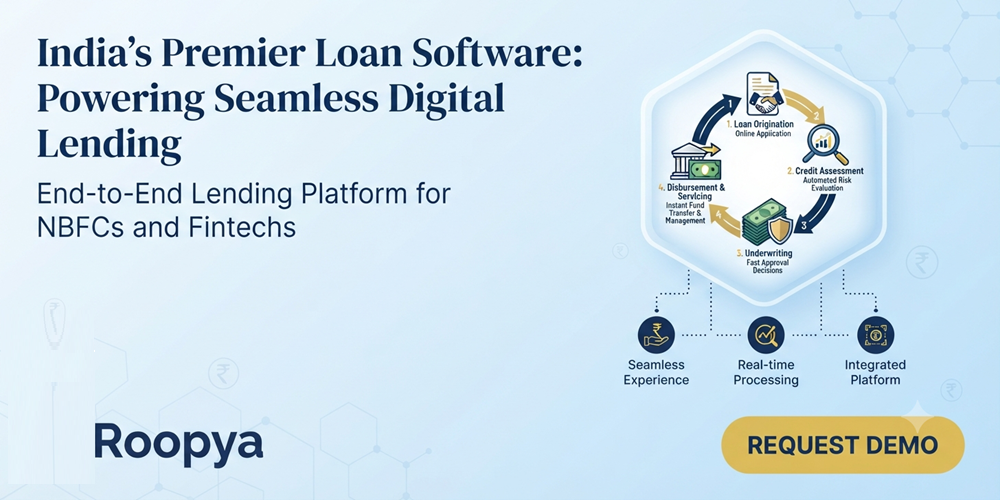
If you are a lender in India — an NBFC, a bank, an MFI, or a fintech startup — chances are you have asked yourself some version of this question at least once: How do I make lending faster, fairer, and less frustrating for the people I serve?
That question sits at the heart of what good loan software in India is supposed to do. Not just automate processes. Not just cut costs. But genuinely make the lending experience better — for the borrower who needs money quickly, for the credit officer who wants to make consistent, fair decisions, and for the institution that wants to grow without losing its soul.
This guide is written for lenders who care about getting it right. It covers what loan software actually does, why it matters in the Indian context, what to look for when choosing a platform, and how a purpose-built solution like Roopya is helping lenders across the country serve borrowers better, faster, and more responsibly.
1. Why Loan Software Matters More Than Ever in India
India's credit gap is one of the most discussed — and least solved — problems in its financial sector. Hundreds of millions of Indians remain underserved or completely excluded from formal credit. Small business owners cannot access working capital. First-time borrowers lack credit histories. Rural households rely on moneylenders charging punishing interest rates because formal institutions cannot reach them efficiently.
The good news is that technology has dramatically changed what is possible. Loan software — when designed thoughtfully — is not just a productivity tool for lenders. It is infrastructure for financial inclusion. A well-built digital lending platform can evaluate a thin-file borrower using alternative data, complete KYC without requiring a branch visit, and disburse a loan to a mobile wallet in a fraction of the time it once took to process a paper application.
At the same time, the rise of digital lending has also brought risks: predatory practices, opaque pricing, aggressive collections, and data misuse. This is exactly why the RBI has strengthened its digital lending guidelines — and why choosing loan software that is built around the borrower's best interests, not just the lender's bottom line, is such an important decision.
2. What Is Loan Software? (A Plain-Language Explanation)
Loan software is the technology platform that manages a lender's core operations — from the moment a borrower expresses interest in a loan to the moment the loan is fully repaid. In practice, modern loan software in India typically covers three interconnected areas:
Loan Origination (Getting the Loan Started)
This is the first stage — capturing the borrower's application, verifying their identity through digital KYC (Aadhaar eKYC, PAN check, Digilocker), pulling their credit bureau report from CIBIL, Experian or CRIF, and analysing their financial documents (bank statements, salary slips, GST returns) to assess creditworthiness. Good origination software does this in minutes, not days, and does it consistently for every single applicant — so a first-generation entrepreneur in Ranchi gets the same fair assessment as a salaried professional in Mumbai.
Credit Decisioning (Making a Fair, Informed Call)
Once the data is in, the platform applies the lender's credit policy — through a rules-based Business Rule Engine (BRE) — to reach a decision. Modern platforms like Roopya allow lenders to configure complex, multi-variable credit policies without writing code. This means credit teams can set and adjust their policies directly, and every decision is documented, auditable, and consistent. No human bias. No undocumented overrides.
Loan Management and Collections (Serving the Borrower After Disbursal)
The relationship does not end at disbursal. A complete loan management system tracks repayments, sends proactive reminders, manages EMI schedules, handles prepayments and foreclosures, and — when necessary — manages collections in a manner that is respectful and compliant with RBI's fair practice guidelines. Good collections software focuses on helping borrowers resolve difficulties, not on harassing them.
3. The Indian Lending Context: Why Generic Software Often Falls Short
India's lending landscape has characteristics that make it genuinely different from other markets — and that make it critical to choose loan software built specifically for India, rather than adapting a foreign platform.
• Regulatory complexity: India's lending regulations — RBI guidelines, PMLA, CERSAI, SARFAESI, credit bureau reporting norms — form a detailed and constantly evolving framework. Loan software must be continuously updated for compliance, and the compliance burden must be manageable for mid-size NBFCs that do not have large legal teams.
• Data infrastructure: India has world-class digital identity infrastructure (Aadhaar, DigiLocker, GSTN, Account Aggregator) but access is through specific APIs that require local integration. A loan platform built for India will have these pre-integrated, saving months of development work.
• Borrower diversity: India's borrowers span salaried urban professionals, self-employed traders, agricultural households, gig workers, and first-generation entrepreneurs — each with different income patterns, documentation norms, and financial behaviours. Software that only handles clean, formal income documentation will miss a huge proportion of creditworthy borrowers.
• Language and connectivity: For software used by field agents or by borrowers directly in Tier 2 and Tier 3 markets, language support and low-bandwidth performance are not optional extras — they are essential.
• Channel diversity: Indian lending happens through branches, DSAs, digital apps, embedded finance partnerships, and co-lending arrangements. Software that handles only one channel creates operational silos.
Roopya was built from the ground up in and for India. Every integration, every workflow, every compliance feature reflects the realities of lending in this market — not an approximation of it.
4. Key Features to Look for in Loan Software in India
4.1 Truly Digital, End-to-End Application Journey
The best loan software offers a seamless digital journey — from the application form to KYC to document upload to credit decision to digital agreement signing — without requiring the borrower to visit a branch or interact with a person unless they want to. This matters for speed, for reach, and for the borrower's experience. Roopya supports 20+ pre-configured loan product journeys that lenders can deploy on day one.
4.2 Pre-Integrated APIs for India's Digital Infrastructure
Look for a platform that comes with ready integrations for Aadhaar eKYC, PAN verification, NSDL, Digilocker, VKYC, all four major credit bureaus (CIBIL, Experian, Equifax, CRIF), GSTN, Account Aggregator, banking APIs, and eSign platforms. Roopya's platform comes with 300+ pre-built integrations — meaning lenders do not spend months (and lakhs of rupees) on custom API development before they can process a single application.
4.3 AI-Powered Document Analysis
Manual document review — checking bank statements for average monthly balance, verifying salary slips, assessing GST returns for business health — is slow, expensive, and inconsistent. AI-powered OCR and NLP can do this in seconds, with accuracy exceeding 99%, and can flag anomalies (overwritten figures, mismatched data, fraud indicators) that human reviewers often miss. This protects the lender from bad loans while ensuring creditworthy borrowers are not unfairly rejected due to processing errors.
4.4 No-Code Configuration for Credit Teams
Credit policy changes should be made by credit professionals, not software engineers. The best loan software in India gives risk and credit teams an intuitive visual interface to configure decisioning rules, eligibility criteria, pricing bands, and workflow steps — without raising a single IT ticket. This is not a luxury; it is how lenders stay agile in a market where credit conditions and borrower profiles evolve constantly.
4.5 Responsible Collections Management
Collections is where many lenders — and much lending software — fails borrowers. Good collections software is built around the principles of the RBI's Fair Practice Code: proactive communication, flexible restructuring options, respectful engagement, and clear escalation paths. It should also give borrowers self-service options — the ability to view their account, download statements, and request support — without having to call a collections agent.
4.6 Real-Time Regulatory Compliance
RBI guidelines on digital lending, KYC, data localisation, and credit bureau reporting are not static. Your loan software provider must track regulatory changes and update the platform continuously. Roopya's compliance team monitors RBI circulars and guidelines and pushes updates to the platform — so lenders stay compliant without having to manage the compliance calendar themselves.
5. The Human Side of Loan Software: What Borrowers Actually Experience
It is easy to get absorbed in the technical specifications of loan software and forget that at the end of every loan application is a person — often someone who needs money urgently, who may be anxious about their application, and who deserves to be treated with respect.
Here is what borrowers experience on a well-built loan platform — and why it matters:
• Clarity from the start: A good digital application tells borrowers exactly what documents are needed, what the eligibility criteria are, and how long the process will take — before they spend time applying. No nasty surprises.
• Respectful identity verification: Digital KYC through Aadhaar eKYC is faster and less intrusive than producing physical documents at a branch. Borrowers complete it from their phone in under two minutes, on their own terms.
• Transparent decisions: When an application is declined, the software should generate a clear, coded decline reason that the lender can communicate to the borrower. This helps borrowers understand their position and take steps to improve their creditworthiness.
• Fast disbursement: For a borrower in urgent need, the difference between same-day and three-day disbursement is significant. Well-designed loan software, with automated underwriting and straight-through processing, can disburse within hours of approval for clean profiles.
• Dignified collections: If a borrower misses an EMI, proactive, empathetic outreach — a WhatsApp message with a payment link, an offer to discuss a restructuring — is far more effective and far more ethical than aggressive calling.
Roopya's platform reflects these principles at every stage. The borrower experience is not an afterthought — it is part of the product design.
6. Roopya: Loan Software Built for India's Lenders and Borrowers
Roopya is a no-code, cloud-native digital lending infrastructure platform built for NBFCs, banks, MFIs, and fintech lenders in India. It covers the full lending lifecycle — origination, underwriting, disbursement, servicing, and collections — in a single integrated platform.
• 1-Day Go-Live: Pre-configured product journeys, plug-and-play integrations, and a no-code setup mean most lenders can begin processing live applications within 24 hours of onboarding.
• 300+ Pre-Integrated APIs: Every bureau, KYC provider, eSign platform, payment gateway, and accounting tool — all pre-connected and ready to use.
• No-Code for Business Teams: Credit policy, workflows, product parameters, and decisioning rules are all configurable by business users — no developer involvement required.
• AI Throughout: Document analysis, fraud detection, credit scoring, and portfolio analytics — AI is embedded at every stage, not bolted on as an add-on.
• Pay-As-You-Use: Zero upfront licence fees. Lenders pay only for what they process — making Roopya equally accessible to a newly licensed NBFC and a large-scale bank.
• RBI-Compliant by Design: Continuous regulatory updates, digital audit trails, consent management, and bureau reporting are built into the platform as standard features.
• Trusted by Indian Lenders: IndiaKaLoan, QuickFinShop, Recapita, Findoc, EazyCredit and others run their lending operations on Roopya.
If you want to build a lending operation that is fast, fair, and genuinely serves the people you lend to, Roopya is the platform designed for that purpose. Explore a free demo at roopya.money.