September 09, 2026
AI-Powered Loan Origination Software: The Future of Digital Lending
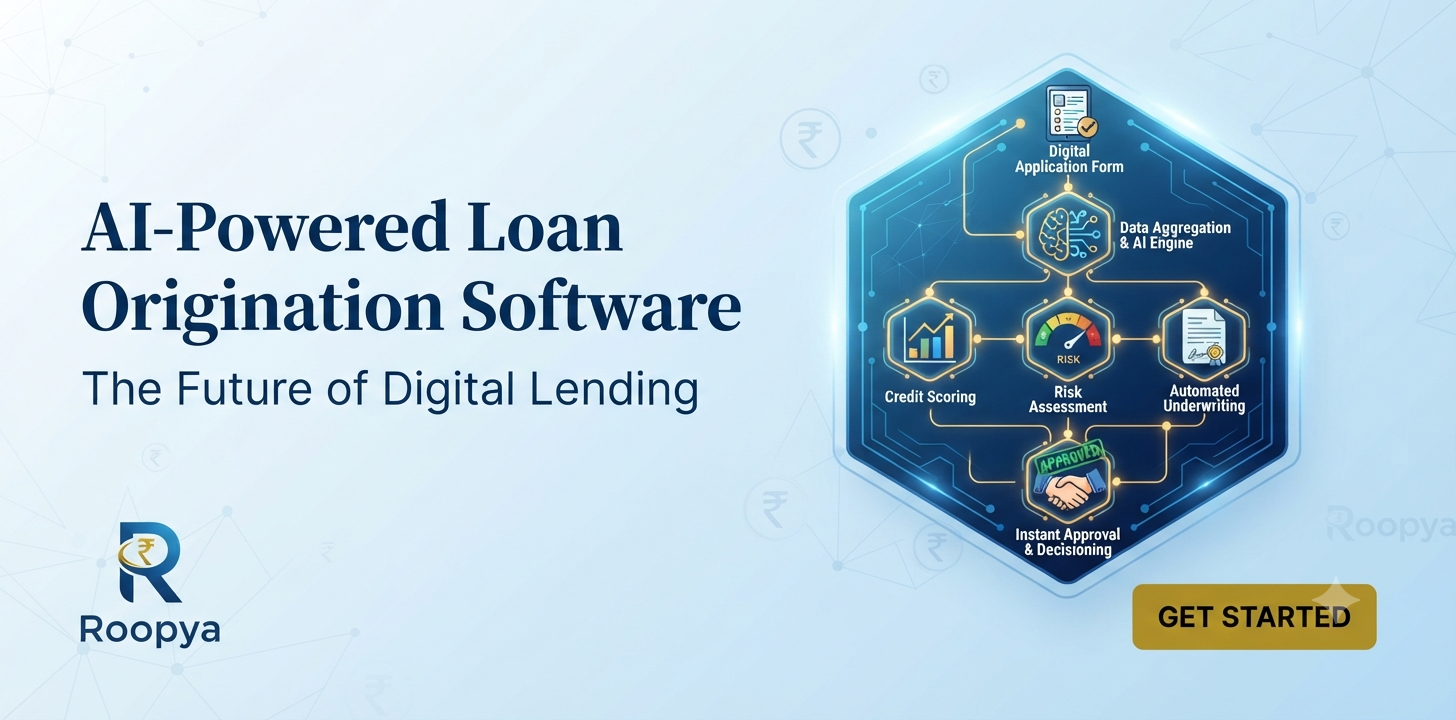
Loan origination has always been the most operationally demanding stretch of the lending lifecycle. It is where paperwork piles up, where applications stall in email inboxes, where underwriters manually re-key numbers from bank statements, and where a genuinely creditworthy borrower can be lost simply because the process took too long. For decades, banks and non-banking financial companies (NBFCs) treated this friction as an unavoidable cost of doing business. That assumption is no longer holding.
Artificial intelligence has moved from being a buzzword in lending conferences to becoming the operational backbone of modern loan origination systems (LOS). What used to take five to ten business days for a standard commercial loan can now be compressed into a same-day or next-day decision. Document verification that once required a back-office team now happens through automated extraction and validation. Credit assessment that relied solely on bureau scores now draws on a much richer, more current picture of a borrower’s financial behaviour. This is not a marginal improvement. It is a structural shift in how lending institutions originate, underwrite, and disburse credit.
This article looks at what AI-powered loan origination software actually does, why traditional origination workflows are struggling to keep pace with borrower expectations and regulatory scrutiny, and what banks and NBFCs should look for as they evaluate and adopt these systems. It also outlines how a modern, configurable loan management platform such as Roopya.money fits into this shift, and what a realistic path to adoption looks like for an institution that is still running on legacy infrastructure.
What Is Loan Origination Software?
Loan origination software is the technology platform that carries a loan application from first inquiry through approval, documentation, and disbursal. It typically covers application intake, applicant identity verification (KYC), document collection and validation, credit bureau checks, underwriting and scoring, approval workflows, sanction letter generation, and handoff to the loan management and servicing system once the loan is disbursed.
In a traditional setup, most of these steps involve a human at every checkpoint: an operations executive reviewing a scanned Aadhaar card, an underwriter manually calculating debt-to-income ratios from a PDF bank statement, a credit manager cross-checking bureau data against a spreadsheet. Each handoff adds time, introduces the possibility of error, and creates a queue. AI-powered loan origination software does not remove human judgement from the process — it removes the repetitive, rules-based work that does not actually need a human, and it gives the humans who remain in the loop far better information to make faster, more consistent decisions.
Why Traditional Loan Origination Is Falling Behind
Borrower expectations have shifted dramatically in the past few years. Someone who can open a savings account, book a flight, or apply for a credit card in under ten minutes on their phone does not have much patience for a loan process that asks them to email scanned documents and wait a week for a callback. Lenders that still rely on manual, paper-heavy origination face several compounding problems.
- Slow turnaround times push qualified borrowers toward competitors who can approve and disburse faster.
- Manual data entry from documents and bureau reports is a major source of underwriting error and inconsistent decisioning across branches or loan officers.
- Bureau-only credit scoring excludes large segments of new-to-credit and thin-file borrowers who may otherwise be perfectly capable of repaying a loan.
- Fraud is harder to catch when identity, income, and document checks happen in silos rather than being cross-verified in real time.
- Compliance and audit trails become difficult to maintain when decisions are made informally or recorded inconsistently across teams.
- Operational costs scale roughly linearly with loan volume, because more applications simply mean more manual hours, which caps how fast a lender can grow without proportionally growing headcount.
None of these problems are new. What has changed is that AI now offers a genuinely mature, deployable answer to each of them — not a lab experiment, but production software that banks and NBFCs of varying sizes are running today.
Core Capabilities of AI-Powered Loan Origination Software
1. Intelligent Document Processing
Instead of a person opening every PDF and image a borrower uploads, AI-powered systems use optical character recognition combined with machine learning models trained specifically on financial documents — bank statements, salary slips, income tax returns, GST filings, property papers — to extract structured data automatically. The system does not just read text; it understands what it is looking at, flags inconsistencies (a name that does not match across documents, a statement that looks edited, a date that falls outside the expected range), and routes only the genuinely ambiguous cases to a human reviewer.
2. AI-Driven Credit Scoring and Alternative Data
Bureau scores remain an important input, but they are no longer the only one. Modern origination platforms can incorporate alternative data — bank transaction patterns, utility and rent payment history, GST turnover for small businesses, e-commerce or payment gateway data for merchants — to build a fuller picture of repayment capacity. This matters enormously in markets like India, where a large share of potential borrowers, particularly self-employed individuals, gig workers, and small business owners, have thin or no formal credit history. AI models can weigh dozens of signals simultaneously in a way that a manual, rules-based scorecard simply cannot, which widens the pool of borrowers a lender can responsibly serve without loosening underwriting standards.
3. Automated Underwriting and Decisioning
Once data is extracted and scored, configurable rule engines and machine learning models can auto-approve straightforward, low-risk applications, auto-reject applications that clearly fail policy, and route the remaining, more nuanced cases to a credit manager with a pre-built risk summary already prepared. This tiered approach means human underwriters spend their time on the applications that genuinely need judgement, rather than on volume. It also produces far more consistent decisions, since the same policy is applied identically to every application rather than varying by which officer happens to review it.
4. Fraud and Identity Risk Detection
Loan fraud has grown more sophisticated, from doctored income documents to synthetic identities to bust-out schemes that look clean at first application. AI models trained on historical fraud patterns can flag anomalies in real time — document tampering, device and location mismatches, duplicate applications across products, or behavioural patterns associated with past fraud cases — well before disbursal. This is a meaningfully different capability from manual fraud checks, which tend to catch fraud only after the fact, if at all.
5. Borrower Self-Service and Conversational Interfaces
AI-powered origination platforms increasingly let borrowers apply, upload documents, check status, and resolve queries through self-service portals and chat-based assistants, without needing to call a branch or wait for an executive. This reduces the operational load on the lender’s team while giving borrowers the instant, always-available experience they now expect from every other financial service they use.
6. Workflow Automation and Configurability
A modern loan origination system is not a single rigid pipeline. It is built around configurable workflows that a lender’s own team can adjust — different approval chains for a personal loan versus a working capital loan versus a loan against property, different document checklists by product and geography, different escalation rules by ticket size. This configurability is what allows one platform to serve a bank’s retail lending arm and its SME lending arm without needing two separate systems.
7. Integrations Across the Lending Stack
AI-powered origination software rarely operates alone. It needs to talk to credit bureaus, KYC and e-KYC providers, bank statement analysis engines, payment and disbursal rails, core banking systems, and the loan management system that takes over once a loan is live. API-first architecture is what makes this possible, and it is increasingly a baseline expectation rather than a differentiator — lenders want to be able to plug in the best-of-breed tool for each function rather than being locked into a single vendor’s bundled stack.
8. Compliance, Explainability, and Governance
As AI takes on a larger share of underwriting decisions, regulators and internal risk committees are asking harder questions about explainability — why was this application approved, why was that one declined, and can the lender demonstrate the decision was fair and compliant with fair-lending norms. Responsible AI-powered origination platforms build in decision logs, audit trails, and model explainability features from the start, rather than treating them as an afterthought. This is one of the areas where the industry conversation has matured the most: the goal is not opaque, black-box automation, but AI that makes lending faster and more consistent while remaining fully auditable.
Benefits for Banks and NBFCs
The case for AI-powered loan origination software ultimately comes down to a small number of measurable outcomes that matter to every lending business, regardless of size or product focus.
- Faster turnaround times: applications that took days can move to hours, which directly improves conversion because fewer borrowers abandon the process or take a competing offer.
- Lower cost per loan: automating document review, data entry, and first-pass underwriting reduces the manual hours needed per application, which matters most at scale.
- Better risk assessment: combining bureau data with alternative data and machine learning models generally produces more accurate risk segmentation than rules-based scorecards alone.
- Reduced fraud losses: real-time anomaly detection catches problems before disbursal rather than during collections.
- Higher approval rates without higher risk: a richer data picture lets lenders say yes to more creditworthy borrowers who would have been declined under a bureau-only policy.
- Improved borrower experience: self-service, faster decisions, and transparent status tracking build the kind of experience that drives repeat business and referrals.
- Scalability without proportional headcount growth: automated workflows let a lending team handle significantly more volume without a matching increase in operations staff.
- Stronger compliance posture: built-in audit trails and explainability features make regulatory reporting and internal audits considerably less painful.
AI-Powered Origination vs. Traditional Origination
The contrast becomes clearest when the two approaches are placed side by side. Traditional origination is document-heavy and manual, with data entered by hand from physical or scanned paperwork; decisions rely primarily on bureau scores and a fixed set of policy rules; fraud is typically caught during collections rather than at the point of application; turnaround for a standard loan often runs from several days to a couple of weeks; and reporting for compliance is assembled after the fact from disparate systems.
AI-powered origination automates document extraction and validation; blends bureau data with alternative and behavioural data for a more complete risk picture; flags fraud indicators in real time, before funds move; compresses turnaround to hours or, for simple products, minutes; and maintains a continuous, queryable audit trail as decisions are made rather than reconstructing one later. The difference is not just speed — it is a fundamentally more defensible and scalable way of running a lending operation.
Where the Industry Is Heading: Agentic AI and Connected Lending
The next stage of this shift, already visible in how leading platforms are being built, goes beyond automating individual steps toward agentic workflows — AI systems that can carry out a multi-step task end to end, such as pulling a borrower’s bank statements, spreading the financials, checking covenant thresholds, and preparing a credit memo, with a human reviewing the output rather than assembling it. Lenders are also increasingly treating origination, servicing, and collections as one connected data flow rather than three separate silos: insights from how existing borrowers repay feed back into origination policy, and origination data shapes how collections strategy is built for a given borrower segment. AI is the connective layer that makes this feedback loop practical instead of theoretical.
For lenders evaluating new technology, the direction of travel is unambiguous. AI in loan origination is no longer an experimental add-on; it is becoming core infrastructure, in the same way that core banking systems became core infrastructure a generation ago. The institutions gaining ground are the ones treating it that way — building it into their operating model rather than bolting it onto the side of an existing manual process.
How to Choose an AI-Powered Loan Origination Platform
Not every platform marketed as "AI-powered" delivers the same depth of capability. Banks and NBFCs evaluating vendors should look closely at a specific set of criteria rather than taking the label at face value.
- Configurability: can your own team adjust workflows, document checklists, and approval chains per product without needing a developer for every change?
- Depth of AI capability: is the AI limited to basic OCR, or does it extend to credit scoring, fraud detection, and decisioning?
- Data and integration breadth: does the platform connect to the bureaus, KYC providers, and bank-statement analysis tools relevant to your market, and does it expose clean APIs for your own stack?
- Explainability and audit trail: can you show a regulator or an internal auditor exactly why a specific decision was made?
- Security and data residency: does the platform meet the data protection and localisation requirements that apply to your institution?
- Scalability: has the platform been proven at loan volumes comparable to, or larger than, what you expect to handle?
- Total cost of ownership: beyond the licence fee, what does implementation, integration, and ongoing support actually cost over a three-year horizon?
- Vendor track record with banks and NBFCs specifically: general-purpose workflow tools are not the same as lending-specific platforms built around regulatory and credit realities.
Regulatory Considerations for Indian Lenders
For banks and NBFCs operating in India, AI adoption in origination cannot be separated from the regulatory framework the Reserve Bank of India has built around digital lending. Guidelines around outsourcing, data privacy, and the use of lending service providers all shape how much of the origination journey can be automated and where a regulated entity retains direct accountability. Borrower consent for data usage, clear disclosure of key facts about a loan before it is accepted, and a documented grievance redressal mechanism are not optional extras — they are baseline requirements that any AI-powered origination workflow has to be built around, not bolted onto afterwards.
This is precisely why explainability matters as much as speed. A model that approves or declines an application without a traceable rationale creates regulatory exposure, even if its predictions are statistically sound. Lenders should expect their origination platform to log the specific data points and rules or model outputs behind every decision, retain that record for the periods regulators require, and make it retrievable quickly during an audit or a customer grievance. Institutions that build this discipline into their AI adoption from the outset find compliance reviews considerably less disruptive than those that try to retrofit it later.
Common Misconceptions About AI in Loan Origination
A few misconceptions tend to slow down otherwise sound AI adoption decisions, and it is worth addressing them directly.
- "AI replaces underwriters." In practice, AI removes repetitive data-gathering and first-pass screening, freeing underwriters to focus on borderline cases, larger exposures, and relationship-based lending where human judgement genuinely adds value.
- "AI models are black boxes regulators will never accept." Modern platforms are built with explainability and audit logging as core features, not afterthoughts, specifically so lenders can defend every decision.
- "This is only for large banks with big technology budgets." Cloud-native, API-first platforms have brought the cost of entry down substantially, making AI-powered origination accessible to mid-sized NBFCs and growing digital lenders, not just the largest banks.
- "Alternative data is unreliable or risky to use." Used correctly and within regulatory bounds, alternative data does not replace bureau data — it supplements it, and typically improves risk segmentation rather than weakening it.
- "Automation means losing control over lending policy." Configurable rule engines mean the lender’s credit policy still drives every decision; automation simply enforces that policy consistently instead of leaving it to individual interpretation.
Measuring the Return on an AI-Powered Origination Investment
Lending institutions evaluating this shift should treat it as a measurable investment rather than a technology upgrade taken on faith. The clearest way to build a business case is to track a small set of metrics before and after implementation: average time from application to decision, cost per loan originated, approval rate at a constant risk threshold, early-delinquency rate on loans originated through the new workflow versus the old one, and the proportion of applications resolved without any manual intervention. Institutions that run a focused pilot on one product line typically have enough data within one or two quarters to see clear movement on these numbers, which then makes the case for a broader rollout largely self-evident rather than a matter of internal debate.
Roopya.money: Purpose-Built for Modern Lending Operations
Roopya.money is built around exactly this set of priorities. It is a loan management system designed for banks and NBFCs that need origination, underwriting, and servicing workflows they can configure to their own products and policies, rather than reshaping their business to fit a rigid vendor template. The platform brings AI-assisted document processing, configurable underwriting workflows, and integration-ready architecture together so that lending teams can move applications through the pipeline faster, with fewer manual touchpoints and a clear, auditable record of every decision.
For lending institutions weighing whether to modernise their origination stack, the practical question is rarely whether AI-powered origination is worth adopting — the efficiency, risk, and experience gains are well established at this point. The real question is how to get there without disrupting a live lending book. That is where a platform built specifically for banks and NBFCs, with configurability and compliance built in from day one, makes the difference between a smooth transition and a painful one.
A Practical Roadmap to Adoption
Institutions that make this transition successfully tend to follow a broadly similar path, even when their starting point and product mix differ.
- Audit the current origination process end to end, and identify exactly where time and errors accumulate today — this is usually document collection, data entry, and first-pass underwriting.
- Define clear success metrics before evaluating vendors: target turnaround time, target approval rate, acceptable fraud loss rate, and cost per loan.
- Start with a single product line or branch as a pilot, rather than attempting a full-scale cutover, so that workflows and risk models can be tuned against real data before a wider rollout.
- Integrate carefully with existing bureau, KYC, and core banking systems, and validate that data flows accurately in both directions before going live.
- Train underwriting and operations teams on the new workflow, with particular attention to how they should handle the cases the system escalates rather than auto-decides.
- Monitor model performance and fairness on an ongoing basis, not just at launch, and keep a clear audit trail so the institution can explain and defend every automated decision.
- Expand product by product once the pilot has demonstrated its metrics, rather than trying to automate every loan type simultaneously.
AI Origination Across Loan Products
The specific value AI delivers shifts depending on the product. In personal and consumer loans, speed and self-service dominate — borrowers expect a decision in minutes, and automated bureau and bank-statement analysis makes that possible at scale. In SME and working capital lending, the bigger win is alternative data: GST filings, banking turnover, and invoice or payment gateway data let lenders underwrite businesses that a bureau-only model would struggle to score fairly. In loan-against-property and secured lending, AI increasingly assists with document verification and valuation cross-checks rather than replacing the manual legal and technical due diligence those products still require. Recognising that AI is not a single, uniform capability but a set of tools applied differently by product is part of choosing the right platform rather than assuming one configuration fits every loan type an institution offers.
The Road Ahead
Digital lending is not converging toward a single, uniform experience. It is converging toward a standard: fast, data-rich, explainable, and largely self-service, with human expertise concentrated on the decisions that genuinely need it. Lenders that treat AI-powered loan origination as core infrastructure — not a side project — will be the ones able to grow loan books responsibly, serve segments that were previously too costly to underwrite manually, and meet regulatory expectations around fairness and transparency without slowing down. For banks and NBFCs planning their technology roadmap, the shift to AI-powered origination is no longer a question of if, but of how soon, and how well the transition is managed.
AI-powered loan origination software has moved from an emerging trend to an operational necessity for banks and NBFCs that want to compete on speed, cost, and borrower experience without compromising on risk discipline. The technology now exists to automate document processing, enrich credit assessment with alternative data, catch fraud before disbursal, and maintain a fully auditable decision trail — all while giving borrowers the instant, self-service experience they have come to expect. Platforms like Roopya.money bring these capabilities together in a configurable, compliance-ready system built specifically for lending institutions, making it possible to modernise origination without rebuilding a lending operation from scratch. The institutions that move on this now will be the ones setting the pace for digital lending over the next decade.