September 04, 2026
Cloud Loan Management Software India: The Complete Guide for NBFCs, Banks & Modern Lenders
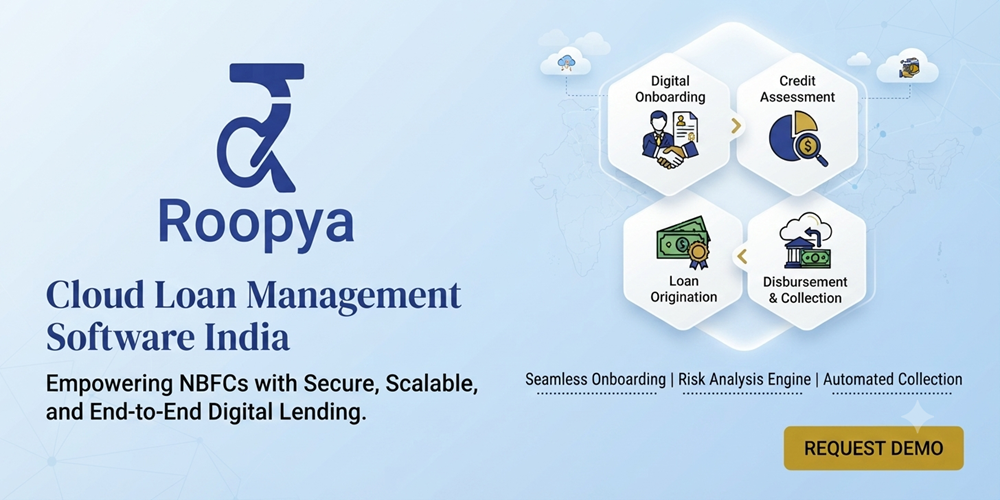
Managing a loan portfolio in India has never been more complex — or more important to get right. Regulatory requirements evolve faster than most compliance teams can keep up with. Borrowers expect digital-first experiences. Collections teams juggle thousands of live accounts simultaneously. Finance teams need real-time portfolio visibility. And through all of this, the technology that most lenders rely on to hold it all together — legacy on-premise software, spreadsheets, or stitched-together point solutions — is failing them.
Cloud loan management software is the answer. Built for the realities of the Indian lending ecosystem, modern cloud-based LMS platforms give NBFCs, banks, MFIs, and fintech lenders a single, intelligent, scalable system to manage the complete loan lifecycle — from disbursement through repayment, collections, and closure — with real-time data, automated workflows, and built-in regulatory compliance.
This guide is written for lending professionals who want to understand not just what cloud LMS software does, but why it matters for their specific business, what to look for when evaluating options, and how Roopya's platform is helping Indian lenders modernise their operations without disruption or upfront capital expenditure.
1. What Is Cloud Loan Management Software?
Cloud loan management software is a web-based platform that manages the post-disbursement lifecycle of loans — tracking outstanding balances, processing repayments, managing EMI schedules, handling prepayments and foreclosures, managing delinquencies and collections, and generating regulatory and portfolio reports.
Unlike traditional on-premise software — which requires physical servers, IT maintenance staff, lengthy installation cycles, and expensive upgrades — cloud-based loan management systems are delivered entirely over the internet. Lenders access them through a browser or mobile app, pay on a subscription or usage basis, and benefit from automatic updates, elastic scaling, and enterprise-grade security without owning any infrastructure.
The cloud model is not merely a delivery mechanism. It fundamentally changes what the software can do. Real-time data synchronisation across branches and teams. Instant integration with payment gateways, banking APIs, and regulatory systems. AI-driven analytics and early warning signals available at scale. Secure mobile access for collections agents in the field. None of these capabilities are feasible — or affordable — in an on-premise model for most Indian lenders.
Roopya's cloud loan management software is purpose-built for the Indian market — its regulatory requirements, its payment infrastructure (NACH, UPI, IMPS), its diverse borrower base, and the specific operational needs of NBFCs, MFIs, housing finance companies, and digital lenders.
2. The Problem With Legacy Loan Management Systems
Before exploring what cloud LMS software can do, it is worth being specific about why legacy systems are failing Indian lenders — because the pain points are real and widespread.
Inflexibility in the Face of Product and Regulatory Change
The RBI's regulatory posture on digital lending, FLDG arrangements, co-lending structures, and data localisation has evolved substantially over the past three years. Legacy on-premise systems often require months of vendor engagement and significant development cost to accommodate even minor policy changes. This makes compliance a slow, expensive, and reactive process rather than an embedded capability.
Data Silos and Poor Visibility
In many NBFC and MFI operations, loan data sits in a core system, collections data in a different tool, field agent data in spreadsheets, and portfolio analytics in yet another system. This fragmentation means that senior leaders cannot get an accurate, real-time picture of portfolio health, and operational teams spend hours each day reconciling data across systems.
Inability to Scale Efficiently
When a lender grows — either through increased disbursement volumes or geographic expansion — legacy on-premise systems require hardware upgrades, new licences, and IT capacity that scales the cost of the system in proportion to the business. Cloud infrastructure, by contrast, scales automatically and is billed based on usage, keeping the cost-per-loan stable as the portfolio grows.
High Total Cost of Ownership
The true cost of an on-premise loan management system includes hardware, maintenance contracts, IT staff, upgrade projects, and business continuity infrastructure. For most Indian NBFCs and MFIs, this cost is both substantial and largely invisible — buried in IT budgets rather than attributed to the cost of running each loan. Cloud LMS platforms replace this with a transparent, predictable operating cost.
3. Core Features of Cloud Loan Management Software
3.1 Complete Loan Account Management
At its foundation, a cloud LMS manages every loan account across its full lifecycle. This includes maintaining the loan schedule (principal, interest, fees), tracking real-time outstanding balances, processing every type of repayment event (standard EMI, prepayment, part-prepayment, waiver, write-off), managing restructured loans, and maintaining a complete transaction history. Roopya's cloud loan management platform handles all of this for multiple loan products simultaneously — personal loans, business loans, gold loans, microfinance, home loans — from a single account management interface.
3.2 Automated Repayment Processing (NACH, UPI, and More)
Manual repayment processing is one of the most resource-intensive operations in a lending business. Cloud LMS software integrates directly with India's payment infrastructure — NACH mandates, UPI AutoPay, IMPS, NEFT, and physical cash collection workflows — to automate repayment reconciliation. Payments are matched to loan accounts in real time, EMI records are updated automatically, and exceptions are flagged for human review rather than requiring end-to-end manual processing. Roopya comes pre-integrated with all major payment service providers and banking APIs, removing the need for custom reconciliation workflows.
3.3 Collections and Delinquency Management
Collections is where portfolio quality is won or lost. A cloud-based LMS provides a dedicated collections module that automatically identifies and buckets overdue accounts (DPD 1-30, 31-60, 61-90, SMA classifications), generates collections queues for agents and telecallers, tracks every borrower interaction, manages payment commitments and follow-ups, and records resolutions. Field collection apps — running on Android smartphones — connect to the cloud LMS in real time, giving field agents their daily queue, enabling cash collection receipts, and updating account status the moment a payment is made. Roopya's collections module includes AI-driven prioritisation, identifying which accounts are most likely to resolve with intervention and routing them to the right agent at the right time.
3.4 Configurable Loan Products and Pricing
Indian lenders often operate multiple loan products simultaneously — each with different interest calculation methods (flat rate, reducing balance, daily reducing), fee structures (processing fees, insurance premiums, prepayment penalties), and repayment schedules (monthly, weekly, bullet, balloon). A flexible cloud LMS must accommodate this product diversity without requiring custom development for each product type. Roopya's no-code product configuration engine lets operations teams define and launch new loan products — with all their pricing and scheduling rules — without IT involvement.
3.5 Real-Time Portfolio Dashboard and Analytics
Portfolio visibility is a fundamental capability that legacy systems rarely provide well. A modern cloud loan management system offers a real-time dashboard showing total assets under management (AUM), EMI collection rates, delinquency rates by bucket, geographic performance, product-level portfolio quality, and collections efficiency — all updated in real time and accessible from any device. Roopya's analytics layer goes further, providing AI-driven early warning signals that identify accounts at elevated risk of default before they become delinquent, allowing proactive intervention.
3.6 Regulatory Compliance and Automated Reporting
Compliance reporting for RBI, credit bureaus (CIBIL, Experian, CRIF, Equifax), and CERSAI is a significant operational burden for Indian lenders. Cloud loan management software can automate the generation of bureau reporting files, CERSAI charge filings, NPA classification, provisioning calculations, and RBI supervisory returns — dramatically reducing the manual effort involved and the risk of errors or delays. Roopya's compliance module is continuously updated to reflect current RBI requirements, meaning regulatory changes are absorbed at the platform level rather than requiring individual lender intervention.
3.7 Escrow and Trust Account Management
For co-lending arrangements, securitisation vehicles, and pool management structures, cloud LMS software must manage escrow accounts and waterfall distributions accurately. This is a growing requirement as co-lending between banks and NBFCs becomes more common under the RBI's co-lending model. Roopya supports co-lending account structures natively, with partner-level reporting and automated fund flow management.
3.8 Multi-Branch and Multi-Entity Support
Large NBFCs and MFIs operate across dozens or hundreds of branches and sometimes across multiple legal entities. A cloud-based LMS must maintain branch-level data segregation while providing consolidated portfolio views at the entity and group level. Roopya's multi-tenancy architecture supports this natively — each branch or entity operates independently within a shared platform, with role-based access control ensuring appropriate data visibility at every level.
3.9 Customer Self-Service Portal
Modern borrowers expect to be able to check their outstanding balance, download their repayment schedule, make payments, and request foreclosure without calling a customer service representative. A cloud LMS with an integrated borrower portal reduces inbound service calls, improves borrower satisfaction, and accelerates payment collection. Roopya provides a white-labelled borrower portal that lenders can brand and deploy as their own — giving borrowers a professional digital experience without requiring lenders to build their own application.
3.10 Open API Architecture for Integration
No lending operation is an island. A cloud loan management system must integrate with accounting software (Tally, SAP, Zoho Books), CRM systems, loan origination systems, credit bureau interfaces, and business intelligence tools. Roopya's open API architecture supports bidirectional integration with all major enterprise systems, and its 300+ pre-built connectors mean that most integrations require configuration rather than development.
4. Why Cloud-Based Is Better Than On-Premise for Indian Lenders
No Capital Expenditure
Cloud LMS operates on an operating expenditure model. There are no servers to buy, no data centres to maintain, and no large upfront licence fees. For growing NBFCs and MFIs, this is transformative — technology investment scales with revenue rather than requiring it upfront.
Always Up-to-Date
When RBI issues new guidelines, a cloud LMS provider updates the platform for all customers simultaneously. On-premise customers, by contrast, must wait for a new release, plan an upgrade project, and absorb the associated cost and disruption. Cloud means compliance is always current.
Superior Security and Business Continuity
Enterprise cloud infrastructure — with data encrypted at rest and in transit, multi-zone redundancy, automated backups, and SOC 2 compliance — provides a level of security and resilience that most NBFCs and MFIs cannot match with their own on-premise infrastructure. Data is stored in RBI-compliant, India-based data centres.
Anywhere, Anytime Access
Collections agents in the field, branch managers in Tier 3 towns, and the CFO in the corporate office all access the same real-time data through a browser or mobile app. This is not possible with on-premise systems, which are typically accessible only within the office network.
Elastic Scaling
A seasonal surge in loan disbursements — during festive seasons or agricultural cycles — creates a corresponding surge in repayment and collections activity. Cloud infrastructure handles this automatically, scaling compute capacity as needed without any action from the lender.
5. Who Benefits Most From Cloud Loan Management Software in India?
- NBFCs (Non-Banking Financial Companies): Regulatory compliance, multi-product portfolio management, and co-lending support are all critical — and all handled by a modern cloud LMS.
- Microfinance Institutions (MFIs): Group lending structures, JLG management, weekly repayment cycles, and field collection workflows all require specialised LMS capabilities that Roopya provides natively.
- Housing Finance Companies (HFCs): Long-tenor loan management, tranche disbursement tracking, and property charge management are built into Roopya's HFC module.
- Digital Lenders and Fintechs: API-first architecture, real-time processing, and embedded finance support are table stakes for digital lending businesses — and core features of Roopya's platform.
- Co-operative Credit Societies: Membership-linked loan management, dividend accounting integration, and multi-branch operations are supported out of the box.
- Banks (Regional and Small Finance): Core banking system integration, regulatory reporting, and SARFAESI compliance workflows are all available within Roopya's cloud LMS.
6. How Roopya's Cloud Loan Management Software Works
Roopya is a no-code, cloud-native lending infrastructure platform built specifically for Indian financial institutions. Here is what makes it different:
- 1-Day Go-Live: Pre-configured product templates and plug-and-play integrations mean lenders can go live on Roopya in 24 hours — not six months.
- No-Code Configuration: Operations and compliance teams can configure loan products, repayment rules, collections workflows, and reporting parameters without developer involvement. Credit policy changes are applied in minutes.
- 300+ Pre-Integrated APIs: Every major payment gateway, credit bureau, KYC provider, eSign platform, accounting tool, and banking API is already connected. No custom integration development required.
- AI-Powered Throughout: Portfolio analytics, delinquency prediction, collections prioritisation, and document processing are all AI-driven — improving decision quality and operational efficiency simultaneously.
- Pay-As-You-Use Pricing: Zero upfront costs. Lenders pay based on portfolio size or transaction volume, making Roopya equally accessible at every stage of growth.
- India-First Compliance: Built for RBI, PMLA, CERSAI, and credit bureau requirements. Always updated. Always compliant.
- Trusted by India's Leading Lenders: IndiaKaLoan, QuickFinShop, Recapita, Findoc, EazyCredit and other growing lenders manage their portfolios on Roopya.
7. The Real Cost of Delay: Why Modernisation Cannot Wait
Every month a lending business operates on legacy loan management software, the gap widens. Competitors with modern cloud infrastructure are processing applications faster, collecting more efficiently, spotting delinquency earlier, and scaling at lower cost. The cost of inaction is not zero — it is the compounding of operational inefficiency, compliance risk, and missed growth opportunity.
The good news is that migrating to cloud loan management software no longer requires a painful, lengthy transformation project. Roopya's implementation approach is designed around minimal disruption — data migration tools, parallel-run capability, and dedicated onboarding support mean that lenders can transition from legacy systems to Roopya's platform in days, not months.
Whether you are a newly licensed NBFC building your operations from scratch, or an established lender looking to replace aging on-premise software, Roopya's cloud LMS is designed to meet you where you are — and take your operations where you need to go.
8. Choosing Cloud Loan Management Software: What to Evaluate
- Is it purpose-built for Indian regulations, or adapted from a global product? Indian-specific compliance — RBI, CERSAI, bureau formats — requires deep, native expertise, not a localisation layer.
- How fast can you go live? Months-long implementations are a red flag. Modern cloud LMS platforms should be operable within days.
- Is configuration truly no-code? If every product or policy change requires a developer, the cost and speed advantage of cloud is negated.
- What integrations are pre-built? Payment gateways, bureaus, KYC, and accounting — all should be available without custom development.
- How is data security handled? Verify encryption standards, data residency (India-based data centres), access controls, and audit logging.
- What does the pricing model look like? Avoid platforms with large upfront fees or opaque pricing. Pay-as-you-use models align the vendor's interests with your success.
- Is there a mobile-first collections capability? Field collection for NBFCs and MFIs requires a robust, offline-capable mobile application, not just a responsive website.
- What reporting and analytics are included? Real-time dashboards, AI-driven early warning, and regulatory reporting should be standard — not expensive add-ons.