September 18, 2026
Loan Management Software for Cooperative Banks: The Complete Guide
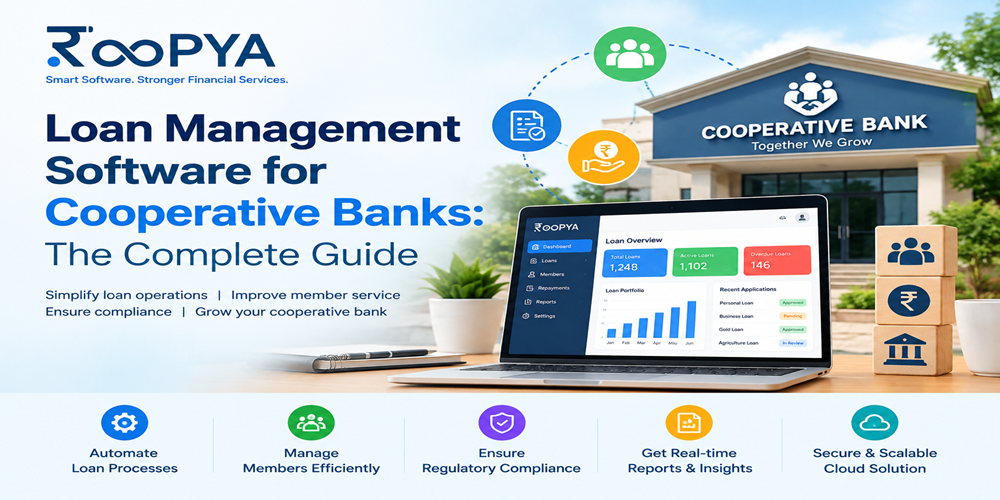
Cooperative banks occupy a unique place in India's financial system. They are member-owned, deeply rooted in local communities, and often the first point of contact for credit in semi-urban and rural India. Yet most cooperative banks still run their lending operations on a patchwork of spreadsheets, legacy core banking add-ons, and manual registers. The result is slow loan turnaround, poor visibility into overdue accounts, and mounting pressure to meet RBI's tightening regulatory expectations.
Loan management software built specifically for cooperative banks solves this gap. It brings origination, servicing, collections, and regulatory reporting onto a single digital platform, without requiring the bank to rip out its existing core banking system or hire a large technology team. This guide explains what such software does, why generic banking tools fall short for cooperative banks, the features that actually matter, and how a modern, no-code platform like Roopya helps cooperative banks modernise lending without the cost and delay of a traditional core banking overhaul.
What Is Loan Management Software for Cooperative Banks?
Loan Management Software (LMS) is a digital system that manages a loan's entire lifecycle after it has been sanctioned, and increasingly, from the moment an application is first submitted. For a cooperative bank, this typically covers member and loan application intake, credit appraisal, sanction and disbursement, EMI scheduling and interest accrual, collections and recovery, non-performing asset (NPA) tracking, and the statutory reports that RBI, NABARD, and Registrar of Cooperative Societies require.
Unlike a generic loan tracking spreadsheet, purpose-built LMS software automates calculations, sends payment reminders without manual follow-up, flags accounts before they slip into overdue status, and produces audit-ready reports at the click of a button. For cooperative banks specifically, the software also needs to reflect how these institutions actually operate: multiple loan products with different member eligibility rules, share-linked lending, jewel loans, agricultural loans with seasonal repayment cycles, and a branch network that may not always have reliable internet connectivity.
Why Cooperative Banks Need Purpose-Built LMS, Not Generic Banking Software
Many cooperative banks are tempted to either continue with manual processes or bolt a generic retail-lending module onto their existing core banking system. Both approaches create friction over time.
Generic commercial lending software is usually designed for NBFCs or private banks with large IT teams, high loan volumes of a few standardised products, and urban customer bases with high digital literacy. Cooperative banks operate differently. They serve members who may prefer assisted, in-branch service. They lend against gold, land, crops, and shares in addition to standard personal and business loans. Their compliance calendar includes cooperative-specific filings alongside RBI's prudential norms, since RBI took over direct regulatory supervision of the sector's banking functions following the Banking Regulation (Amendment) Act, 2020.
A cooperative-bank-ready LMS is configured out of the box for this reality: multiple product types, flexible collateral handling, vernacular language support for member communication, and reporting formats that match what examiners and auditors actually ask for. This purpose-built fit is what separates a system that gets adopted from one that ends up abandoned six months after go-live because it didn't match how the bank actually lends.
The State of Digital Lending in India's Cooperative Banking Sector
India has more than 1,500 urban cooperative banks and tens of thousands of rural cooperative credit institutions, together serving a member base that runs into tens of millions and holds a meaningful share of retail deposits and priority-sector lending in the country. For decades, this scale was managed with paper ledgers, local core banking installations, and staff judgment built up over years of relationship banking.
That model is under real pressure. Since the Banking Regulation (Amendment) Act, 2020 brought urban cooperative banks more directly under RBI's banking supervision, the sector has had to move toward the same asset-classification discipline, capital adequacy tracking, and reporting cadence expected of commercial banks, while operating with a fraction of their technology budgets. At the same time, members increasingly expect the same digital convenience they get from NBFCs and fintech lenders — quick sanction decisions, SMS and WhatsApp updates, and the ability to check a loan balance without visiting a branch.
This combination — tighter regulation on one side and rising member expectations on the other — is why loan management software has moved from a "nice to have" for large urban cooperative banks to a practical necessity for cooperative banks and credit societies of almost every size.
Key Challenges Cooperative Banks Face Today
Before evaluating any software, it helps to be clear-eyed about the problems it needs to solve.
Tightening regulatory oversight. Since RBI assumed direct supervisory control over cooperative banks' banking operations, compliance expectations around asset classification, provisioning, and reporting have moved much closer to those of commercial banks. Manual NPA tracking and quarter-end scramble for reports are no longer sustainable.
Rising NPA stress and weak early-warning capability. Without systems that track days-past-due in real time and flag stressed accounts early, recovery teams often find out about a defaulting account only after it has aged well past the point where intervention is effective.
Manual, paper-heavy processes. Loan applications, sanction notes, and repayment registers maintained on paper or in disconnected spreadsheets slow down every stage of the loan lifecycle and make audits painful.
Limited IT budgets and technical staff. Most cooperative banks cannot justify a multi-year, multi-crore core banking transformation project, nor do they have in-house developers to maintain custom software.
Fragmented member data. Because deposits, shares, and loans are frequently tracked separately, banks lose the ability to get a single view of a member's total relationship with the institution, which weakens credit decisions.
Reach into low-connectivity areas. Branches in rural and semi-urban locations need software that performs reliably even with patchy internet, and that supports the regional languages members are comfortable with.
Fraud and data security gaps. Manual verification processes are more vulnerable to forged documents, duplicate loans, and identity fraud than systems with automated, API-based verification.
Disconnected member communication. Without automated SMS, email, or WhatsApp reminders, follow-up on due EMIs falls entirely on branch staff making individual calls, which doesn't scale as the loan book grows.
Difficulty benchmarking branch performance. When each branch maintains its own registers, head office and the board struggle to compare portfolio quality, turnaround time, or collection efficiency across branches in a consistent, timely way.
LOS vs LMS: Understanding the Difference
The terms Loan Origination System (LOS) and Loan Management System (LMS) are often used interchangeably, but they cover different parts of the loan lifecycle, and it's worth being precise about the distinction when evaluating vendors.
A Loan Origination System handles everything from the moment a member applies for a loan up to disbursement: application capture, document collection and verification, credit appraisal, scoring, and the approval workflow. Its job is to get a loan decisioned and sanctioned quickly and consistently.
A Loan Management System takes over from there: it manages the loan for its entire life, including EMI scheduling, interest accrual, payment processing, collections, delinquency management, restructuring, and closure. It is also where NPA classification and most regulatory reporting happen, since these depend on the ongoing repayment history of the account.
Many cooperative banks that start by digitising only origination find that servicing and collections remain manual, which limits the benefit they get from the investment. Platforms like Roopya are built to cover both LOS and LMS functions, along with collections and early-warning modules, on one connected platform, so data captured at origination — income details, collateral, credit score — is still available and useful when the loan is being serviced and collected years later.
Must-Have Features of a Cooperative Bank LMS
Not every "loan software" on the market is built to handle these realities. Here are the capabilities cooperative banks should treat as non-negotiable.
Digital Loan Origination and Onboarding
The system should support multi-channel application capture (branch, web, and mobile), pre-filled digital forms, e-KYC and document upload, and real-time eligibility checks, so members are not asked to submit the same paperwork more than once.
Configurable Loan Products
Cooperative banks rarely offer just one type of loan. The LMS needs a no-code product builder so the bank's own staff can configure interest rates, tenures, processing fees, and eligibility rules for personal loans, gold loans, agricultural loans, SME loans, and share-linked credit, without waiting on a vendor's development team.
Credit Appraisal and Scoring
Integration with credit bureaus (CIBIL, Experian, Equifax, CRIF) combined with a configurable scorecard lets the bank apply consistent, auditable credit policies rather than relying purely on branch-manager discretion, while still allowing a manual underwriting workbench for the judgment calls cooperative lending often requires.
Disbursement and Loan Accounting
Once sanctioned, the system should automatically generate amortization schedules, handle interest accrual correctly for the loan type (including seasonal or bullet repayment structures common in agricultural lending), and post disbursement entries in a way that reconciles with the core banking ledger.
EMI, Repayment, and Collections Management
Automated EMI scheduling, NACH/eNACH mandate management, multi-channel reminders (SMS, WhatsApp, email), a collections workflow with bucket-wise agent assignment, and payment-promise tracking all reduce the manual effort collections teams currently spend on follow-up calls and registers.
NPA and Early Warning Systems
Real-time DPD (days-past-due) tracking, automated asset classification in line with RBI norms, provisioning calculations, and predictive early-warning indicators let the bank intervene before an account becomes a written-off loss rather than after.
Regulatory and Statutory Reporting
Pre-built templates for RBI reporting (NPA statements, ALM, CRR/SLR returns), credit bureau reporting, and audit trails save the finance and compliance teams from rebuilding the same reports manually every quarter.
Member and Share Management
Because cooperative banking is member-based, the LMS should ideally connect a member's loan account with their share and deposit relationship, giving credit and recovery teams a complete picture rather than a fragmented one.
Multi-Branch, Role-Based Access
With branches spread across districts, the system needs role-based permissions, branch-wise dashboards, and centralized oversight so head office can monitor every branch's portfolio without waiting for manual consolidation.
Analytics and Dashboards
Real-time dashboards for portfolio quality, collection efficiency, vintage analysis, and approval/rejection trends turn scattered data into decisions the board and management committee can act on.
Integration Ecosystem
Pre-integrated connections to payment gateways, KYC providers (DigiLocker, UIDAI), core banking systems, and accounting software (Tally, SAP) mean the bank isn't stuck building custom integrations from scratch.
Data Security and Compliance
ISO 27001-aligned infrastructure, encryption at rest and in transit, role-based access control, and regular security audits are essential given the sensitivity of member financial data.
Mobile and Vernacular Access
Field and branch staff in semi-urban and rural locations need a system that works reliably on modest mobile data connections and supports regional languages for both staff workflows and member-facing communication such as SMS and WhatsApp reminders. A platform that only works well on a fast office broadband connection quickly becomes a system that field staff route around rather than use.
Member Self-Service Portal
A self-service dashboard where members can check their EMI schedule, download statements, raise service requests, and generate a No Objection Certificate reduces the volume of routine queries branch staff handle in person, freeing them to focus on credit appraisal and member relationships instead of paperwork.
Benefits of Implementing LMS in Cooperative Banks
The case for modernising loan operations comes down to a handful of measurable outcomes:
- Faster loan turnaround — digital origination and automated decisioning can cut sanction times from days to hours, which matters when members are comparing the bank's service against a fintech app on their phone.
- Better asset quality — real-time DPD tracking and early-warning signals catch stressed accounts sooner, giving recovery teams a realistic chance to intervene before a loan needs to be written off.
- Lower operating cost — automation of EMI calculations, reminders, and reporting reduces the manual workload on branch and back-office staff, letting a lean team manage a larger loan book.
- Audit-ready compliance — pre-built regulatory reports and complete audit trails reduce the time finance and compliance teams spend preparing for RBI inspections and statutory audits every quarter.
- Stronger member trust — a self-service portal and faster disbursement improve the member experience, which matters for retention in a sector that competes on relationships as much as on rates.
- Scalability without heavy IT investment — cloud-native, pay-as-you-use platforms let a bank grow its loan book and branch network without a proportional increase in IT headcount or spend.
- Better decisions at the board level — consolidated, real-time portfolio dashboards give the management committee and board a current picture of asset quality, rather than a snapshot that is weeks old by the time it reaches a meeting.
How Roopya Powers Loan Management for Cooperative Banks
Roopya is a no-code, AI-first, cloud-native lending infrastructure built to take institutions from origination through collections on a single platform. For cooperative banks weighing a modernisation project, several aspects of how Roopya is built are directly relevant.
No-code configuration, not custom development. Roopya's business rule engine and product builder let the bank's own team configure loan products, approval hierarchies, and credit policies through a visual interface, without writing code or depending on a vendor's development queue for every change.
Fast, low-risk go-live. Roopya is designed for sign-up-to-production timelines measured in days rather than the multi-year rollouts associated with core banking replacements — sandbox access within hours, configuration and integration within a few days, and a phased or parallel-run rollout option so the bank's existing operations are never disrupted mid-transition.
Pay-as-you-use pricing. Rather than a large upfront license fee, Roopya's pricing model is built around actual usage, which matters for cooperative banks operating with tighter capital budgets than commercial banks.
300+ pre-integrated APIs. Credit bureaus, KYC and e-KYC providers, payment gateways, and banking APIs are already connected, so the bank doesn't need to negotiate and integrate each one separately.
AI-powered document verification and fraud detection. Automated OCR and document analysis, combined with fraud-detection modules, reduce both the manual verification workload and the risk of forged or duplicate applications slipping through.
Built-in regulatory reporting. NPA, ALM, and CRR/SLR reporting formats are maintained as part of the platform, so the compliance team spends less time reassembling reports manually before every filing.
End-to-end coverage. Origination, servicing, collections, and early-warning modules sit on one platform with a shared data model, so a member's loan status, DPD, and repayment history are consistent everywhere they're viewed, rather than living in separate systems that need manual reconciliation.
Always-updated compliance posture. As regulatory requirements evolve, the platform is maintained centrally, so the bank isn't responsible for tracking and implementing every regulatory change in a self-hosted system.
Implementation Roadmap: What Go-Live Actually Looks Like
A realistic modernisation timeline for a cooperative bank moving to a platform like Roopya looks roughly like this:
Day 1 — Sign-up and account setup. Entity verification, documentation, license and compliance checks, and sandbox provisioning, typically completed within a few hours.
Day 2–3 — Configuration and customisation. Loan product setup (interest rates, tenure, fees), approval workflow configuration, document checklists, credit policy rules, user roles, branding, and communication templates.
Day 3–4 — Integration setup. Payment gateway, credit bureau, banking API, KYC provider, and SMS/email gateway connections, plus accounting system integration where needed.
Day 4–5 — Training and testing. Staff training, end-to-end test loan processing, user acceptance testing, and security assessment.
Day 5–7 — Go-live and support. Production launch with data migration where applicable, final security checks, and dedicated support through the first week of operation.
This kind of phased rollout, with an option for a parallel run alongside existing processes, lets a cooperative bank modernise its lending operations without a disruptive "big bang" cutover.
How to Choose the Right LMS Vendor for Your Cooperative Bank
A short checklist to apply when evaluating vendors:
- Does it support your actual loan products — gold loans, agricultural loans, share-linked credit — not just standard personal and business loans? A demo built around a generic personal-loan journey won't tell you much about how the system handles seasonal agricultural repayment or jewel-loan valuation.
- Can your own team configure it, or does every change require a vendor service request and a wait? No-code configuration is what lets the bank react quickly when the board approves a new product or revises an interest rate.
- Does it include RBI, NABARD, and cooperative-specific reporting out of the box, or will your compliance team still be building reports manually? Ask to see an actual sample NPA or ALM report generated from the system, not just a feature list.
- What is the realistic go-live timeline, and does the vendor offer a phased or parallel-run rollout to avoid disruption? Be wary of timelines that sound too fast to include proper testing and staff training.
- What does it cost to scale — is pricing usage-based, or does growth trigger large licensing jumps? Understand the full pricing model, including any per-integration or per-branch costs, before signing.
- How is member data secured, and does the vendor undergo independent security audits? Ask for certifications such as ISO 27001 and details of recent penetration testing.
- Does it integrate with your existing core banking system, or does it require replacing it? A modernisation project is far less risky when the LMS integrates with, rather than replaces, the systems the bank already depends on.
- What language and connectivity support does it offer for branches outside major cities? Field staff need a system that works on ordinary mobile data, not just office broadband.
Cooperative banks don't need to choose between staying manual and undertaking a disruptive, multi-year core banking overhaul. Purpose-built, no-code loan management software offers a middle path: faster loan processing, real-time NPA visibility, audit-ready regulatory reporting, and a better member experience, deployed in days rather than years, and priced for how cooperative banks actually operate. Roopya's platform brings origination, servicing, collections, and compliance reporting together on infrastructure designed for exactly this kind of fast, low-risk modernisation.
If your cooperative bank is ready to move loan operations off spreadsheets and registers, request a demo to see how Roopya's loan management platform fits your specific loan products and compliance requirements.