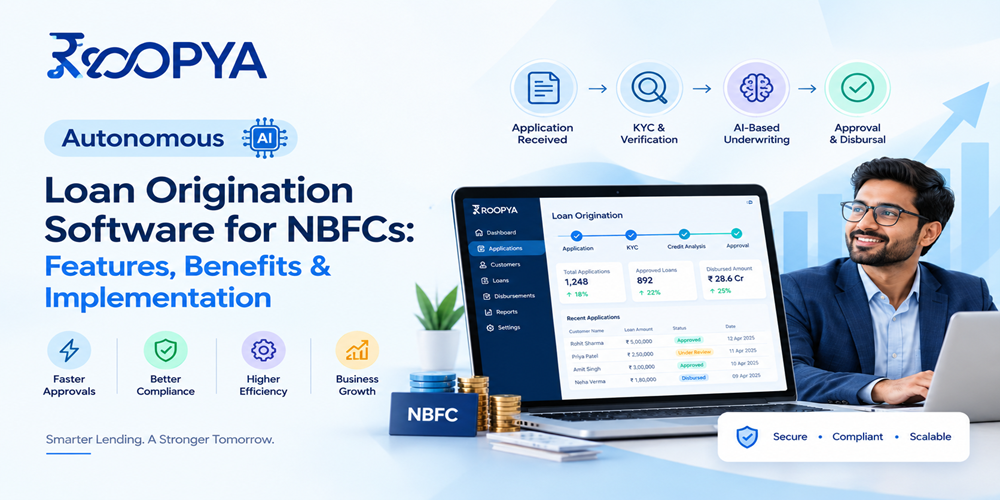
Non-Banking Financial Companies are competing for the same borrower in a market where a rival's app can approve a loan before a branch employee finishes reading the file. That single fact has turned Loan Origination Software (LOS) from a nice-to-have into the backbone of every serious NBFC's lending operation. It decides how fast you can say yes, how safely you can say it, and whether you can prove to a regulator, an auditor, and a borrower exactly why you said it.
India's regulatory environment has made this even more pressing. The RBI's consolidated Digital Lending Directions, along with the mandatory Key Fact Statement, direct-to-bank-account disbursal rules, cooling-off periods, and tightening rules around recovery conduct and device access, mean an NBFC's origination process is no longer just a sales funnel — it is a compliance system that happens to also sell loans. A spreadsheet, a shared inbox, and a manual credit file simply cannot keep pace with that combination of speed and scrutiny.
This guide walks through what Loan Origination Software actually does, the features that matter for an NBFC operating in India today, the measurable benefits of moving off manual or semi-digital processes, and a practical, phase-by-phase approach to implementation — including the mistakes that derail most rollouts.
What Is Loan Origination Software?
Loan Origination Software is the platform that manages a loan application from the moment a prospective borrower expresses interest to the moment funds are disbursed. It typically covers lead capture, application intake, identity and address verification (KYC), document collection, credit bureau checks, income and fraud assessment, underwriting and credit decisioning, approval workflows, sanction letter and Key Fact Statement generation, e-signing of loan agreements, and the handoff to disbursement.
It is distinct from, but closely connected to, a Loan Management System (LMS), which takes over once the loan is live — handling repayment schedules, collections, restructuring, and closure. Many NBFCs, including those built on platforms like Roopya, run LOS and LMS as a connected suite so that a borrower's origination data — income proof, risk grade, collateral details, consent records — flows straight into servicing without being re-keyed or lost at handover.
In practical terms, LOS is the system of record for "why we lent, and on what terms we agreed to lend." That makes it as much a risk and compliance tool as it is an operations tool.
Why NBFCs Need a Modern LOS in 2026
Three forces are pushing NBFCs toward dedicated origination software, and none of them are slowing down.
- Regulatory density: Mandatory Key Fact Statements, a standardised APR disclosure, borrower cooling-off rights, direct bank-to-bank disbursal, and stricter oversight of Lending Service Providers (LSPs) all have to be enforced at the point of origination, every single time, with an audit trail. Manual processes cannot guarantee that consistency.
- Borrower expectations: Retail and MSME borrowers now compare an NBFC's turnaround time against instant-approval apps, not against other NBFCs' branch queues. A multi-day, paper-heavy process is a direct driver of drop-off.
- Portfolio growth and co-lending: As NBFCs scale through direct lending, LSP partnerships, and co-lending arrangements with banks, the volume and variety of applications outgrow what a small credit team can process by hand without a proportional rise in errors and delinquency.
A well-implemented LOS addresses all three at once: it enforces policy and regulatory checks automatically, compresses turnaround time from days to minutes for straightforward cases, and gives a lean credit team the throughput to handle multiples of their manual capacity.
Core Features of Loan Origination Software for NBFCs
Not every LOS on the market is built with India's NBFC regulatory and operational context in mind. The features below are the ones that separate a system that merely digitises paperwork from one that genuinely transforms origination.
1. Omnichannel Digital Application & Lead Capture
Borrowers should be able to start an application from a website, a mobile app, a partner or DSA portal, or an LSP integration, and pick up exactly where they left off on any channel. A good LOS unifies these entry points into a single applicant record instead of creating duplicate, disconnected leads that credit and sales teams have to reconcile manually.
2. eKYC, Aadhaar/PAN Verification & Video KYC
Identity verification needs to be both fast and defensible. This means API-based Aadhaar e-KYC (via UIDAI-authorised channels), PAN verification, CKYC registry checks, and Video KYC for cases that require it. The system should store consent artefacts and verification timestamps automatically, since these are exactly what an RBI audit or DPDP Act data-handling review will ask for.
3. Credit Bureau & Alternate Data Integration
Native integration with CIBIL, Experian, Equifax, and CRIF High Mark lets the system pull bureau scores and full reports the moment an application is submitted, rather than waiting on a manual pull. Leading LOS platforms also plug into alternate data — GST filings, bank statement analysis, UPI transaction history, utility payments — which matters enormously for thin-file borrowers and MSME lending, a segment where many NBFCs compete hardest.
4. Configurable Credit Policy & Rules Engine
Credit policy changes — a tweak to a debt-to-income cap, a new exclusion list, a revised loan-to-value ratio for a product — should be something the risk team can configure, not something that requires a change request to a development team. A visual rules engine lets an NBFC encode eligibility criteria, auto-reject conditions, and referral triggers, and update them in hours instead of weeks.
5. AI/ML-Based Credit Scoring & Risk Grading
Beyond bureau scores, many platforms now layer machine-learning risk models that combine bureau data, alternate data, and the NBFC's own repayment history to produce a proprietary risk grade. This supports risk-based pricing and helps identify creditworthy borrowers that a bureau-score-only approach would reject, while flagging fraud patterns that rules alone tend to miss.
6. Document Management with OCR
Optical Character Recognition automatically extracts data from uploaded salary slips, bank statements, GST returns, and identity documents, pre-filling application fields and cross-checking them against declared information. This cuts manual data entry and catches simple inconsistencies — a mismatched name or address — before they reach an underwriter.
7. Configurable Approval Workflows & Maker-Checker Controls
Loan approval authority in an NBFC is rarely flat — different ticket sizes, products, and risk grades route to different sanctioning authorities. The LOS should support multi-level, role-based approval hierarchies with maker-checker segregation, complete with SLA timers and automatic escalation when an application sits idle too long.
8. Key Fact Statement (KFS) & Regulatory Document Generation
Since the standardised Key Fact Statement became mandatory for digital loans, generating it automatically — with APR, all-in cost of credit, and fee breakup pulled directly from the sanctioned terms — has gone from a convenience feature to a compliance necessity. The same applies to sanction letters, loan agreements, and cooling-off period disclosures, which should be templated and auto-populated rather than drafted per application.
9. e-Sign, e-Stamp & e-Mandate (e-NACH)
Aadhaar-based e-signing, digital stamping, and e-NACH mandate setup for EMI collection let a borrower complete the entire agreement and repayment-authorisation step without a physical visit, while producing legally valid, timestamped, tamper-evident records.
10. Disbursement & Direct Bank Account Integration
Regulatory direction is explicit that disbursement must flow directly between the borrower's bank account and the NBFC's, with no pass-through via a third-party or LSP account. The LOS should integrate directly with payment rails (IMPS/NEFT/RTGS APIs) and log disbursement confirmation against the specific sanctioned application, closing the loop cleanly.
11. Seamless LOS–LMS and Core System Integration
The moment a loan is disbursed, every piece of origination data — the credit file, risk grade, collateral documentation, consent records, and KFS — needs to flow into the Loan Management System without manual re-entry. This is where running LOS and LMS on a connected platform, rather than two disconnected point solutions stitched together after the fact, saves the most operational friction.
12. Compliance, Audit Trail & Reporting
Every action — who viewed an application, what data was pulled, when consent was captured, which policy rule triggered a decision — should be logged immutably. This is what makes an RBI inspection, an internal audit, or a borrower grievance investigation a matter of pulling a report instead of reconstructing events from memory.
13. Analytics Dashboards
Real-time dashboards on application volume, approval rates, turnaround time by stage, drop-off points in the funnel, and portfolio quality by source (branch, DSA, LSP, digital) let credit and business heads spot problems — a sudden fraud spike from one channel, a bottleneck at document verification — while they're still small.
14. Co-Lending & LSP Partner Management
For NBFCs running co-lending arrangements with banks or sourcing through multiple Lending Service Providers, the LOS should support partner-wise workflows, exposure-sharing rules, and the enhanced due-diligence and monitoring records regulators now expect an NBFC to maintain on every LSP relationship.
Key Benefits of Loan Origination Software for NBFCs
The features above translate into benefits that show up directly in an NBFC's operating metrics.
Faster Turnaround Time (TAT)
Automating KYC, bureau pulls, document verification, and rules-based pre-screening can compress a process that took two to five days down to minutes for straightforward, policy-fitting applications, with only genuinely borderline cases routed to a human underwriter. Faster TAT is consistently one of the strongest predictors of conversion in digital lending.
Lower Operating Cost Per Loan
Automation reduces the manual effort spent on data entry, document chasing, and status updates, letting a fixed credit and operations team process a substantially larger volume of applications without a proportional increase in headcount.
Stronger, More Consistent Risk Decisions
A rules engine and scoring model apply the same policy to every application, removing the inconsistency that creeps in when different underwriters interpret the same policy differently under time pressure. Combined with alternate-data scoring, this also tends to improve approval rates for genuinely creditworthy thin-file borrowers.
Built-In Regulatory Compliance
KFS generation, consent capture, direct disbursement, and audit logging stop being manual checklist items that someone might forget under deadline pressure, and become steps the system simply will not let an application skip.
Better Borrower Experience
A borrower who can apply, verify identity, upload documents, and e-sign from a phone — and track status in real time — is far less likely to abandon the application or default to a competitor with a smoother process.
Reduced Fraud and Credit Losses
Document authenticity checks, cross-verification against bureau and alternate data, and ML-based anomaly detection catch synthetic identities, income inflation, and duplicate applications that manual review, working under volume pressure, is more likely to miss.
Scalability Without Proportional Headcount Growth
Because the system — not a person — absorbs most of the repetitive work, an NBFC can grow application volume several times over before it needs to scale its credit and operations team at the same rate.
Data for Better Product and Policy Decisions
With every application, decision, and outcome captured in one system, an NBFC can analyse which policy rules are too strict, which channels bring the best-performing borrowers, and where in the funnel applicants are dropping off — insights that are nearly impossible to extract reliably from paper files or disconnected spreadsheets.
Measuring ROI from a Loan Origination System
Before signing off on an LOS investment, an NBFC's leadership team typically wants a defensible answer to one question: what does this actually return? The honest answer is that most of the return shows up as a set of operating metrics moving in the right direction simultaneously, rather than a single dramatic number.
- Turnaround time (TAT): Track average time from application submission to sanction, broken down by product and channel, before and after go-live.
- Cost per loan originated: Divide total origination operating cost (staff, technology, third-party checks) by loan volume, and watch this ratio fall as volume scales without proportional headcount growth.
- Approval-to-disbursement conversion: A drop in this figure usually points to friction in document collection, e-sign, or disbursement steps that the LOS should be removing.
- Portfolio quality by channel and vintage: Compare early delinquency rates for loans originated through the new system against the pre-LOS baseline to confirm underwriting quality hasn't been traded away for speed.
- Compliance exceptions: Count of missing KFS records, late disclosures, or audit findings — this should trend toward zero as automated generation replaces manual document preparation.
Most NBFCs start seeing meaningful movement in TAT and cost-per-loan within the first two to three months of stable operation, while portfolio-quality effects take a full credit cycle or two to confirm, since early-stage delinquency data needs time to mature before it's a reliable signal.
How to Implement Loan Origination Software: A Step-by-Step Guide
Implementation is where most of the value of an LOS is won or lost. A powerful platform, poorly rolled out, ends up as an expensive digitised version of the old paper process. The sequence below reflects how successful NBFC implementations are typically structured.
Step 1: Map the Current Process and Define Requirements
Before evaluating any vendor, document the existing origination journey end-to-end — every handoff, every document, every approval level, every place applications currently stall. Involve credit, operations, compliance, IT, and a few frontline sales staff, since they see failure points that leadership often doesn't. This becomes the requirements checklist against which vendors are scored, and later the basis for measuring whether the new system actually improved things.
Step 2: Shortlist and Evaluate Vendors
Score candidate platforms against functional fit, depth of pre-built integrations (bureaus, KYC providers, payment rails), configurability without heavy custom development, data security certifications, deployment model (cloud vs. on-premise), pricing structure, and — critically — whether the vendor understands NBFC-specific regulatory requirements rather than treating India as an afterthought to a generic global product.
Step 3: Plan Data Migration and Integration Architecture
Decide what historical data — existing borrower records, in-progress applications, credit policy configurations — needs to migrate, and map every external system the LOS must talk to: credit bureaus, KYC/Aadhaar authentication providers, the core lending or LMS platform, payment gateways, and any partner or LSP portals. Integration scope is consistently the most underestimated part of LOS projects; plan it early and in detail rather than discovering gaps during testing.
Step 4: Configure Credit Policy, Workflows & Templates
Translate the NBFC's actual credit policy — eligibility rules, scoring thresholds, approval hierarchies, product-specific terms — into the platform's rules engine, and set up the document templates (sanction letters, KFS, loan agreements) with correct, compliant language. This is best done jointly by the risk/credit team and the implementation partner, not delegated entirely to IT.
Step 5: Run a Pilot with a Controlled Segment
Launch with a single product, branch, or channel rather than a big-bang, company-wide switch. A pilot surfaces configuration errors, edge cases in the credit policy, and integration hiccups while the blast radius of any mistake is still small, and gives the credit team confidence in the system's decisions before it handles full volume.
Step 6: Conduct User Acceptance Testing (UAT)
Have the actual credit officers, sales staff, and compliance team run real (or realistic) applications through the system end-to-end, including deliberately testing edge cases — incomplete documents, borderline eligibility, unusual income patterns — that a straightforward happy-path test would never catch.
Step 7: Train Staff and Update SOPs
New software changes how people work, not just what tools they click. Update standard operating procedures, train credit and operations staff on the new workflow (not just the software's buttons), and give sales and DSA teams enough hands-on time that they're comfortable guiding a borrower through the digital journey before go-live.
Step 8: Roll Out in Phases and Monitor Closely
Expand from the pilot to additional products, branches, or channels in planned phases, watching turnaround time, approval rates, error rates, and user feedback closely at each stage. Keep a clear rollback or hybrid-processing plan for the first few weeks in case a critical issue surfaces under real volume.
Step 9: Review, Optimise, and Iterate Post Go-Live
Treat go-live as the start, not the end. Review dashboard data after 30, 60, and 90 days to refine credit rules, adjust workflow bottlenecks, and retrain the scoring model with fresh outcome data — an LOS should keep improving as it accumulates the NBFC's own performance history.
Choosing the Right LOS Vendor for Your NBFC
A few criteria matter disproportionately when comparing platforms:
- India-specific compliance built in: native KFS generation, Aadhaar e-KYC, CKYC, e-NACH, and direct-disbursement support, not bolted on as an afterthought.
- Pre-built bureau and KYC integrations: fewer custom integrations mean a faster, cheaper, lower-risk implementation.
- Configurability by business users: credit and risk teams should be able to adjust policy without submitting a development ticket every time a rule changes.
- Native LOS–LMS connectivity: avoids the data-loss and duplication that comes from stitching together two separate systems from two different vendors.
- Data security and residency: look for ISO 27001 or equivalent certification, encryption standards, and clarity on where data is hosted, given DPDP Act obligations.
- Vendor track record with NBFCs specifically: a platform proven with banks or global fintechs doesn't automatically translate to NBFC-specific product structures, ticket sizes, and co-lending needs.
- Total cost of ownership: weigh licensing, implementation, integration, and ongoing support costs together, not just the headline subscription price.
Common Implementation Challenges (and How to Avoid Them)
- Underestimating integration complexity: Bureau, KYC, and payment integrations often take longer than expected. Build integration testing time into the project plan from day one rather than treating it as a final checklist item.
- Resistance from frontline and credit staff: Staff who built expertise around the old manual process may see the new system as a threat rather than a tool. Involve them early in requirements-gathering and pilot testing so they have ownership in the outcome.
- Over-customisation: Heavily customising a platform to replicate every quirk of the old manual process can erase most of the efficiency gains and make future upgrades harder. Use the implementation as an opportunity to simplify policy, not just digitise it as-is.
- Incomplete data migration: Missing or poorly mapped historical data creates gaps that surface months later during an audit. Validate migrated data against source records before go-live, not after.
- Treating go-live as the finish line: Without post-launch monitoring and iteration, an LOS's rules and scoring models stay frozen at day-one assumptions and drift out of step with actual portfolio performance.
The Future of Loan Origination for NBFCs
A few trends are already reshaping what NBFCs will expect from origination platforms over the next few years.
- Deeper AI underwriting: Machine-learning models are moving from a supporting signal to a primary driver of credit decisions for well-understood product segments, with human underwriters increasingly focused on exceptions and high-value cases.
- Account Aggregator and OCEN-based data flows: Consent-based access to a borrower's financial data across institutions, via frameworks like the Account Aggregator ecosystem and the Open Credit Enablement Network, is making richer, faster underwriting possible without relying solely on uploaded documents.
- Embedded lending: More NBFCs will originate loans inside partner platforms — e-commerce checkouts, B2B marketplaces, payroll apps — pushing LOS platforms toward API-first, embeddable architectures rather than standalone applicant portals.
- Real-time regulatory adaptability: As RBI guidance continues to evolve (recovery conduct rules, device-access restrictions, and further KFS refinements are already in motion for 2026), the NBFCs best positioned will be the ones whose LOS can absorb a new compliance requirement through configuration, not months of redevelopment.
LOS for Different NBFC Lending Segments
The right configuration of an LOS shifts depending on what an NBFC actually lends against, and a platform that's excellent for one segment can feel poorly fitted to another if it isn't flexible enough to adapt.
- Personal and consumer loans: Prioritise speed — instant bureau pulls, automated e-KYC, and straight-through processing for low-ticket, low-risk applications, with manual review reserved for borderline scores.
- MSME and business loans: Prioritise alternate data — GST returns, bank statement analysis, and cash-flow-based scoring matter more here than bureau score alone, since many MSME borrowers have thin credit files.
- Gold loans: Prioritise valuation and collateral workflows — the LOS needs tight integration with in-branch gold appraisal and collateral documentation alongside standard KYC, since approval often happens in-person and TAT is measured in minutes.
- Loan Against Property (LAP) and secured lending: Prioritise document depth and legal workflow — title verification, property valuation reports, and legal opinion tracking need dedicated workflow stages that unsecured lending products don't require.
- Co-lending and partnership-sourced loans: Prioritise partner-wise configuration — separate underwriting rules, exposure caps, and reporting views per bank or LSP partner, since a single blended workflow rarely satisfies every partner agreement.
Loan Origination Software has moved from a competitive advantage to a baseline requirement for any NBFC that wants to grow loan volume, hold turnaround times down, and stay ahead of an increasingly detailed regulatory framework at the same time. The NBFCs that get the most value from it are the ones that treat implementation as a genuine process redesign — with the right vendor fit, a realistic rollout plan, and continuous tuning after go-live — rather than a like-for-like digitisation of the paper file.
Roopya.money is built specifically around this connected view of lending technology — origination and loan management working as one system rather than two separately purchased tools — for banks and NBFCs that need speed, control, and audit-ready compliance in the same platform.