August 24, 2026
Free Lending Management Software: A Practical Guide for Modern Lenders
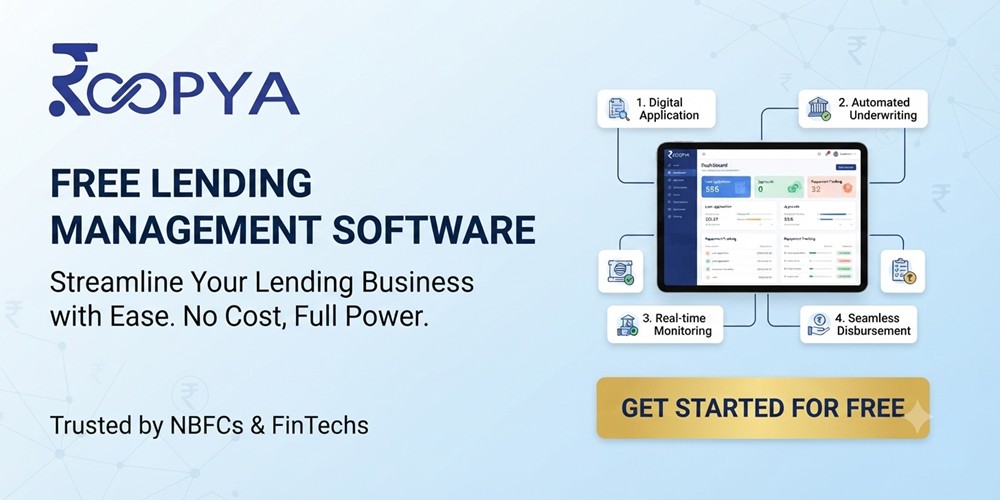
Finding lending software that is affordable, practical and reliable can be difficult for a growing lender. Banks, NBFCs, MFIs, fintech companies, digital lenders and other lending businesses need technology to manage borrowers, applications, loan accounts, repayment schedules, collections, documents, reports and compliance. At the same time, smaller and growing businesses may not want to commit to a large upfront software investment before they know whether a platform fits their processes.
That is why the phrase “free lending management software” attracts so much attention. But free should not simply mean a product with a limited screen or a short trial. For a lender, the real question is whether the platform can help reduce manual work, organize loan operations and create a foundation for sustainable growth without creating hidden operational costs.
Modern cloud-based lending platforms can make sophisticated lending capabilities more accessible. Roopya positions its lending infrastructure around a low-entry, usage-oriented model and provides capabilities covering loan origination, loan management, collections, integrations, analytics and automation. Its existing lending-management material describes cloud-based, no-code infrastructure, while its resource content also promotes a free LOS and LMS offering.
What Is Free Lending Management Software?
Free lending management software is software that allows a lending business to manage important loan processes with little or no initial platform cost, depending on the provider’s pricing model and plan. The exact meaning of “free” varies. Some products provide a permanent free tier, some provide a free trial, and others reduce upfront implementation fees while charging according to usage.
A useful lending management platform should go beyond storing borrower names and loan amounts. It should help lenders manage the operational journey of a loan. Depending on the platform, this can include borrower onboarding, document management, loan product configuration, approval workflows, disbursement, repayment schedules, payment tracking, collections, customer communication, portfolio reporting and integrations.
For this reason, businesses should evaluate free lending management software by its practical value rather than by the word “free” alone. A platform that saves staff hours, reduces spreadsheet errors and creates better visibility into the loan portfolio can deliver considerably more value than a basic tool that costs nothing but requires extensive manual work.
Why Lenders Look for Free or Low-Cost Lending Software
Cost is an important consideration, particularly for startups and smaller lenders. Building a lending technology stack internally can require software development, cloud infrastructure, security controls, integrations, maintenance and specialist teams. Buying multiple disconnected tools can also create integration and reconciliation problems.
A low-entry lending platform can help businesses test digital lending workflows before making a larger technology commitment. It can also be useful when a lender is launching a new product and wants to validate demand before investing heavily in custom technology.
However, cost should always be evaluated alongside security, scalability, configurability, support, integrations and compliance requirements. A cheap platform can become expensive if employees have to maintain spreadsheets around it or if the business later needs to migrate data to another system.
The better approach is to ask: What lending work can the platform automate? What integrations are available? How easily can the system adapt when loan products change? Can the platform support the lender as its portfolio grows?
Key Features to Look for in Free Lending Management Software
1. Borrower and Customer Management
A central borrower profile helps teams organize customer information, documents, communication history and loan relationships. This reduces the need to search across spreadsheets, email threads and disconnected applications.
2. Loan Product Configuration
Lenders may offer multiple products with different eligibility rules, interest structures, fees and repayment schedules. Flexible product configuration allows business teams to manage these differences without rebuilding the entire system.
3. Loan Origination and Workflow Support
Although lending management is often associated with post-disbursement servicing, a connected platform should work with origination workflows. Digital applications, document collection, KYC, credit checks, underwriting and approval workflows can create a smoother handoff into loan servicing.
4. EMI and Repayment Schedule Management
The platform should generate accurate repayment schedules based on the agreed loan terms. It should support relevant repayment structures and maintain a clear account-level history of amounts due, amounts received and outstanding balances.
5. Payment and Reconciliation Support
A lender may receive payments through several channels. Software should help capture, reconcile and post repayments accurately so that portfolio data remains reliable.
6. Collections Management
Collections teams need visibility into overdue accounts, DPD buckets, follow-up activity and payment commitments. Automated reminders and configurable workflows can reduce repetitive work and help teams prioritize accounts.
7. Reporting and Analytics
A lender should be able to understand disbursements, outstanding balances, repayments, overdue accounts, collection performance and portfolio trends. Dashboards can make this information accessible without requiring staff to build reports manually.
8. API and Third-Party Integrations
Lending businesses depend on external services for identity verification, credit bureaus, account aggregation, payments, communication and other functions. API-ready architecture can reduce integration effort and help a lender build a connected technology ecosystem.
9. Role-Based Access and Auditability
Different employees should have access to information appropriate to their responsibilities. Activity logs and permissions are important for operational control and audit readiness.
10. Scalability
A solution that works for 100 accounts should not become unusable at 10,000 accounts. Cloud infrastructure, configurable workflows and API support can help lenders scale without repeatedly replacing their technology.
Free Lending Management Software vs. Spreadsheets
Spreadsheets can be useful during the earliest stages of a lending operation, but they become increasingly difficult to manage as the number of borrowers, loan products and repayment transactions grows.
With spreadsheets, employees may manually update repayment records, calculate outstanding amounts, create collection lists and prepare management reports. Multiple versions of the same file can create uncertainty about which information is current. Formula errors and accidental edits can also affect reporting.
A lending management system creates a centralized operational environment. Instead of treating each spreadsheet as a separate source of truth, the business can use workflows, account records, repayment schedules and dashboards within one system.
This does not mean spreadsheets have no role. They can still be useful for analysis and ad-hoc work. The important distinction is that the core loan ledger and operational processes should be controlled by systems designed for lending rather than dependent on manually maintained files.
How Roopya Can Support Lending Operations
Roopya is a lending infrastructure platform designed for lenders such as NBFCs, banks, MFIs and fintech businesses. Its lending-management offering brings together loan origination, loan management, collections, analytics and integrations in a cloud-based environment.
Roopya’s published lending-management information highlights no-code configuration, automated loan servicing, repayment scheduling, collections workflows, portfolio dashboards and API integrations. Its platform materials also describe pre-integrated services across areas such as credit, KYC and verification, account aggregation, payments and communications.
For a business evaluating a free lending management solution, the practical benefit is the ability to start with a lower barrier to adoption and then assess the platform against real lending workflows. Instead of selecting software only from a feature checklist, lenders can evaluate how the platform handles their own products, borrower journeys, repayment rules and collection processes.
The exact features, limits and commercial terms of any free or usage-based plan should be confirmed with Roopya before implementation because pricing and product offerings can change.
Who Can Use Free Lending Management Software?
NBFCs can use lending software to organize loan origination, servicing, collections, portfolio monitoring and reporting. A configurable platform can be particularly useful when an NBFC operates multiple loan products or branches.
Fintech companies can benefit from API-first lending infrastructure when they need to connect onboarding, verification, credit, payments and servicing components into a digital customer journey.
Microfinance institutions can use lending software to manage high-volume small-ticket loans, repayment schedules, field collections and borrower records.
Startups can use a low-entry solution to test lending workflows without immediately building a large internal technology stack.
Other lenders, including specialized finance businesses and lending service providers, can evaluate a lending platform based on their specific operating model, regulatory responsibilities and technology requirements.
Benefits of Using a Modern Lending Management Platform
The strongest benefit of lending automation is not simply faster data entry. It is operational consistency.
First, automation can reduce repetitive manual work. Employees can spend less time updating records and more time handling exceptions and customer needs.
Second, centralized information can improve visibility. Managers can monitor loan performance, overdue accounts and collection activity from a common system.
Third, configurable workflows can help standardize processes. Instead of depending on individual employees to remember every step, the system can guide tasks according to defined rules.
Fourth, integrated communication can improve borrower servicing. Automated reminders can help customers understand upcoming or overdue payments.
Fifth, analytics can support better decisions. Portfolio information becomes easier to review when reports are generated from structured operational data.
Finally, a scalable platform can make technology less of a bottleneck as the lending business grows.
How to Evaluate Whether “Free” Is Really Right for Your Business
Before choosing a free lending management platform, create a simple evaluation checklist.
Start with your loan volume and product types. Document the number of active borrowers, expected monthly applications, disbursements and repayments.
Next, list the workflows that must be automated. Include onboarding, verification, underwriting, disbursement, repayment, collections, customer service and reporting.
Then identify integrations. A lender may need credit bureau, KYC, payment, bank-account, communication, accounting or other APIs.
Review data security and access controls. Understand how the provider handles authentication, permissions, backups, audit trails and data protection.
Check the pricing model carefully. Determine what is included in the free plan, whether there are transaction or usage charges, and what happens when the business exceeds the free limits.
Finally, test the system with real-world scenarios. A useful demonstration should include a normal loan, a missed EMI, a part-payment, a prepayment or foreclosure scenario where relevant, and a collection workflow. This reveals much more than a generic product tour.
Free Does Not Mean Compromise on Reliability
Financial data is sensitive, and lending operations can affect both the lender and borrower. Therefore, software selection should never be based only on price.
A reliable platform should provide appropriate access controls, auditability, data protection and operational resilience. The lender should also understand its responsibilities for regulatory compliance and customer-data handling.
It is equally important to evaluate vendor support. If a repayment calculation or integration fails, the business needs a clear process for resolving the issue.
The objective should be affordable technology with professional capabilities, not simply technology with a zero price tag.
A Practical Roadmap for Moving From Manual Lending to Digital Lending
A lender does not need to digitize every process simultaneously. A phased approach can reduce disruption.
Phase 1: Document current workflows. Map how applications, approvals, disbursements, repayments and collections are currently handled.
Phase 2: Identify repetitive tasks. Look for manual data entry, calculations, reminders, reconciliations and reporting tasks that consume employee time.
Phase 3: Configure the core lending workflow. Start with borrower records, loan products, repayment schedules and account servicing.
Phase 4: Add integrations. Connect the services required for verification, credit, payments and communications.
Phase 5: Introduce analytics and collections automation. Use portfolio dashboards and collection workflows to improve operational visibility.
Phase 6: Review results. Compare turnaround time, manual effort, reconciliation accuracy, collection activity and customer service performance before and after implementation.
This approach makes the technology project measurable. It also helps the lender discover which features create real value rather than implementing software simply because it has a long feature list.
Why People-First Lending Software Content Matters
When lenders search for “free lending management software,” they usually want answers to practical questions: Is it really free? What can it do? Is it suitable for an NBFC or fintech? Can it manage repayments? Can it integrate with other services? Can it scale? What happens when the free limit is exceeded?
Helpful content should answer these questions directly rather than repeating keywords. It should clearly explain limitations, avoid unsupported promises and distinguish between general lending-software capabilities and features actually offered by a particular provider.
For Roopya, this means explaining the platform in a way that helps a lender decide whether it is suitable for its business. Product claims should be kept accurate and updated as features and pricing evolve. Google’s people-first guidance emphasizes content created primarily to help users rather than content created solely to manipulate search rankings.
This approach can also improve conversion quality. Visitors who understand the product are more likely to become relevant leads because they know what problem the platform is designed to solve.
Conclusion
Free lending management software can be a useful starting point for lenders that want to reduce manual operations without committing to a large initial technology investment. But the most important question is not whether the software has a zero price. The real question is whether it provides dependable lending capabilities that can support the business today and as it grows.
A modern platform should help manage borrowers, loan products, repayment schedules, payments, collections, reporting, integrations and operational workflows. It should also provide the flexibility, security and scalability required by a financial-services business.
Roopya provides cloud-based lending infrastructure for modern lenders, with capabilities across loan origination, loan management, collections, analytics and API integrations. Its low-entry and usage-oriented approach can be evaluated by businesses that want to digitize lending without starting with a large technology investment.
If you are comparing free lending management software, start with your real workflows, test the platform with representative loan scenarios and confirm the current pricing, usage limits, integrations, security controls and support terms before making a decision. The right software should make lending simpler for your team and more transparent for your customers.