August 26, 2026
AI-Powered LOS: How Artificial Intelligence Is Transforming Loan Origination Systems
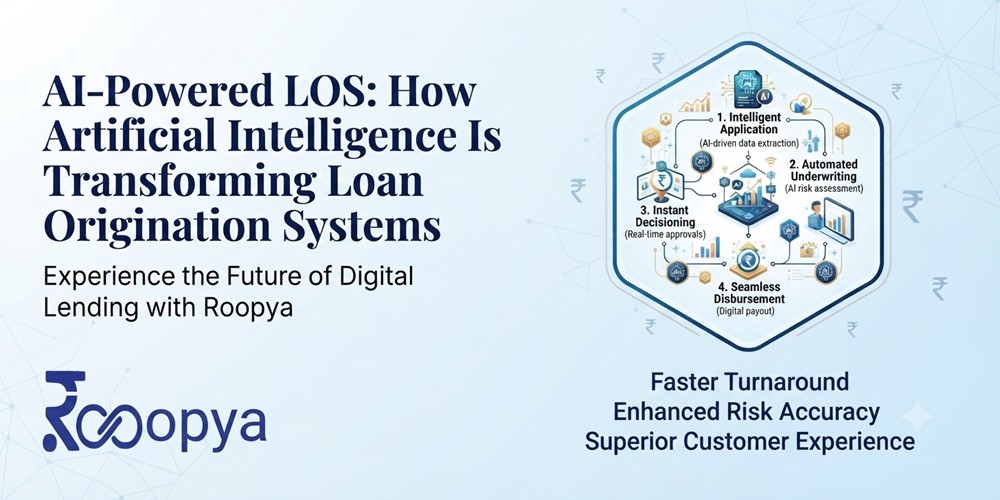
Lending has always been a business built on trust, data, and speed — but for decades, the process of originating a loan remained painfully manual. Paper forms, physical document verification, days-long credit checks, and back-and-forth communication between underwriters and borrowers made loan origination one of the slowest parts of the entire lending lifecycle.
That is changing rapidly. Artificial intelligence has moved from being a buzzword to becoming the operating core of modern lending infrastructure. An AI-Powered Loan Origination System (LOS) doesn't just digitize paperwork — it thinks, learns, and decides. It reads documents the way a human underwriter would, but in seconds instead of hours. It evaluates creditworthiness using thousands of data points instead of a handful of static rules. It flags fraud before it becomes a loss. And it keeps improving with every single loan it processes.
For banks, NBFCs (Non-Banking Financial Companies), microfinance institutions, and fintech lenders, adopting an AI-powered LOS is no longer a competitive advantage — it is quickly becoming table stakes. This article explores what an AI-powered LOS actually is, how it works, the real benefits it delivers, and what lenders should look for when choosing one.
What Is a Loan Origination System (LOS)?
A Loan Origination System is the software backbone that manages the entire journey of a loan application — from the moment a borrower applies to the moment funds are disbursed. A typical LOS handles:
- Application intake — capturing borrower details through digital forms
- KYC and identity verification — confirming who the borrower is
- Document collection and verification — income proof, bank statements, address proof, etc.
- Credit assessment and underwriting — evaluating the borrower's ability and willingness to repay
- Decisioning — approving, rejecting, or referring the application for manual review
- Disbursal management — releasing funds once approval conditions are met
Traditionally, most of these steps involved manual effort: a loan officer reviewing PDFs, calling a credit bureau, cross-checking documents by eye, and manually applying credit policy rules. This made the process slow, inconsistent, and expensive to scale — especially for lenders trying to process thousands of small-ticket loans profitably.
What Makes an LOS "AI-Powered"?
An AI-powered LOS embeds machine learning, natural language processing (NLP), computer vision, and predictive analytics directly into the origination workflow, rather than treating AI as an add-on feature. The distinction matters. A traditional LOS with a chatbot bolted on is not the same as a system where AI actively reads documents, scores risk, tunes lending rules, and generates insights as part of its core logic.
In practice, an AI-powered LOS typically brings intelligence to four critical layers of the origination process:
1. AI-Powered Document Analysis
Instead of a human manually opening every PAN card, Aadhaar card, salary slip, or bank statement, AI-driven OCR (Optical Character Recognition) combined with NLP automatically extracts, verifies, and cross-checks the information within documents. This includes:
- Detecting tampered or forged documents
- Cross-verifying names, addresses, and numbers across multiple documents
- Reading bank statements to estimate income stability and spending behavior
- Flagging anomalies such as mismatched signatures or edited PDFs
What used to take a back-office team hours can now be completed in seconds, with accuracy levels that often exceed manual review, since AI models don't get fatigued or skip steps.
2. Intelligent Credit Decisioning
Traditional credit scoring relied heavily on bureau scores and a narrow set of financial ratios. AI-powered credit decisioning goes further by analyzing alternative data — utility bill payments, transaction patterns, digital footprint, employment stability, and behavioral signals — to build a fuller picture of a borrower's creditworthiness. This is especially valuable in markets like India, where a large portion of potential borrowers are "new-to-credit" or thin-file customers who don't have an extensive bureau history.
Machine learning models can process this data in milliseconds, producing risk scores that adapt as new repayment data flows in, rather than relying on static scorecards that go stale over time.
3. AI-Enhanced Business Rule Engine (BRE)
Every lender operates on credit policy — rules that determine who qualifies for a loan, at what amount, and at what interest rate. In a conventional LOS, these rules are configured once and rarely revisited. An AI-enhanced BRE continuously analyzes approval and rejection patterns, portfolio performance, and default trends to suggest rule refinements — while keeping a human decision-maker in the loop for final sign-off. This creates a system that gets smarter with every loan cycle instead of staying frozen in time.
4. Fraud Detection and Risk Monitoring
Loan fraud — from identity theft to income misrepresentation to synthetic identities — costs lenders heavily every year. AI fraud detection models are trained to spot subtle patterns that a human reviewer would likely miss: unusual application velocity from a single device, inconsistent metadata in uploaded documents, or behavioral patterns that resemble known fraud rings. Because these models learn continuously, they adapt to new fraud tactics far faster than static, rule-based fraud checks ever could.
5. AI-Driven Analytics and Natural Language Reporting
Beyond origination itself, AI is increasingly used to generate insights from lending data. Instead of a business analyst building custom reports, natural language–powered systems allow risk and business teams to simply ask a question — "Which loan product had the highest default rate last quarter?" — and get an instant, accurate answer along with supporting charts. This dramatically shortens the time between a business question and a business decision.
How an AI-Powered LOS Works: The End-to-End Flow
- Borrower applies online through a digital form or an embedded journey on a partner app.
- AI-based KYC and document verification instantly validates identity documents and checks for tampering.
- Multi-bureau data pull happens automatically, combined with alternative data sources.
- AI credit scoring model evaluates the applicant using both traditional and alternative data points.
- Business Rule Engine applies the lender's credit policy, informed by AI-suggested optimizations.
- Fraud detection layer runs in parallel, screening for red flags.
- Real-time decision is generated — approve, reject, or refer for manual underwriting.
- Disbursal workflow is triggered automatically once conditions are satisfied.
What once took days of back-and-forth can now be compressed into minutes, and in many small-ticket loan use cases, into seconds.
Why Lenders Are Moving to AI-Powered LOS
Speed at Scale
Manual document review and credit checks simply cannot keep pace with the volume modern digital lenders need to process, particularly for small-ticket personal loans, buy-now-pay-later products, and embedded finance use cases where borrowers expect near-instant decisions. AI compresses verification and decisioning timelines from hours to seconds, letting lenders process significantly higher application volumes with the same team size.
Better Risk Accuracy
By incorporating alternative data and continuously learning from repayment outcomes, AI-powered credit models tend to outperform static, rules-only scoring approaches — reducing both false approvals (which lead to defaults) and false rejections (which lead to lost good customers).
Lower Fraud Losses
Automated, pattern-based fraud detection catches sophisticated fraud attempts — such as synthetic identities or document manipulation — that are difficult for even experienced underwriters to catch consistently across a high volume of applications.
Reduced Operating Costs
Every document that AI verifies automatically, and every rule refinement it suggests, reduces the manual workload on underwriting and operations teams. This lowers the cost per loan originated, which is especially important for lenders operating in low-ticket-size, high-volume segments where margins are thin.
Continuous Improvement
Unlike static rule-based systems, AI models recalibrate themselves as new data comes in. A model trained on last year's repayment behavior can be refined with this year's outcomes, keeping decisioning aligned with current market and borrower behavior rather than relying on assumptions from years past.
Improved Borrower Experience
Faster decisions, fewer document re-submission requests (because AI catches errors upfront), and 24/7 availability through AI-powered conversational interfaces all combine to create a smoother borrower journey — which translates into higher conversion rates and better customer retention for lenders.
AI-Powered LOS vs. Traditional LOS
Aspect Traditional LOS AI-Powered LOS Document Verification Manual review, hours to days Automated OCR/NLP, seconds Credit Scoring Bureau score + static rules Bureau + alternative data + ML models Business Rules Fixed, manually updated Self-learning, continuously optimized Fraud Detection Rule-based checks Pattern-based, adaptive detection Reporting Manual dashboards Natural language, auto-generated insights Decisioning Speed Hours to days Seconds to minutes Scalability Limited by manual headcount Scales with infrastructure, not headcountIndustry Use Cases
Banks: Large banks use AI-powered LOS to handle high application volumes across retail, SME, and mortgage lending, while maintaining consistent compliance and audit trails.
NBFCs: Non-banking lenders, particularly those focused on underserved and thin-file borrowers, rely on AI-driven alternative data scoring to extend credit responsibly to customers who wouldn't qualify under traditional bureau-only models.
Microfinance Institutions (MFIs): AI helps MFIs process high volumes of small-ticket loans efficiently, where manual underwriting costs would otherwise make such lending economically unviable.
Fintechs and Embedded Finance Players: Digital lenders and platforms offering embedded credit (checkout financing, merchant loans, salary advances) depend on AI-powered LOS to deliver the instant, in-app credit decisions their users expect.
Gold Loan, Personal Loan, and Business Loan Providers: Product-specific lenders use AI to speed up niche underwriting workflows — for instance, using computer vision to assist gold appraisal documentation, or cash-flow analysis for SME/business loan applicants.
Challenges to Consider
AI-powered LOS platforms deliver clear advantages, but lenders should go in with realistic expectations:
- Data quality dependency: AI models are only as good as the data feeding them. Poor-quality or biased training data can lead to inconsistent decisions.
- Regulatory and explainability requirements: Financial regulators increasingly expect lenders to explain why a credit decision was made. AI-powered systems need built-in explainability, not "black box" scoring.
- Integration complexity: Connecting AI models to existing core banking systems, credit bureaus, and third-party APIs requires careful planning.
- Human oversight: The most effective AI-powered LOS platforms keep humans in the loop for edge cases and policy sign-off, rather than fully automating every decision blindly.
- Ongoing model monitoring: AI models can drift over time as market conditions change, so continuous monitoring and retraining are essential to keep decisioning accurate.
Choosing a platform that treats AI as an assistive, continuously monitored layer — rather than an unchecked black box — is critical to managing these risks responsibly.
How Roopya Brings AI-Powered LOS to Lenders
Roopya is a no-code, cloud-based lending infrastructure platform built for banks, NBFCs, MFIs, and fintech lenders in India. Its Loan Origination Platform embeds AI directly into the core workflow rather than treating it as an optional layer, covering:
- AI-powered document analysis for identity documents and bank statements, aimed at high accuracy and near-instant fraud detection
- An AI-enhanced Business Rule Engine that learns from historical approval and rejection patterns to continuously refine credit policy, with human oversight retained throughout
- Intelligent credit decisioning that evaluates alternative data alongside bureau scores for more accurate, real-time risk assessment
- AI-driven analytics and reporting, including natural-language querying of portfolio data for faster business decision-making
Beyond origination, Roopya's unified lending infrastructure extends across loan management, collections, and early warning systems — with 300+ pre-integrated APIs (credit bureaus, verification services, payment gateways) and 20+ pre-configured loan products, allowing lenders to go live in as little as a day without writing code. This end-to-end approach means AI capabilities built into origination carry through the entire loan lifecycle, from the first application to final collections.
The Future of AI in Loan Origination
AI's role in lending is still evolving. Emerging directions include:
- Generative AI for underwriter assistance — summarizing complex financial documents and flagging risk factors in plain language for human reviewers.
- Real-time, event-driven scoring — credit decisions that update as new transactional data streams in, rather than being based on a static snapshot.
- Conversational AI loan assistants — handling borrower queries, document collection, and status updates through natural, contextual conversations rather than static FAQs or forms.
- Federated and privacy-preserving learning — allowing lenders to benefit from broader data patterns without compromising individual borrower privacy.
- Deeper embedded finance integration — AI-powered origination becoming invisible, running silently within e-commerce checkouts, payroll platforms, and merchant apps to extend credit at the point of need.
As these capabilities mature, the line between "loan origination software" and "AI decision engine" will continue to blur — and lenders who build on flexible, AI-native infrastructure today will be best positioned to adopt these advances without needing to rebuild their core systems from scratch.
Conclusion
An AI-Powered Loan Origination System is no longer a futuristic concept — it's an operational necessity for lenders who want to compete on speed, accuracy, and cost efficiency. From instant document verification and fraud detection to intelligent credit decisioning and self-optimizing business rules, AI touches every stage of the modern lending journey. Platforms like Roopya are making this technology accessible to banks, NBFCs, and fintechs through no-code, cloud-native infrastructure — helping lenders go from application to disbursal faster, more accurately, and at lower cost than ever before.
For any lender evaluating new origination technology, the question is no longer whether to adopt AI, but how quickly and responsibly they can put it to work.