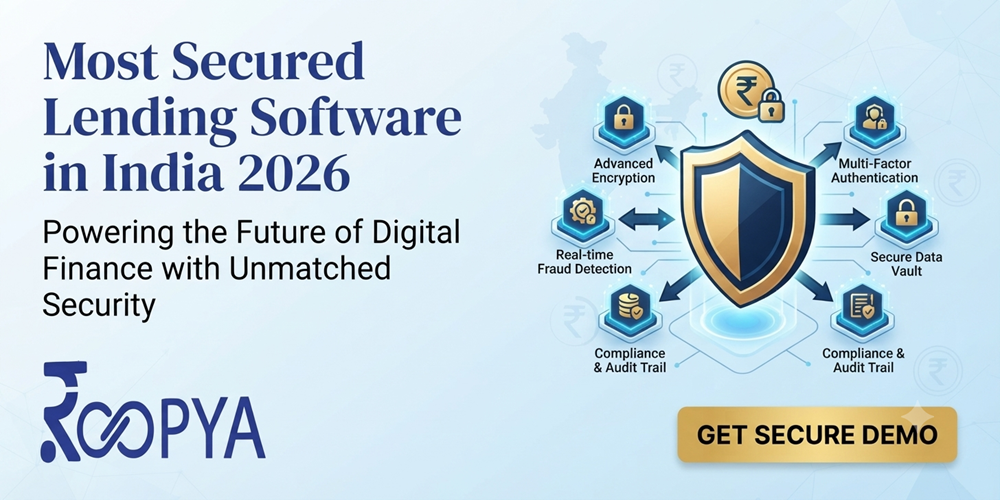
Most Secured Lending Software in India 2026: What Every NBFC, Bank, and MFI Must Know
Trust is the foundation of the lending business. Borrowers trust lenders with the most sensitive information of their financial lives — PAN numbers, Aadhaar details, bank account data, income records, and credit histories. Lenders trust their software platforms to store, process, and transmit that information without it ever falling into the wrong hands.
In 2026, that trust is under more pressure than ever. Cybercrime against financial institutions in India increased by 41% in 2024-25, according to CERT-In. Regulatory penalties for data breaches have escalated sharply under amended IT Act provisions. And borrowers, increasingly aware of their digital rights, are choosing lenders they perceive as trustworthy custodians of their data.
This is why security is no longer a checkbox feature in lending software — it is the core value proposition. The question every NBFC, bank, microfinance institution, and fintech lender must answer is: can I confidently say my lending platform is truly secure?
This guide walks you through what genuine security looks like in a lending software platform, what layers of protection matter most, how Indian regulations define data security obligations, and why Roopya has earned its reputation as the most secured lending software in India in 2026.
1. Why Security Is the Most Critical Feature in Lending Software
Before diving into what makes lending software secure, it is worth being honest about the threat landscape that modern lenders are navigating.
Indian financial institutions handled over ₹2.2 lakh crore in digital loan disbursements in FY 2024-25. That volume of financial data is an extraordinarily attractive target for cybercriminals. The attacks are not abstract possibilities — they are daily realities:
- SQL injection and API exploitation attacks targeting lender databases containing PAN, Aadhaar, and bank account data.
- Credential stuffing attacks on borrower-facing portals using stolen username-password combinations from unrelated breaches.
- Man-in-the-middle attacks intercepting unsecured API calls between lending systems and credit bureaus or KYC providers.
- Ransomware deployments that encrypt lender operational data and demand payment for decryption keys.
- Insider threats — employees or vendors with excessive access privileges extracting sensitive borrower data for sale.
- Third-party integration vulnerabilities — weaknesses in connected APIs, payment gateways, or KYC providers that expose lender data.
Beyond cybercrime, there are severe regulatory consequences for lenders whose platforms fail to meet data security standards. The Reserve Bank of India's IT Framework for NBFCs, the RBI Cybersecurity Framework for Banks, the Digital Personal Data Protection Act 2023, and IRDAI guidelines for insurance-linked lending all impose specific, enforceable security obligations. A breach does not just cost money — it costs regulatory standing, customer trust, and in severe cases, the operating licence itself.
In this environment, choosing the most secured lending software in India is not just a technology decision — it is a business survival decision.
2. What 'Secured Lending Software' Actually Means
The word 'secure' is overused in technology marketing. Every vendor claims their platform is secure. The meaningful question is: what specific layers of security are in place, how are they implemented, and how are they verified?
Genuinely secure lending software operates across seven distinct security dimensions:
2.1 Data Encryption — At Rest and In Transit
Every piece of sensitive data in a lending platform — borrower PII, financial records, document images, credit bureau responses — must be encrypted both when stored in databases and when transmitted between systems. The industry standard is AES-256 encryption at rest and TLS 1.3 encryption in transit. Anything less is unacceptable in 2026.
Roopya implements AES-256 encryption for all data at rest, with encrypted key management using HSM (Hardware Security Module) infrastructure. All data in transit is protected by TLS 1.3. Encryption keys are rotated automatically on a defined schedule, and the key management system itself is isolated from application access.
2.2 Identity and Access Management (IAM)
The principle of least privilege — every user and system having only the minimum access required to perform their function — is the cornerstone of access security. Lending software must implement role-based access control (RBAC) with granular, configurable permission sets. A collections officer should not be able to access underwriting data. A DSA agent should not be able to view loan officer notes. A vendor integrating through an API should not be able to read borrower PII beyond what their specific function requires.
Roopya's IAM framework includes role-based access control with 50+ configurable permission nodes, multi-factor authentication (MFA) mandatory for all administrative access, session timeout controls, IP allowlisting for sensitive operations, and a complete access audit log that records every permission-level action with timestamp and user attribution.
2.3 API Security
Modern lending platforms are integration-heavy — they connect to credit bureaus, KYC providers, eSign services, payment gateways, accounting systems, and partner platforms through APIs. Each integration point is a potential vulnerability. Secure lending software must implement OAuth 2.0 authentication for all external API connections, rate limiting to prevent API abuse, payload signing to detect tampering, and endpoint-level access controls.
Roopya's 300+ pre-integrated APIs are all secured through OAuth 2.0 / API key authentication with request signing, rate limiting, and anomaly detection. Unusual API call patterns — high-volume requests, unusual geographic origins, abnormal timing — trigger automatic alerts and temporary endpoint suspension pending review.
2.4 Infrastructure Security
The security of the cloud infrastructure on which the lending platform runs is foundational. This includes network-level firewalls and intrusion detection, virtual private cloud (VPC) isolation, regular vulnerability assessments and penetration testing, DDoS protection, and data centre physical security certifications.
Roopya operates on ISO 27001-certified cloud infrastructure with dedicated VPC environments, Web Application Firewall (WAF) protection, DDoS mitigation, and regular third-party penetration testing conducted by CERT-In empanelled security auditors. Infrastructure security policies are reviewed and updated quarterly.
2.5 Application Security (AppSec)
Vulnerabilities in the application code itself — SQL injection flaws, cross-site scripting (XSS), insecure direct object references, broken authentication implementations — are a major attack surface. Secure lending software must follow secure development lifecycle (SDL) practices, including code review for security vulnerabilities, static and dynamic application security testing (SAST/DAST), and dependency vulnerability scanning.
Roopya's engineering team follows OWASP Top 10 secure coding standards as a mandatory baseline. Every code release undergoes automated SAST scanning and manual security review. The platform holds zero critical or high CVEs in its current production codebase, validated by bi-annual third-party security assessments.
2.6 Audit Trails and Non-Repudiation
In a regulated lending environment, it is not enough to be secure — you must be able to prove it. Every action taken within the lending platform must be logged with complete, tamper-evident audit trails: who did what, when, from where, and what the outcome was. These logs must be immutable — even system administrators should not be able to modify or delete them.
Roopya maintains immutable, cryptographically signed audit logs for every system action. Logs are replicated in real time to an independent, isolated log management system that is not accessible to application-layer administrators. Log retention meets or exceeds all RBI and DPDPA requirements, with logs searchable and exportable for regulatory review or forensic investigation.
2.7 Data Residency and Sovereignty
The RBI requires that payment system data and certain categories of financial data be stored exclusively within India. The Digital Personal Data Protection Act 2023 imposes additional data localisation and cross-border transfer restrictions. Lending software operating in India must ensure complete data residency compliance — no borrower data should transit through or be stored in servers outside India without explicit regulatory approval.
Roopya's entire infrastructure operates on India-resident cloud regions. All borrower data — PII, financial records, document images, credit bureau data, and transaction logs — is stored exclusively on servers physically located in India. Cross-border data transfer is disabled by default, with architectural controls that prevent inadvertent data exfiltration to foreign systems.
3. Regulatory Security Obligations for Lenders in India 2026
Security in Indian lending is not optional — it is mandated by a dense and evolving body of regulation. Every lender, regardless of size, must comply with the following:
3.1 RBI IT Framework for NBFCs
The Reserve Bank of India's IT Framework for NBFCs requires all non-banking finance companies with assets above defined thresholds to implement formal IT governance, information security policies, incident response procedures, business continuity planning, and regular IT audits. NBFCs in the upper and middle layers of the Scale-Based Regulation framework face the most stringent requirements, but even base-layer NBFCs must demonstrate basic cybersecurity hygiene.
3.2 RBI Cybersecurity Framework for Banks
Commercial banks and payment banks operating in India are subject to the RBI Cybersecurity Framework, which mandates: security operations centre (SOC) capability, incident response and recovery time objectives (RTO/RPO), threat intelligence sharing, secure software development lifecycle, and third-party risk management for all technology vendors — including lending software providers.
3.3 Digital Personal Data Protection Act 2023 (DPDPA)
The DPDPA, which came into full effect in 2025, imposes comprehensive obligations on any organisation that processes personal data of Indian residents. For lending software, this means: lawful basis for data processing, explicit and granular consent management, data minimisation (collecting only what is necessary), defined retention limits, mandatory breach notification within 72 hours, data principal rights (access, correction, erasure), and significant penalties — up to ₹250 crore per instance — for non-compliance.
3.4 PCI-DSS for Payment Data
Lenders processing card payment repayments or disbursing funds to cards must comply with PCI-DSS standards for payment card data security. This includes encrypted transmission and storage of card data, access restrictions, and regular security audits.
3.5 CERT-In Incident Reporting
Under CERT-In directions effective from 2022, all financial entities must report cybersecurity incidents to CERT-In within six hours of detection. Lending software platforms must have the logging, detection, and incident management infrastructure to enable this rapid reporting.
Roopya's platform is architected to support full compliance with all of the above regulatory frameworks. Compliance certifications, audit reports, and security documentation are available to institutional customers for their own regulatory submissions and vendor risk assessments.
4. The Roopya Security Architecture: A Detailed Look
Roopya has been designed from day one with security as a first principle, not an afterthought. Here is a layer-by-layer view of how Roopya's security architecture protects lenders and their borrowers:
Zero-Trust Network Architecture
Roopya operates on a zero-trust network model — no user, system, or service is trusted by default, regardless of whether they are inside or outside the network perimeter. Every request is authenticated, authorised, and logged. Lateral movement between system components is controlled through micro-segmentation, so even if one component is compromised, the blast radius is contained.
End-to-End Encrypted Data Pipeline
From the moment a borrower enters their information on a Roopya-powered application form to the moment that data is stored in the lender's database, every byte is encrypted. The data pipeline is designed with no unencrypted intermediate states — there is no point in the journey where sensitive data exists in plaintext outside a secured, access-controlled environment.
Biometric and MFA Authentication
Access to the Roopya platform for lender administrators, credit officers, operations staff, and other users requires multi-factor authentication. The platform supports TOTP-based authenticator apps, SMS OTP, and hardware security key (FIDO2/WebAuthn) authentication. Administrative access to sensitive configuration or data export functions requires step-up authentication even for already-authenticated sessions.
AI-Powered Anomaly Detection
Roopya's security layer includes machine learning-based anomaly detection that monitors system behaviour in real time. Unusual patterns — a user accessing 10x their typical volume of records, API calls from unexpected geographic locations, bulk data export requests outside normal hours — are flagged instantly and trigger automatic alerts to the lender's designated security contacts. Repeated anomalies trigger automatic session termination and account lockout pending investigation.
Secure Document Vault
Loan documents — salary slips, bank statements, Aadhaar copies, property documents — are stored in an encrypted document vault with object-level access controls. Documents are encrypted at the object level (not just at the storage volume level), meaning each document has its own encryption key. Access to documents is logged at the document level, and documents cannot be bulk-exported without explicit authorisation.
Regular Penetration Testing and Bug Bounty
Security is not a one-time implementation — it requires continuous validation. Roopya undergoes bi-annual penetration testing by CERT-In empanelled security firms, with findings remediated within defined SLAs based on severity. Additionally, Roopya operates a responsible disclosure programme that invites security researchers to report vulnerabilities through a structured process, ensuring that external security expertise continuously stress-tests the platform.
Business Continuity and Disaster Recovery
Security includes availability. Roopya maintains a recovery time objective (RTO) of under 4 hours and a recovery point objective (RPO) of under 1 hour for all critical lending operations. Data is backed up continuously to geographically separated India-resident data centres, with backup integrity verified daily through automated restoration tests.
5. Security Certifications That Matter — And What Roopya Holds
When evaluating lending software security claims, certifications provide objective third-party validation. The certifications that matter most for Indian lenders are:
- ISO 27001:2022 — International standard for information security management systems. Roopya's infrastructure partners hold ISO 27001 certification, and Roopya's own ISMS is aligned with ISO 27001:2022 controls.
- SOC 2 Type II — American Institute of CPAs auditing standard covering security, availability, confidentiality, and privacy. Roopya is SOC 2 Type II compliant, with annual audit reports available to institutional customers under NDA.
- PCI-DSS Level 1 — For payment card data handling. Roopya's payment processing integrations are PCI-DSS compliant.
- CERT-In Empanelled Auditor Validation — Roopya's security posture has been validated by CERT-In empanelled security auditors, providing assurance aligned with Indian regulatory expectations.
- DPDPA Readiness Assessment — Roopya has completed a comprehensive Digital Personal Data Protection Act readiness assessment, with all required consent management, data rights, and breach notification capabilities in place.
6. How Roopya Protects Borrower Data at Every Stage of the Loan Journey
At Application
When a borrower initiates a loan application on a Roopya-powered interface, the connection is TLS 1.3 encrypted. Form data is validated client-side before transmission and encrypted server-side immediately on receipt. Sensitive fields — Aadhaar numbers, bank account details — are masked in logs and never stored in plain text. Consent records are timestamped and cryptographically signed.
During KYC and Bureau Checks
API calls to Aadhaar eKYC systems, PAN verification services, and credit bureaus are made through encrypted, authenticated connections with request signing. Responses — including full credit bureau reports — are encrypted before storage and accessible only to authorised users with a legitimate lending purpose. Bureau data is never shared across lender tenants — Roopya operates a strict multi-tenant data isolation architecture.
During Underwriting and Credit Decisioning
Credit decisioning workflows — where the most sensitive financial analysis occurs — are conducted in isolated compute environments with no public network access. Decisioning inputs (bureau scores, income data, financial ratios) and outputs (credit decisions, loan offer parameters) are logged with complete attribution but are accessible only to authorised credit personnel and automated systems.
During Documentation and eSign
Loan agreement documents generated by Roopya are digitally signed by the platform with a tamper-evident signature. Borrower eSign events — Aadhaar OTP-based or Digilocker-based — are logged with legal timestamp, IP address, and device fingerprint. The signed document package is stored in the encrypted document vault and cannot be modified after execution.
Post-Disbursement and During Repayment
Loan account data, repayment records, and communication logs are retained in compliance with RBI record-keeping requirements. Data retention schedules are automated — data that has passed its regulatory retention period is deleted according to a defined, auditable data lifecycle policy. Borrowers exercising DPDPA data access or erasure rights are served through a defined workflow with full audit logging.
7. Multi-Tenancy and Data Isolation: Why It Matters
Most enterprise lending software serves multiple lender clients from shared infrastructure. This multi-tenant architecture creates a critical security requirement: strict data isolation between tenants. A breach of one lender's environment — or even a misconfiguration — should never expose another lender's data.
Roopya implements logical data isolation at every layer of its multi-tenant architecture. Each lender tenant has dedicated database schemas with row-level security policies. Encryption keys are unique to each tenant. Tenant A cannot query, access, or even detect the existence of Tenant B's data at any application, database, or infrastructure layer. Tenant isolation is verified as part of every security audit and penetration test.
8. Vendor and Third-Party Risk Management
A lending platform is only as secure as the weakest link in its integration chain. Third-party services — KYC providers, eSign platforms, payment gateways, cloud infrastructure providers — must meet the same security standards as the core platform.
Roopya maintains a formal third-party risk management programme. All integrated service providers are assessed against a standardised security questionnaire before integration approval. Security certifications (ISO 27001, SOC 2, PCI-DSS) are required for all data-handling integrations. Contracts include data processing agreements (DPAs) with defined security obligations and breach notification SLAs. Third-party security assessments are repeated annually.
9. Security for NBFCs at Different Scales
Early-Stage and Base-Layer NBFCs
Newly licensed NBFCs and smaller base-layer entities may feel that enterprise-grade security is beyond their budget or operational capacity. Roopya's pay-as-you-use model makes bank-grade security infrastructure accessible to lenders of all sizes. A new NBFC processing its first hundred applications on Roopya benefits from exactly the same encryption, access controls, audit trails, and infrastructure security as a large, established lender — there is no 'lite' security tier.
Mid-Market and Upper-Layer NBFCs
Mid-market lenders facing RBI Scale-Based Regulation (SBR) requirements for upper-layer and middle-layer NBFCs need documented IT governance and security policies to present to regulators. Roopya provides comprehensive security documentation, audit logs, and compliance reports that mid-market lenders can use directly in their RBI submissions and internal board reporting.
Large Banks and Financial Institutions
Large commercial banks and financial institutions have their own IT security teams and enterprise risk management frameworks. Roopya supports integration with existing SIEM (Security Information and Event Management) systems through log streaming APIs, supports custom data retention policies, and offers dedicated, single-tenant deployment options for institutions with the strictest data isolation requirements.
10. Why Roopya Is the Most Secured Lending Software in India 2026
Roopya's security leadership in the Indian lending software market is not a marketing position — it is the result of deliberate architectural choices made from the very first line of code. Here is why Roopya stands apart:
- Security by Design, Not Afterthought: Roopya's architecture was designed with zero-trust, end-to-end encryption, and multi-tenant isolation as foundational requirements — not features added later.
- India-Specific Regulatory Alignment: Roopya is designed for Indian regulatory requirements — RBI frameworks, DPDPA, CERT-In obligations — and is continuously updated as regulations evolve.
- Third-Party Validated Security: CERT-In empanelled auditor assessments, SOC 2 Type II compliance, and ISO 27001 infrastructure certification provide objective third-party validation.
- AI-Powered Threat Detection: Machine learning anomaly detection catches threats that rule-based systems miss, protecting lenders from novel attack patterns.
- Zero Data Breaches: Roopya has maintained a zero data breach record across all customer deployments since inception — the most meaningful security metric of all.
- Transparent Security Documentation: Unlike many vendors who make security claims without evidence, Roopya provides detailed security documentation, audit reports, and compliance attestations to institutional customers.
- Dedicated India-Resident Infrastructure: All data stays in India, fully satisfying RBI data localisation and DPDPA requirements.
For any NBFC, bank, MFI, or fintech lender that takes data security seriously — and every lender should — Roopya offers not just a lending software platform, but a trusted, verifiable, people-first security partnership.