July 14, 2026
Best Loan Management Software for NBFCs – Features, Comparison & Complete Buying Guide
The Indian lending ecosystem has transformed significantly over the past decade. With increasing digital adoption, evolving RBI regulations, and rising customer expectations, Non-Banking Financial Companies (NBFCs) are under constant pressure to streamline operations while delivering faster and more secure lending experiences. Traditional manual loan processing methods are no longer sufficient to handle growing loan volumes, complex compliance requirements, and the demand for instant approvals.
This is where Loan Management Software (LMS) plays a critical role.
Modern Loan Management Software enables NBFCs to automate the entire lending lifecycle—from customer onboarding and loan origination to repayment tracking, collections, reporting, and portfolio management. By replacing manual workflows with intelligent automation, NBFCs can significantly reduce operational costs, improve productivity, minimize risks, and deliver exceptional customer experiences.
If you're searching for the best Loan Management Software for NBFCs, this guide will help you understand the essential features, compare leading capabilities, and learn why Roopya is emerging as one of India's preferred digital lending platforms for modern financial institutions.
What is Loan Management Software?
Loan Management Software (LMS) is an end-to-end digital platform that automates the complete loan lifecycle. It enables financial institutions such as NBFCs, banks, microfinance companies, fintech lenders, and cooperative societies to manage lending operations from a centralized dashboard.
Instead of relying on spreadsheets, paperwork, or multiple disconnected applications, a comprehensive LMS integrates every stage of lending into a single platform.
These stages typically include:
- Customer onboarding
- Digital application processing
- KYC verification
- Credit assessment
- Loan approval workflow
- Loan disbursement
- EMI scheduling
- Repayment tracking
- Collection management
- Delinquency monitoring
- Regulatory reporting
- Portfolio analytics
By digitizing these processes, NBFCs can reduce turnaround time, improve operational efficiency, and maintain better compliance with regulatory requirements.
Why NBFCs Need Modern Loan Management Software
India's lending market is becoming increasingly competitive. Customers expect instant loan approvals, paperless documentation, and real-time communication. At the same time, NBFCs must comply with evolving RBI regulations, safeguard customer data, and manage credit risk effectively.
A modern LMS addresses these challenges by enabling:
Faster Loan Processing
Manual verification often delays loan approvals. Automated workflows can process applications within minutes by integrating with digital KYC, bureau checks, and document verification systems.
Improved Customer Experience
Borrowers can apply online, upload documents digitally, track application status, receive notifications, and make EMI payments without visiting a branch.
Better Compliance
Automated compliance checks ensure adherence to RBI guidelines, audit requirements, and internal lending policies while maintaining comprehensive digital records.
Reduced Operational Costs
Automation minimizes manual intervention, reduces paperwork, eliminates repetitive tasks, and allows staff to focus on higher-value activities.
Better Risk Management
Integrated credit scoring, fraud detection, and portfolio monitoring help lenders make informed lending decisions while minimizing defaults.
Increased Scalability
As loan volumes grow, the software can efficiently handle thousands of applications without requiring proportional increases in manpower.
Essential Features of the Best Loan Management Software for NBFCs
Selecting the right LMS requires understanding which features directly impact lending efficiency. The following capabilities should be considered essential.
1. Digital Loan Origination
An effective LMS should automate the complete application journey, allowing borrowers to submit applications online while reducing manual data entry.
Key capabilities include:
- Online application forms
- Digital document uploads
- Aadhaar-based eKYC integration
- PAN verification
- OCR document reading
- Automated application routing
2. Automated Credit Assessment
Modern lending depends on accurate risk evaluation.
A powerful LMS should integrate with:
- Credit bureaus
- Banking data
- Income verification
- Alternative data sources
- Internal credit policies
Automation helps lending teams make faster and more consistent credit decisions.
3. Workflow Automation
Loan processing involves multiple departments.
An advanced platform should automate workflows including:
- Branch approvals
- Credit manager approvals
- Risk assessment
- Legal verification
- Final sanction
- Disbursement approvals
This reduces delays while improving accountability.
4. Digital Document Management
Managing physical documents creates operational inefficiencies.
An ideal platform provides:
- Secure cloud storage
- Document indexing
- OCR extraction
- Version control
- Electronic signatures
- Instant retrieval
This simplifies audits and improves operational efficiency.
5. Loan Disbursement Management
The software should automate loan disbursement by integrating with banking APIs.
Features include:
- Bulk disbursement
- Bank account validation
- Real-time payment processing
- UPI integration
- NEFT/RTGS support
- Disbursement approval workflows
6. EMI & Repayment Management
Managing repayments efficiently is critical for maintaining healthy cash flow.
Essential features include:
- Automated EMI schedules
- Interest calculations
- Penalty management
- Partial payment handling
- Prepayment calculations
- Foreclosure management
- Payment reminders
7. Collection Management
Effective collections reduce delinquency and improve portfolio performance.
The best LMS includes:
- Automated reminder notifications
- SMS alerts
- WhatsApp integration
- Email reminders
- Collection agent allocation
- Field collection tracking
- Promise-to-pay monitoring
8. Customer Self-Service Portal
Today's borrowers expect digital convenience.
A customer portal should allow users to:
- View loan details
- Download statements
- Track EMIs
- Make online payments
- Update contact information
- Raise support requests
9. Advanced Reporting & Analytics
Real-time business intelligence helps NBFCs make informed decisions.
Key dashboards include:
- Loan portfolio reports
- Branch performance
- Collection efficiency
- NPA analysis
- Revenue reports
- Customer acquisition metrics
- Approval ratio
- Disbursement trends
Interactive dashboards enable management to monitor business performance effectively.
10. API Integration
Modern lending platforms must integrate seamlessly with third-party services.
Common integrations include:
- Credit bureaus
- Payment gateways
- Banking systems
- eKYC providers
- Digital signature platforms
- GST verification
- Accounting software
- CRM systems
- SMS gateways
- WhatsApp Business APIs
API-first architecture ensures flexibility and future scalability.
Why Roopya is a Smart Choice for NBFCs
Roopya is designed to simplify and automate the complete lending lifecycle for NBFCs and financial institutions. The platform combines digital loan origination, workflow automation, borrower management, repayment tracking, collections, analytics, and API integrations into a unified solution.
Some of the key advantages include:
- End-to-end loan lifecycle automation
- Configurable workflows for different loan products
- API-ready architecture for easy integrations
- Digital onboarding and document management
- Real-time reporting and dashboards
- Secure cloud-based infrastructure
- Scalability for growing lending businesses
- Support for multiple lending products and operational models
Whether you're a startup NBFC or an established lender managing large loan portfolios, Roopyya helps reduce manual effort, improve compliance, and deliver a faster, more efficient lending experience.
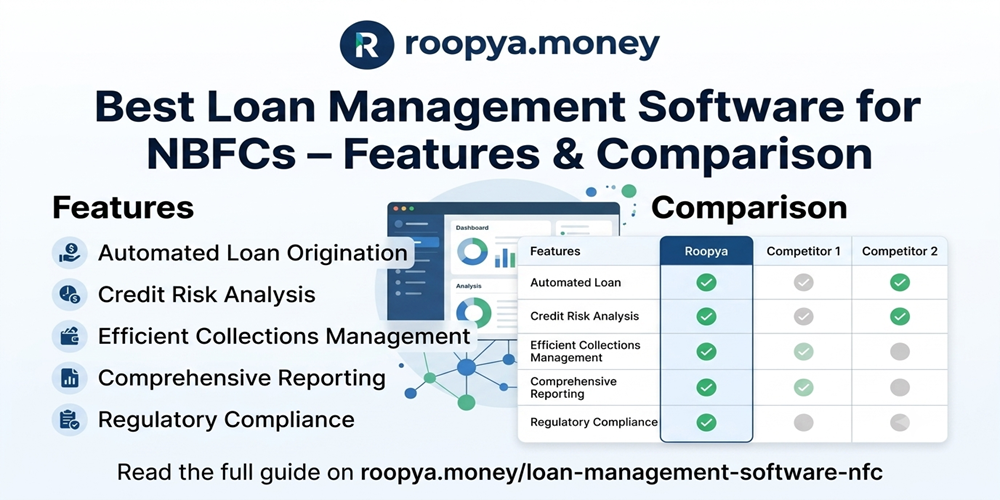
Loan Management Software Feature Comparison
Choosing the right Loan Management Software is not just about price—it’s about selecting a platform that aligns with your business goals, supports regulatory compliance, and can scale as your lending operations grow. The following comparison highlights the essential features every NBFC should evaluate before making a decision.
Feature Basic LMS Advanced LMS Roopya Digital Loan Origination Limited Yes ✔ Complete Online Customer Onboarding Partial Yes ✔ Complete eKYC & Aadhaar Verification Optional Yes ✔ Integrated Credit Bureau Integration Limited Yes ✔ Supported OCR Document Processing No Yes ✔ Available Workflow Automation Basic Advanced ✔ Configurable Loan Approval Engine Manual Automated ✔ Intelligent Multi-Product Lending Limited Yes ✔ Supported API Integration Limited Available ✔ API-First EMI Management Basic Advanced ✔ Automated Collection Management Basic Advanced ✔ End-to-End Payment Gateway Integration Optional Yes ✔ Available Customer Self-Service Portal No Yes ✔ Included Mobile Accessibility Limited Yes ✔ Responsive Portfolio Analytics Basic Advanced ✔ Real-Time Compliance Reporting Partial Yes ✔ Built-In Cloud Deployment Optional Yes ✔ Cloud-Based Data Security Standard Advanced ✔ Enterprise-Grade Scalability Medium High ✔ Highly Scalable Technical Support Standard Premium ✔ DedicatedHow to Choose the Best Loan Management Software for Your NBFC
Investing in the right LMS is a strategic decision. Here are the most important factors to consider:
1. End-to-End Loan Lifecycle Management
Select a platform that covers the complete lending journey—from application and underwriting to disbursement, repayment, collections, and loan closure. Avoid using multiple disconnected systems that create data silos and operational inefficiencies.
2. Automation Capabilities
Automation reduces manual effort and accelerates loan processing. Look for features such as:
- Automated eligibility checks
- Rule-based approvals
- Workflow automation
- Auto-generated repayment schedules
- Smart reminders
- Automated reporting
3. Integration Flexibility
Your LMS should integrate seamlessly with:
- Credit bureaus
- Payment gateways
- Banking systems
- Accounting software
- CRM platforms
- eKYC providers
- SMS and email gateways
- WhatsApp Business APIs
- Digital signature providers
An API-first architecture ensures future scalability and easy expansion.
4. Security & Compliance
Financial institutions manage highly sensitive customer information. Your LMS should provide:
- Data encryption
- Role-based access control
- Secure cloud hosting
- Audit logs
- Regular backups
- Regulatory reporting
- Compliance with applicable RBI guidelines
5. Customization
Every NBFC has unique workflows, approval hierarchies, and loan products. Choose software that allows you to configure:
- Loan products
- Interest calculations
- Approval workflows
- Eligibility rules
- Repayment structures
- User roles
- Reports and dashboards
6. Scalability
Your software should support future growth without requiring a complete system replacement. Whether you're processing hundreds or hundreds of thousands of loans, the platform should maintain consistent performance.
Benefits of Cloud-Based Loan Management Software
Cloud deployment has become the preferred choice for modern NBFCs due to its flexibility and cost-effectiveness.
Lower Infrastructure Costs
There is no need to invest in expensive on-premise servers or dedicated IT infrastructure. Cloud solutions significantly reduce capital expenditure.
Faster Implementation
Cloud-based LMS platforms can often be deployed much faster than traditional on-premise software, helping lenders realize value sooner.
Automatic Updates
Software updates, security patches, and new features are delivered automatically, ensuring your platform remains current without disrupting operations.
Anywhere Access
Authorized users can securely access the system from branch offices, corporate headquarters, or remote locations using internet-enabled devices.
Improved Business Continuity
Cloud infrastructure offers redundancy, automated backups, and disaster recovery capabilities, helping protect critical lending data.
Emerging Trends in Loan Management Software
Digital lending continues to evolve rapidly. Modern LMS platforms are incorporating technologies that improve decision-making, operational efficiency, and customer experience.
Artificial Intelligence
AI is increasingly used for:
- Credit risk analysis
- Fraud detection
- Loan recommendations
- Customer support chatbots
- Predictive analytics
Machine Learning
Machine learning models continuously improve credit assessment by analyzing repayment behavior and historical lending data.
API-Driven Lending Ecosystems
Open APIs allow lenders to connect with fintech partners, payment providers, identity verification services, and other financial platforms, creating a more agile lending ecosystem.
Digital Customer Experiences
Borrowers increasingly expect:
- Paperless applications
- Instant eligibility checks
- Real-time status tracking
- Digital agreements
- Online repayments
An LMS should support these expectations to remain competitive.
Data Analytics
Advanced analytics help NBFCs:
- Identify high-performing loan products
- Monitor portfolio quality
- Reduce delinquency
- Improve collections
- Forecast business performance
Why Roopya Stands Out
Roopya is built specifically to meet the evolving needs of NBFCs, fintech companies, and lending institutions in India. By combining automation, scalability, and flexibility, it enables lenders to digitize the entire lending lifecycle while maintaining operational efficiency and regulatory compliance.
Key advantages include:
- End-to-end loan lifecycle management
- Digital borrower onboarding
- Configurable workflows
- Multi-product lending support
- Secure cloud infrastructure
- API-first architecture
- Automated repayment tracking
- Intelligent collection management
- Comprehensive dashboards and analytics
- Enterprise-grade security
- Easy integration with third-party services
- Scalable platform for growing businesses
Whether you're launching a new lending operation or modernizing an existing one, Roopya provides the technology foundation to streamline processes, enhance customer experiences, and support long-term growth.
Conclusion
As competition within the Indian lending industry intensifies, NBFCs require technology that can streamline operations, improve compliance, and deliver superior customer experiences. The right Loan Management Software is no longer a luxury—it's a strategic necessity.
When evaluating an LMS, focus on automation, integration capabilities, security, scalability, analytics, and ease of use. A platform that supports the complete loan lifecycle can significantly reduce operational costs, accelerate loan processing, and strengthen portfolio performance.
Roopya combines all these capabilities into a single, cloud-based platform designed for the needs of modern lenders. From digital onboarding and loan origination to collections and analytics, Roopya empowers NBFCs to operate more efficiently, serve customers better, and scale with confidence.
If your organization is planning to upgrade its lending technology, Roopya offers a future-ready solution that supports sustainable growth in an increasingly digital financial landscape.